
Re-Punished for the Past: How Criminal Records Increase Prison Terms and Racial Injustice
Prior criminal records account for a large share of already lengthy prison sentences, often adding years or even decades to sentences, without evidence of community safety benefits.
Related to: Sentencing Reform, Incarceration, Racial Justice
Although it is a widespread practice in the United States to increase criminal penalties for people with prior convictions, there is little evidence that this practice advances public safety.1 Research by the Robina Institute has shown that state and federal sentencing guidelines dramatically increase sentence lengths based on individuals’ prior criminal records.2 This effect is even more pronounced for African Americans.3 Given the limited public safety benefits from criminal record “enhancements”4 and the accompanying harms to incarcerated individuals, their families, and communities — and the steep financial costs — this further lengthening of sentences should be reconfigured.5
Sentencing guidelines–frameworks developed in state and federal systems to standardize sentencing–are one mechanism by which criminal records increase criminal penalties, along with sentencing laws and the discretion of prosecutors and judges. This report examines how sentencing guidelines’ reliance on criminal records impacts already lengthy sentences—those that are 10 years or longer—in a sample of four states: Maryland, Minnesota, Pennsylvania, and Washington.6 The practice of relying on criminal records to prolong sentences of this duration merits closer review given criminological evidence that criminal careers typically end within approximately 10 years7 and recidivism rates fall measurably after about a decade of imprisonment.8
Findings include:
- In all four states, criminal records are a significant contributor to lengthy sentences (i.e., a sentence of 10 years or longer). Most people given lengthy sentences in these states had a criminal record.9 On average in Maryland, 63% of the duration of lengthy sentences for those with criminal records was attributable to their record; this value was 30% in Minnesota, 45% in Pennsylvania, and 41% in Washington.
- Take, for example, someone with a criminal record who received a 20 year sentence in Maryland. On average, 12.6 of those years were added to an initial sentence because of their record.
- African Americans are disproportionately impacted when criminal records lengthen sentences. Across the four states studied here, among persons sentenced to 10 years or longer, African Americans had criminal record scores—representing both length of history and offense severity—that were 26% higher than whites.10 This disparity contributed to African Americans receiving sentences that were significantly longer. Among people with sentences of 10 years or longer, African Americans averaged 31 years and seven months, while white individuals were sentenced to an average of 26 years and four months.
- The recommended influence of a criminal record on lengthy sentences varies between states.11 For example, in Pennsylvania, sentences of 10 or more years can be extended by an average of two years and 10 months due to a criminal record.12 Maryland’s guidelines recommend an average sentence length increase of 11 years and seven months due to a criminal record. These figures should be considered alongside the sentencing recommendations for people with no criminal record, which also vary significantly by state.13
Recent reforms have begun to tackle the excessive and racially disparate impact of criminal records on sentencing. Pennsylvania’s sentencing commission scaled back the impact of criminal records in its sentencing guidelines in 2023. That same year, Washington state passed legislation to prevent most juvenile adjudications from being used in adult sentencing calculations. In 2025, the Minnesota Sentencing Guidelines Commission agreed to scale back the impact of criminal records, including eliminating consideration of most juvenile adjudications, from its sentencing guidelines.14 But people previously sentenced do not benefit from these reforms and far more progress must be made nationwide.
The Sentencing Project has long recommended and worked towards the elimination of mandatory minimum sentencing laws and life sentences.15 This position applies to “three strikes,” “habitual offender,” and “career criminal” laws.16 Based on the findings in this study and prior research, The Sentencing Project recommends that for sentences that are 10 years or longer, criminal records should account for no more than 10% of sentence lengths. This recommendation builds upon the proposal from Michael Tonry, emeritus professor of law at the University of Minnesota and past advisor to several sentencing commissions, that criminal histories not account for more than one-third of sentence lengths overall.17 This cap should be lowered for already lengthy sentences of 10 years or longer, given that these sentences are already associated with lower recidivism rates.18
Reducing the impact of criminal records on sentencing more broadly requires reforming sentencing statutes and improving prosecutorial and judicial discretion to limit excessive sentencing increases due to criminal records. Achieving this change in sentencing guidelines requires amendments such as:
- Excluding many types of prior convictions from criminal record score calculations, such as convictions for offenses committed under age 18 and many drug convictions
- Reducing the impact of the number and severity of prior convictions on the criminal record score calculation
- Significantly reducing how much time criminal records can add to new sentences
- Restricting criminal record calculations to consider only convictions from the preceding seven years
- Expanding opportunities for judges to depart from recommended sentences that they find to be excessive.
Jurisdictions should also create second look resentencing opportunities to ensure that sentencing reforms are retroactively applied to people serving extreme sentences under old sentencing laws and guidelines.19
Key Terms
Prison sentences are generally based on the severity of the conviction offense and on the individual’s criminal record, which is primarily a catalog of the number and seriousness of their past convictions. In 12 states, Washington, DC, and the federal system, sentencing guidelines standardize the impact of these two factors using a sentencing grid (see example in Appendix: Methods). These grids either recommend or require both the type (e.g., jail, prison, or probation) and duration of sentences based on these factors.
Sentencing guidelines in most jurisdictions calculate a numeric value to represent a person’s criminal record, often called a criminal record score. Jurisdictions also assign a severity or seriousness score to the offense/s for which a person was convicted. These two values–criminal record score and offense severity score–are the basis of sentencing grids used by jurisdictions with sentencing guidelines.
Research Landscape: Criminal Records and Sentencing in the United States
In the United States, when a person is convicted of a crime, their sentence often accounts for a range of factors beyond the seriousness of their conviction offense, including circumstances surrounding the offense such as the presence of a weapon, age of the victim, and court-specific context such as caseload pressure and racial/ethnic composition of jurisdictions.20 One of the most critical factors that affects the nature and duration of punishment is record of prior criminal convictions–the criminal record.
Although people with criminal convictions have already been sentenced for their prior convictions, the United States has had a long practice of increasing penalties for new convictions based on criminal records. While there are some justifications for making the type and duration of punishment more severe based on a criminal record, experts caution that criminal records currently have an outsized impact on sentencing in the United States and that re-punishing people for their past convictions exacerbates racial disparities in sentencing.
How Criminal Records Increase Sentence Lengths
A person’s criminal record, or history of past convictions, affects their sentence in all state and federal courts.21 Sentencing guidelines are one mechanism, along with sentencing laws and the discretion of prosecutors22 and judges,23 by which criminal records increase criminal penalties. In 12 states,24 Washington, DC, and the federal system, sentencing guidelines include sentencing grids that recommend or require the type and duration of sentences based on two key factors: the seriousness of the offense that a person was convicted of, and their criminal record. In addition to sentencing guidelines, many state and federal laws also explicitly require longer sentences for people with prior convictions. For example:
- New York expands sentencing ranges for people who have had prior felony convictions in the preceding 10 years.25
- Wisconsin increases statutory maximum sentences for “repeaters”—people with a felony or three misdemeanor convictions in the preceding five years.26
- In Texas, a person with a prior felony conviction who is convicted of a third-degree felony is punished as though the conviction were for a more serious second-degree felony.27
- California’s “three strikes” law doubles prison sentences for a second “strikeable” offense and mandates parole-eligible life sentences for a third.28
- Florida’s “two strikes” law allows prosecutors to seek the maximum sentence for people convicted of an offense three years after leaving prison and accounts for 15% of the state’s population sentenced to life without the possibility of parole.29
- Federal law requires a mandatory life without parole sentence for certain repeat serious convictions.30: An overview. Congressional Research Service.))
The use of criminal records as a driver of lengthier sentences has contributed to the country’s anomalously large and aging prison population. Recent research has shown that as the country nears record-low crime rates, prison populations remain high in part because those entering prisons are increasingly likely to have criminal records, which both increases the likelihood of imprisonment for their conviction, and increases the length of their sentence.31 This trend has disproportionately impacted older individuals, who may be re-punished for crimes committed several decades earlier during an era of even more extensive reliance on criminal punishment.32 Consequently, the U.S. prison population is older than ever,33 despite the fact that many of the people receiving longer sentences due to their criminal record have a low risk of recidivism, with research showing that they are “past their peak offending years.”34
The United States is unusual in its heavy reliance on criminal records to determine sentencing. Michael Tonry, emeritus professor of law at the University of Minnesota, notes that, in contrast: “In Scandinavian countries, with minor exceptions, prior convictions are considered irrelevant when imposing a sentence for a new crime.”35 In other countries that use a similar sentencing model as those in U.S. guidelines states (such as England, Wales, Germany, Australia,36 and New Zealand), a criminal record is used as an aggravating factor, but not weighed as heavily when determining punishment.37 Criminal records have a greater impact on U.S. sentencing than what Julian Roberts, emeritus professor of criminology at the University of Oxford, describes as the more “modest” role criminal records play in sentencing across most other Western countries.38
The Long Arm of a Criminal Record:
A criminal record is factored into decision-making at every stage of the criminal legal process, including long before and after sentencing. For example, people with a criminal record are more likely to be booked after arrest compared to people with no record who were arrested for the same offense.39 Lawmakers and court practitioners often use criminal histories as a basis for requiring pretrial detention and risk assessment instruments used to determine pretrial release include prior convictions when calculating risk scores and making detention decisions.40 Diversion programs offering alternatives to incarceration, such as drug, mental health, and veterans treatment courts, disproportionately disqualify people with past convictions.41 Finally, parole guidelines used in many states to determine when people should be released from prison factor in criminal records.42
Limited Justifications for Re-Punishing the Past
While incarceration in some cases may be necessary for public safety objectives, it also harms the incarcerated individual, families, and communities, and carries steep financial costs.43 Therefore, society must carefully weigh these costs against expected benefits. In the case of lengthening sentences on the basis of criminal records, the expected benefits are 1) improved public safety and 2) increased punishment for more “deserving” violators of the law.44 However, the ways that criminal record histories are calculated, the effect on public safety of lengthening sentences, and the extent to which people should receive more punishment due to past crimes are rarely—if ever—validated or evidence-based.
Regarding sentencing grids developed by sentencing commissions, Michael Tonry has written:
So far as I know, (I worked with seven commissions), none of these policies were theory-based but resulted instead from back-of-an-envelope calculations and collective intuitive judgements.45
Richard Frase, emeritus professor of law at the University of Minnesota, and his colleagues suggest that although the practice of increasing punishment based on a past criminal record is widespread in the United States, there is little evidence that it achieves its putative goals. Despite these concerns, few states have made efforts to evaluate how much weight to give prior records in their sentencing guidelines and whether they have produced any improvement in public safety.46 As Rhys Hester, professor of sociology, anthropology and criminal justice at Clemson University and his colleagues have written: criminal records “mechanically make sentences longer without any evidence that they make the public safe.”47
Criminal Record Scores Poorly Measure Future Risk
In their book Paying For the Past,48 Frase and Roberts point to public safety as one of the most common justifications for lengthening sentences based on criminal records, as past offending has been assumed to predict future risk. They acknowledge that research does suggest that if a person has a prior record, they are more likely to commit future crimes.49 However, they identify a major concern: the ways in which a criminal record score is calculated are oversimplified, omitting consideration of information that is directly tied to an individual’s likelihood of recidivism, and including other information that does not reliably predict risk. As a result, broad use of prior records in this way lengthens the sentences of many people with a low risk of future offending, greatly increasing incarceration rates with little benefit to public safety.50 They write:
It is implausible to suppose that all existing criminal history scores are equally accurate and efficient in their risk-predictive power. It is far more likely that the criminal history scoring formulas in many guidelines systems include components with little additional risk-predictive value that are unnecessarily enhancing sentences, consuming scarce resources, and burdening offenders and their families.51
Criminal record scores are often calculated without consideration of how well they measure a person’s risk of committing future crimes. For example:
- Criminal record score calculations may not distinguish between offending patterns. A past drug conviction may say little about future risk for theft or other offenses.
- Sentencing schemes typically assume linear increases in risk alongside increases in criminal record—as criminal record scores go up, risk is assumed to increase at the same rate. This assumption has been proven to be faulty by multiple scholars.52
- One of the most well-established findings of criminological research is that risk of offending greatly declines with age.53 Nevertheless, barring unusual or extreme circumstances, guidelines rarely consider age in sentencing.54. Amendments & Documentation, effective November 1, 2024. https://www.ussc.gov/guidelines/amendment/829))
- Research shows that for people with criminal records, after about seven years without arrests, the risk of re-arrest is almost indistinguishable from that of people with no record.55 Most jurisdictions have “gap policies” that remove or discount past offenses after a crime-free period (most commonly 10 years) or a “decay policy” that reduces the impact of prior offenses after a defined period of time has passed. However, these policies vary between jurisdictions and lack validation.56
- Research has shown predictive power of many factors when weighing recidivism risk, such as crime type (violent/property/drug), relationship to the victim, location of an offense, and participation in treatment programs. Some states acknowledge a handful of these factors in sentencing guidelines, but most do not.57
Longer Sentences are Unlikely to Deter Crime
In addition to imprecise measures of prior record and poor prediction of risk, there is minimal evidence that more severe punishment actually prevents future law-breaking.58
Frase and Roberts argue that “the available evidence suggests that increased penalty severity, whether based on prior record or other factors, has little increased crime-control benefit” and that “the net crime-preventive benefits of such enhancements are very limited, and unlikely to be cost-effective.”59
One theoretical justification of increased sentence lengths as a way to prevent future offending lies in the concept of deterrence, or the prevention of crime through the threat of more severe punishment. However, research suggests that the severity of punishment matters far less than its certainty. Deterrence relies on an individual rationally considering that they may be punished before committing a crime, and on knowing what the punishment will be. Many individuals do not believe they will be apprehended60 or are unaware of what punishment entails,61 while others may not fully consider the ramifications of their actions due to the influence of drugs, alcohol, or cognitive impairments.62 There is little evidence that harsher punishment in the form of longer sentences has a deterrent effect,63 and studies of “three strikes” laws similarly find no evidence.64
Whether someone is likely to desist from law-breaking based on the potential for severe punishment is contingent on many factors that prior record models do not consider. For example, people who are younger, less affluent, and have less advanced reasoning or decision-making capacities are less likely to be deterred, as are people with substance use disorders and those with weaker familial and social ties.65 As Roberts and Frase note, using longer sentences for deterrent purposes—without greater consideration of the offense and the characteristics of the individual—is like prescribing the same medication to all patients regardless of their profile or condition.66
Incapacitation:
Another theoretical justification for increased sentence lengths is incapacitation, or preventing people who have already caused harm or violated the law from reoffending in free society through incarceration. But criminological evidence has established that criminal careers typically end within approximately 10 years67 and recidivism rates fall measurably after about a decade of imprisonment.68 Further, any incapacitative effects are likely outweighed by the costs associated with universal increases to sentence lengths on the basis of a prior record.69
Increased Punishment Based on Past Convictions Violates Constitutional Ideals
Retributivist rationales for increasing sentence lengths for people with a criminal record argue that such individuals have failed to course-correct after having been punished for prior crimes, and are therefore deserving of more punishment for their current conviction(s). Some have suggested that this justification is at odds with core tenets of the justice system; for example, Hester and his colleagues note that a person:
with many prior convictions may very well be more blameworthy in an overall sense, but he cannot now be given more punishment for his prior crimes because he has already been punished for those; added punishment for these priors would be inconsistent with the values that underlie constitutional double jeopardy principles.70
For many, there is an intuitive appeal to the notion that people with a criminal record are more blameworthy and “deserve” greater punishment, and the federal sentencing manual explicitly states as much.71 However, sentencing experts caution that retributivist justifications for greatly increasing punishment on the basis of a criminal record can be unconstitutional and overly punitive. While they also agree that retributive justifications are valid to some degree, they suggest that they should play a minimal role in sentencing.72
Criminal Records of Youth and Emerging Adults:
As the Juvenile Law Center, The Sentencing Project, and other organizations explained in a comment to the U.S. Sentencing Commission, the use of prior juvenile criminal records—and those acquired as young adults—to shape future sentencing is particularly problematic.73 The Supreme Court’s rulings, based on research showing that the human brain is incompletely developed until a person is in their mid-twenties,74 throws into question whether crimes committed by younger people should be considered as either a predictive or retributive consideration.75 Some jurisdictions do not differentiate between juvenile and adult convictions when calculating criminal record scores,76 but most limit the weight of juvenile convictions, restrict age ranges for which they can be considered, and/or have lapse or decay policies specifying a period of time after which juvenile convictions are no longer considered in calculations of criminal record.77 Across our analysis within this report, we see all four states consider juvenile or young adult status in varying ways.78
Re-Punishing the Past Exacerbates Racial Injustice
Punishing people more severely due to their criminal record is problematic because it increases the harms of incarceration while producing limited contributions to community safety—and these harms disproportionately impact African Americans. For example, the Robina Institute has noted that reliance on criminal records accounts for approximately half of the African American / white disparity in the imposition of a prison sentence versus community supervision sentence in Kansas, Minnesota, North Carolina, and Washington.79 Research by Ojmarrh Mitchell, professor of criminology, law and society at UC Irvine, and his colleagues found that stricter adherence to sentencing guidelines in Florida would have hampered its recent decarceration and increased racial disparities in its prisons.80 The racially disparate impact of criminal records on sentencing is especially unjust because criminal records are already the products of a racially biased criminal legal system.
Increasing criminal penalties based on prior records means that the criminal legal system is failing twice, by amplifying its past racial injustice.81
For example, research on Pennsylvania and Arizona has shown that arrest records overestimate actual criminal behavior by African American and Latino youth compared to white youth, due in part to differential enforcement.82 Racial disparities in the rate at which youth of color become entangled with the juvenile justice system, as well as in how often they are transferred into adult courts,83 magnify future sentencing disparities when these records are considered.
An even broader issue is the unquestioned inclusion of prior drug convictions in criminal record scores, given the well-documented racial disparities in drug law enforcement. Surveys by federal agencies show that both recently and historically, whites and African Americans have used illicit drugs at roughly similar rates.84 Many studies also suggest that people who use drugs generally purchase drugs from people of their own race or ethnicity.85 But racially disparate policies and biases drive racial and ethnic disparities in drug arrests and incarceration. For example, the ACLU found that African Americans were 3.6 times as likely as whites to be arrested for marijuana possession in 2018, even though African Americans used marijuana at just 1.2 times the rate of whites.86 These disparities widen at later stages of the criminal legal system such that 62% of people in state prisons for drug offenses are people of color, even though people of color comprise only 40% of the U.S. population.87
Overpolicing of Communities of Color:
Police officers’ reliance on millions of minor traffic stops annually as a pretext to investigate drivers for criminal activity disproportionately has adverse effects on African American and Latino drivers’ arrest records. Among those they pull over, police are more likely to search African American (6.2%) and Latino (9.2%) drivers than white (3.6%) drivers.88 Furthermore, many studies find that police are less likely to find drugs or weapons when they search African American and Latino drivers compared to white drivers.89 Nevertheless, this form of policing contributes to a high prevalence of arrests and its inequitable distribution. By age 23, 49% of African American men had been arrested, in contrast to 38% of white men, based on a 2014 study.90
Racial disparities in enforcement of youth crimes and drug laws are two examples of the broader problems of racial injustice. In 2023, African Americans were imprisoned at 4.9 times the rate of whites.91 The roots of this disparity precede criminal legal contact: conditions of socioeconomic inequality contribute to higher rates of serious violent crimes—although not drug crimes—among certain populations of color.92 But the criminal legal system exacerbates this underlying disparity across all crime types. As a comprehensive scholarly review conducted by the National Academies of Sciences explains:
Blacks are more likely than whites to be confined awaiting trial (which increases the probability that an incarcerative sentence will be imposed), to receive incarcerative rather than community sentences, and to receive longer sentences. Racial differences found at each stage are typically modest, but their cumulative effect is significant.93
Some scholars have noted that when seeking to understand racial disparities in imprisonment, criminal records can reflect a form of racial discrimination, rather than being simply a legally relevant factor in sentencing. In their influential analysis, the late criminologist Alfred Blumstein of Carnegie Mellon University, and criminologist Allen Beck of Justice Concepts Inc., estimated that 25%–30% of racial disparities in imprisonment cannot be explained by differences in arrest rates, but rather:
may be an indicator of racial discrimination in the criminal justice system. However, there may be other factors that account for the residual, including variations by race in the seriousness of the crimes committed, socioeconomic differences by race that impact the strength of the defense counsel, and variations by race in prior records that involve accumulated arrests for minor offenses among blacks due to differing police practices and patrol patterns.94
These racially disparate criminal legal outcomes warrant a reassessment of the impact of criminal records on sentencing.
Current Analysis
This work builds on past research by scholars affiliated with the Robina Institute investigating the impact of criminal records on sentencing.95 By focusing our analysis on sentences that are 10 years or longer, this report analyzes how criminal records influence already lengthy sentences. Maryland, Minnesota, Pennsylvania, and Washington were selected for this analysis based on data availability and geographic representation. Sentencing data were analyzed for 2012, 2015, 2019, and 2022 to represent a range of years, while excluding those that were most directly impacted by the COVID-19 pandemic. Data were combined across years for analysis.
Variation in State Sentencing Guidelines:
In Washington and Minnesota, sentencing grids prescribe fixed terms of imprisonment. In Maryland, sentencing grids provide an advisory range with lower and upper bounds, but judges must ultimately stay within statutory minimums and maximums. In Pennsylvania, sentencing grids are advisory, and provide a range of recommended minimum sentences. Judges must then set maximums at least twice the minimum but not exceeding the statutory limit.96
Sentencing guidelines in most jurisdictions calculate a numeric value to represent a person’s criminal record, often called a criminal record score.97 Jurisdictions also assign a severity or seriousness score to the offense/s for which a person is being sentenced. These two values–criminal record score and offense severity score–become the basis of sentencing grids used by most jurisdictions with sentencing guidelines.98 These sentencing grids are tables wherein one axis represents the criminal record of a person via their criminal record score, and the other axis represents the gravity of the offense/s via the offense severity score (see example in Appendix: Methods). As either value increases,99 recommended sentences increase.
For the majority of sentences examined in this study, judges gave sentences that were within standard guideline recommendations.100 In our sample of states, sentences were within grid guidelines in 80% of sentences in Maryland, 86% of sentences in Minnesota, 79% of sentences in Pennsylvania, and 79% of sentences in Washington.101 In most cases where sentences were outside of standard guidelines, they still fell within aggravated or mitigated sentence ranges, which are also defined by sentencing grids or guidelines. The ability of judges to depart from guideline recommendations varies by jurisdiction. In Pennsylvania, guidelines are advisory but required as a starting point of sentencing, and only through appeal can sentences depart from guidelines. In some states, including Minnesota and Washington,102 judges can only depart by providing specific, written reasons, and in some cases, there are further constraints on the degree to which judges can reduce or lengthen sentences. In other states, including Maryland, guidelines are advisory, with little restriction on a judge’s ability to follow recommended sentences and still, judges followed guidelines in most cases.
Study findings: How criminal records increase prison terms and racial injustice
Overview: Criminal Records Account for a Major Part of Lengthy Sentences
Criminal records have a significant impact on the duration of lengthy sentences (those that are 10 years or longer), though their impact varies significantly across the four states in this study. Our analysis of sentencing data among people with criminal records revealed that in Maryland, 63% of the duration of a lengthy sentence was due to a person’s criminal record. In Minnesota, this value was 30%; in Pennsylvania, 45%, and in Washington, 41%.103
| Maryland | 63% |
| Minnesota | 30% |
| Pennsylvania | 45% |
| Washington | 41% |
Note: Unless a state has a separate grid for a category of offense (see Table 2), those offenses are included in the main sentencing grid.104 People convicted of an offense with a mandatory minimum life sentence regardless of criminal record are omitted from this portion of the analysis, because their criminal record is not considered in their sentencing. See Appendix: Methods for details.
Take, for example, someone with a criminal record who received a 20 year sentence in Maryland. On average, 12.6 of those years were added to an initial sentence because of their record. In Minnesota, the comparable figure is six years; in Pennsylvania, it is nine years, and in Washington it is eight years and two months.
In Maryland and Minnesota, the two states with specialized sentencing grids for drug crimes, property crimes, or crimes of a sexual nature, the amount of time added to lengthy sentences because of criminal records was even more significant for these types of convictions than for convictions on the main grid.105 For drug and property convictions in Maryland for people with criminal records, 97% of the duration of prison sentences that are at least 10 years were attributable to a criminal record, rather than to the current conviction. This outcome occurs because Maryland’s sentencing grids for drug and property convictions rarely recommend sentences longer than 10 years unless an individual has a criminal record.106 Sentencing for drug convictions in Minnesota was also more impacted by criminal records than conviction guidelines indicated on its main grid, although to a lesser degree than in Maryland.
| Drug Crimes | Property Crimes | Crimes of a Sexual Nature | |
|---|---|---|---|
| Maryland | 97% | 93% | N/A |
| Minnesota | 61% | N/A | 41% |
Note: An “N/A” denotes that people convicted of that category of offense are sentenced according to the main grid (see Table 1). See Appendix: Methods for details.
Figure 1. Main Sentencing Grids’ Recommended Impact of Criminal Records Where Sentence Lengths of 10 Years or Longer Are Possible
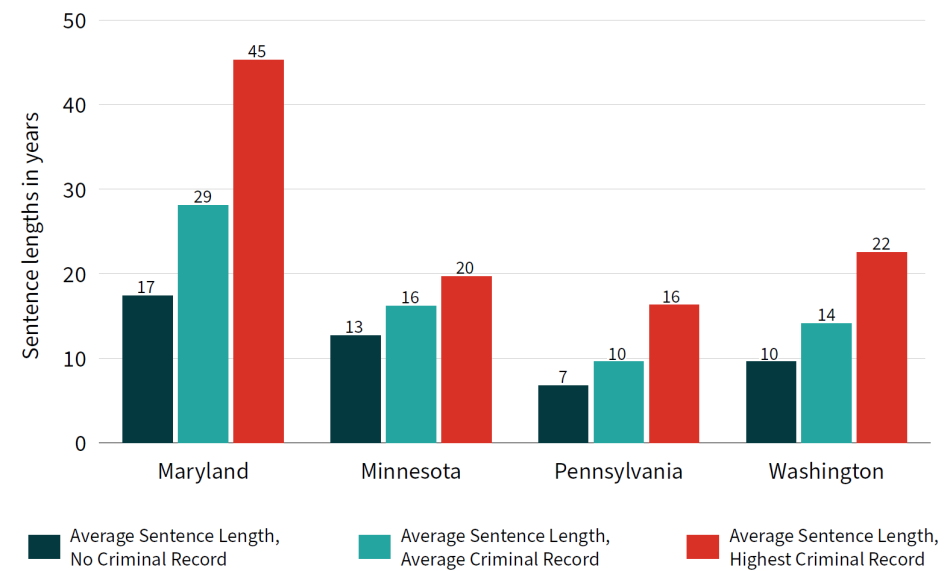
To better understand these figures, the following sections examine how state sentencing guidelines recommend that sentence durations be lengthened based on criminal records, and how this influences sentencing outcomes.
Sentencing Guidelines: Recommended Impact of Criminal Records
Sentencing grids recommend sentences for a given offense severity for people with no criminal record, and lengthen the duration of the sentence as the person’s criminal record score increases (see example in Appendix: Methods). We examined, on main sentencing grids, how much additional time is added to a person’s sentence at varying levels of criminal record.
For all offense severity levels where a sentence of 10 years or longer is possible, Figure 1 displays average sentence lengths according to main sentencing grids107 for people with (a) no criminal record, (b) an average level of criminal record,108 and (c) the highest level of criminal record. We also calculated the sentence length in years and months that would be added to the no criminal record baseline when one moves to the average and highest levels of criminal record. As Figure 1 shows, sentencing guidelines recommend significant and varying increases in sentences based on criminal records.
Sentencing Data: Impact of Criminal Records in Practice
Sentencing grids reflect the intended effect of criminal records on sentence lengths as established in sentencing guidelines. To understand how guidelines are implemented and intermix with actual patterns of offense severity and criminal records, we determined how sentencing actually unfolded using sentencing data. This section presents how a criminal record impacted sentence lengths during the study period of 2012, 2015, 2019, and 2022, and how this impact varied by race.109
| State | Median Time Added to Sentence | Number of People Sentenced With Criminal Records |
|---|---|---|
| Maryland | 12 years, 9 months | 1,594 |
| Minnesota | 5 years, 4 months | 225 |
| Pennsylvania | 7 years, 8 months | 288 |
| Washington | 6 years, 11 months | 189 |
Note: See Appendix: Methods for details.
Impact of Criminal Records on Sentence Length
Across the four states examined, people with criminal records who received prison sentences of at least 10 years had sentences that were between five and almost 13 years longer than people without criminal records convicted of offenses of the same severity. Table 3 shows the median amount of time added to sentence lengths for people with a criminal record compared to people without a criminal record for main sentencing grids.110 For example, in Maryland, for individuals sentenced on the main grid to at least 10 years in prison for offenses of similar severity, individuals with a criminal record had a sentence that was typically about 12 years and nine months longer than those of people without a criminal record.
Similarly, Table 4 shows the median amount of time added to sentences for people with a criminal record compared to people without a criminal record, based on specialized sentencing grids.111 For example, in Maryland, among those sentenced to at least 10 years in prison for drug offenses of similar severity, individuals with a criminal record had sentences that were typically about 11 years and nine months longer than those of people without a criminal record.
| State | Sentencing Grid | Median Time Added to Sentence | Number of People Sentenced With Criminal Records |
|---|---|---|---|
| Maryland | Drug Crimes | 11 years, 9 months | 297 |
| Maryland | Property Crimes | 13 years | 212 |
| Minnesota | Drug Crimes | 6 years, 4 months | 33 |
| Minnesota | Crimes of a Sexual Nature | 5 years, 2 months | 146 |
Note: See Appendix: Methods for details.112
Racial Disparities in the Impact of Criminal Records on Sentence Length
Criminal records contribute to longer sentences, disproportionately impacting people of color.113 Our findings echo prior research showing that African Americans are excessively impacted by the lengthening of sentences due to criminal records, since they are more likely to have criminal records than white individuals.114 As noted earlier, this underlying disparity stems from differential police enforcement, especially for drug offenses; differential treatment by the criminal legal system across all offense types; and different rates of serious violent offending.
In all four states, among those sentenced to at least one year of incarceration in jail or prison, and especially among those sentenced to 10 years or more, African Americans were overrepresented relative to their proportion of the state’s population (see Figure 2).
Figure 2. African Americans as Percentage of: State Population, Sentenced to One or More Years of Incarceration, and Sentenced to 10 or More Years of Incarceration
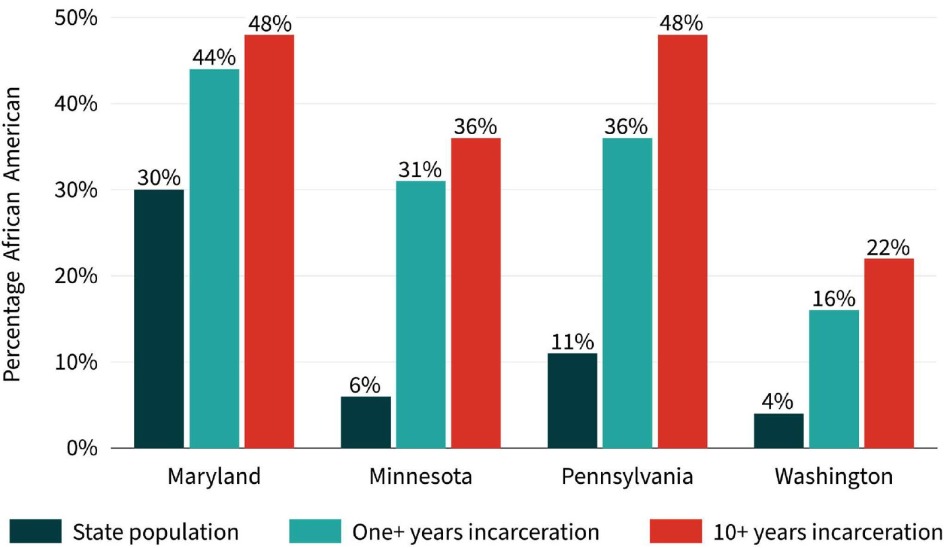
Note: Prison data include people who were given mandatory life sentences. State population figures are from the U.S. Census Bureau American Community Survey.115
Among those sentenced to 10 years or longer across all four states, African Americans were sentenced to an average of 31 years and seven months, while white individuals were sentenced to an average of 26 years and four months. For this group of individuals subjected to lengthy sentences, African Americans received prison sentences that were over five years longer than white Americans. A closer look at this data found that African Americans sentenced to 10 years or longer often had notably higher average criminal record scores yet held offense severity scores that were nearly equal to, or lower than, those held by whites.
| State | Offense Severity Score: African American to White Ratio | Criminal Record Score: African American to White Ratio | Difference in African American to White Average Sentence Length |
|---|---|---|---|
| Maryland | 0.97:1 | 1.30:1 | 4 years, 2 months |
| Minnesota | 1.02:1 | 1.28:1 | 2 years, 7 months |
| Pennsylvania | 0.97:1 | 1.46:1 | 5 years, 6 months |
| Washington | 0.94:1 | 0.98:1 | 3 years, 5 months |
Note: See Appendix: Methods for details.
Table 5 details the state-by-state differences in average offense severity scores, criminal record scores, and sentence lengths for African Americans compared to whites.116 Across Maryland, Minnesota, Pennsylvania, and Washington, the average offense severity score was similar for African Americans compared to whites: the average African American–white ratio for all four jurisdictions was 0.94:1 to 1.02:1.117 This indicates that African Americans and whites given 10-plus year sentences were convicted of crimes that were almost the same level of seriousness.118
Racial disparities begin to emerge, however, as we examine the differences in average criminal record scores among those sentenced to 10 years or longer. Except for Washington, all jurisdictions reflected meaningfully higher average criminal record scores for African Americans than for whites. On average, African Americans’ criminal record scores were 26% higher than those of white individuals. This difference contributed to the greater sentence lengths for African Americans. Focusing on those sentenced to 10 years or longer, we find:
- In Maryland, African American individuals had an average criminal record score that was 30% higher than that of white individuals, and received sentences that were four years and two months longer for crimes that were, on average, marginally less severe.119
- In Minnesota, African Americans had an average offense severity score that was approximately the same as whites, while their average criminal record score was 28% higher. African Americans in Minnesota received sentences which were, on average, two years and seven months longer than those for white individuals.120
- In Pennsylvania, the average offense severity score for African Americans was slightly lower than that of whites, while their average criminal record score was 46% higher. This contributed to African American individuals receiving sentences which were, on average, five years and six months longer than those of white individuals.121
- Washington is the only state of the four jurisdictions analyzed where African American individuals had an average criminal record score that was similar to that of white individuals.122 Despite this roughly equivalent average criminal record score, and slightly lower average offense severity score, African American individuals were given sentences that were, on average, three years and five months longer than white individuals.123
African Americans had offense severity scores that were approximately the same as those of white individuals, yet received sentences that were notably longer. In many of these states, criminal record scores likely contributed to this discrepancy given that African Americans had records that were significantly greater than those of white individuals.
Reforms and Recommendations
Recent reforms have begun to tackle the excessive and racially disparate impact of criminal records on sentencing. In 2023, Pennsylvania’s sentencing commission scaled back the impact of criminal records in its sentencing guidelines. That same year, Washington state passed legislation to prevent most juvenile adjudications from being used in adult sentencing calculations.124 In 2025, the Minnesota Sentencing Guidelines Commission agreed to scale back the impact of criminal records, including eliminating consideration of most juvenile adjudications from its sentencing guidelines.125 People previously sentenced do not benefit from these reforms
Modest reforms have also occurred at the federal level and in some state sentencing laws. The U.S. Sentencing Commission removed the restriction on judges that prevented them from giving below-guidelines sentences for people with prior minor marijuana convictions.126 The U.S. Supreme Court has limited the expansive applications of the federal Armed Career Criminal Act, which imposes increased penalties based on criminal records, though it narrowed the First Step Act’s protections from mandatory minimum sentences for people with prior records.127 In 2012, California voters passed Proposition 36, narrowing the expansive impact of the “three strikes and you’re out” law, and in 2019 lawmakers repealed the one-year sentencing “enhancement” for each prior prison or county jail felony term128. Alabama also modestly narrowed its habitual sentencing law in 2015, but did not apply the reform retroactively.129
Reforms Removing Barriers to Diversion Programs:
Some programs that divert people away from incarceration have also begun removing barriers for people with criminal records. In New York, the Manhattan Felony Alternative to Incarceration Court ensures that those often rejected by other diversion programs are provided a crucial network of support and services, regardless of their offense or history.130 In California, Proposition 36 mandated drug treatment instead of incarceration for people with up to two drug possession convictions, reducing racial and ethnic disparities in access to diversion.131
As many experts have noted, far more progress must be made nationwide to curb the sentencing excesses and racial injustice produced by reliance on criminal records:
- Richard Frase and Julian Roberts, who helped conduct the Robina Institute’s analysis of criminal records, have recommended eliminating any sentencing impact from prior convictions acquired under age 18, adult misdemeanor convictions, and convictions that are older than 10 years, as well as reducing the greater weight placed on serious prior convictions and numerous prior convictions.132 The Robina Institute has also encouraged reconsidering the impact of prior drug convictions on sentences, as well as other types of prior convictions “that are found to play a disproportionate role in raising the criminal history scores of nonwhite” individuals.133
- The Council on Criminal Justice has called for “limiting the role of criminal history in sentencing and release decision-making, as African American populations tend to have more substantial contact with the justice system.”134
- Vera Institute’s Motion for Justice initiative has recommended that prosecutors exclude all consideration of criminal histories from charging, diversion, and sentencing decisions. Vera has also recommended removing prior record “enhancements” from criminal codes, noting their disproportionate impact on African American individuals.135
- The North Carolina Task Force for Racial Equity in Criminal Justice has recommended eliminating the use of habitual felony status for people under the age of 21 or for those convicted of drug offenses.136
Given the dramatic and racially disproportionate impact that criminal record “enhancements” have on prison sentencing and the evidence of their limited contribution to community safety, their impact should be reduced. Policymakers and practitioners should dramatically scale back how much people are re-punished for their prior convictions. Such a shift would better align U.S. sentencing practices with other industrialized countries.
The Sentencing Project has long recommended and worked towards the elimination of mandatory minimum sentencing laws and life sentences.137 This position applies to “three strikes,” “habitual offender,” and “career criminal” laws.138
Based on the findings in this study and prior research, The Sentencing Project recommends that for sentences that are 10 years or longer, criminal records should account for no more than 10% of sentence lengths.139 This recommendation builds on Michael Tonry’s proposal that criminal histories not account for more than one-third of sentence lengths overall.140 This cap should be lowered for already lengthy sentences of 10 years or longer, given that these sentences are already associated with lower recidivism rates.141 Reducing the impact of criminal records on sentencing requires reforming sentencing statutes and improving prosecutorial and judicial discretion. Achieving this change in sentencing guidelines requires amendments such as:
- Excluding many types of prior convictions from criminal record score calculations, such as convictions for offenses committed under age 18 and many drug convictions (especially given their racial disparities)
- Reducing the impact of the number and severity of prior convictions on the criminal record score calculation
- Significantly reducing how much time criminal records can add to new sentences
- Restricting criminal record calculations to consider only convictions from the preceding seven years
- opportunities for judges to depart from recommended sentences that they find to be excessive.
Jurisdictions should also create second look resentencing opportunities to ensure that sentencing reforms are retroactively applied to people serving extreme sentences under old sentencing laws and guidelines.142
More generally, the practice of using criminal records to lengthen sentences should be carefully examined to determine whether the primary goal of this practice, increasing public safety, is being met. If a measure used to calculate criminal record cannot be justified as relating to risk of reoffending, it should not be included; further, the weighting of different factors in a criminal record score should be proportional to how they increase risk.143 Lengthening sentences in the name of public safety should be evidence-based, validated, and fair. At present, a substantial body of research indicates that it is not.
Appendices
| 1. | Hester, R., Frase, R. S., Roberts, J. V., & Mitchell, K. L. (2018). Prior record enhancements at sentencing: Unsettled justifications and unsettling consequences. Crime and Justice, 47(1), 209–254. https://doi.org/10.1086/695400; Frase, R. S., & Roberts, J. V. (2019). Paying for the past: The case against prior record sentence enhancements. Oxford University Press. |
|---|---|
| 2. | We use the term “criminal record” to generally refer to a person’s prior convictions. We avoid using the term “criminal history” since this term can refer to criminal activity that goes undetected. State and federal sentencing guidelines quantify a person’s criminal record with a “criminal record score” that primarily considers the number and characteristics of prior convictions. This measure of a criminal record also considers, to a lesser degree, factors such as: custody status (whether a person was on probation or parole at the time of the offense), presence of prior probation or parole violations, relationships between prior convictions and the present conviction, and the length of time since the last conviction. These factors can vary between jurisdictions. |
| 3. | The Robina Institute also finds that criminal records dramatically increase the likelihood of receiving a prison, rather than community supervision, sentence. Frase, R. S., Roberts, J. V., Hester, R., & Mitchell, K. L. (2015). Criminal history enhancements sourcebook. Robina Institute of Criminal Law and Criminal Justice, University of Minnesota Law School. |
| 4. | “Enhancements” are increases in the severity and duration of sentences (i.e., making imprisonment more likely than community supervision, and increasing the length of incarceration). We present the term in quotation marks to create distance from the other definition of “enhancement:” an improvement. |
| 5. | National Research Council. (2014). The growth of incarceration in the United States: Exploring causes and consequences. National Academies Press; Wakefield, S., & Uggen, C. (2010). Incarceration and stratification. Annual Review of Sociology, 36, 387–406. https://doi.org/10.1146/annurev.soc.012809.102551; Clear, T. R. (2007). Imprisoning communities: How mass incarceration makes disadvantaged neighborhoods worse. Oxford University Press. |
| 6. | These states were selected based on data availability and geographic representation. Analysis is based on sentencing data from 2012, 2015, 2019, and 2022. See Appendix: Methods for details. |
| 7. | Kazemian, L. (2021). Pathways to desistance from crime among juveniles and adults: Applications to criminal justice policy and practice. National Institute of Justice; Blumstein, A., & Piquero, A. (2007). Restore rationality to sentencing policy. Criminology & Public Policy, 6(4), 679-687. https://doi.org/10.1111/j.1745-9133.2007.00463.x; Kazemian, L., & Farrington, D. P. (2018). Advancing knowledge about residual criminal careers: A follow-up to age 56 from the Cambridge Study in Delinquent Development. Journal of Criminal Justice, 57, 1-10. https://doi.org/10.1016/j.jcrimjus.2018.03.001; Piquero, A., Hawkins, J., & Kazemian, L. (2012). Criminal career patterns. In R. Loeber & D. P. Farrington (Eds.), From juvenile delinquency to adult crime: Criminal careers, justice policy, and prevention (pp. 14–46). New York, NY: Oxford University Press. |
| 8. | United States Sentencing Commission. (2022). Length of incarceration and recidivism (2022). United States Sentencing Commission Antenangeli, L., & Durose, M. R. (2021). Recidivism of prisoners released in 24 states in 2008: A 10-year follow-up period (2008–2018). Bureau of Justice Statistics. |
| 9. | The proportion of people given lengthy sentences who had some criminal record ranged from 61% in Pennsylvania to 85% in Maryland. See Appendix: Methods. |
| 10. | “White” refers to non-Hispanic white in the entirety of this report. See Appendix: Methods on data constraints. |
| 11. | Maryland State Commission on Criminal Sentencing Policy. (n.d.). Guidelines scoring matrices. Retrieved January 2nd, 2026, from https://msccsp.org/guidelines/matrices/; Minnesota Sentencing Guidelines Commission. (n.d.). Guidelines commentary. Retrieved January 2nd, 2026, from https://mn.gov/sentencing-guidelines/abouttheguidelines/guidelinescommentary/; Pennsylvania Commission on Sentencing. (n.d.). Sentencing. Retrieved October 29, 2025, from https://pcs.la.psu.edu/guidelines-statutes/sentencing/; State of Washington Caseload Forecast Council. (2024). Washington State adult sentencing guidelines manual (Version 20241108). https://cfc.wa.gov/sites/default/files/Publications/Adult_Sentencing_Manual_2024.pdf |
| 12. | See Appendix: Criminal Record Multipliers for an alternative presentation of these figures. |
| 13. | See Figure 1 for more details. |
| 14. | Reitz, K. (2025). “Criminal history reform in sentencing guidelines: Examples from Minnesota and Pennsylvania.” PowerPoint presentation. On file with authors. |
| 15. | Nellis, A. (2024). How mandatory minimums perpetuate mass incarceration and what to do about it. The Sentencing Project; Nellis, A., & Barry, C. (2025). A matter of life: The scope and impact of life and long term imprisonment in the United States. The Sentencing Project. |
| 16. | Loehr, D. (2025). The Eugenic origins of Three Strikes laws: How “habitual offender” sentencing laws were used as a means of sterilization. The Sentencing Project. |
| 17. | Tonry, M. (2017). Making American sentencing just, humane, and effective. Crime and Justice, 46(1), 441-504. https://doi.org/10.1086/688456. See also Reitz, K. R. (2025). Tonry’s blueprint for the comparative study of sentencing law and policy. Criminal Law Forum, 36, 233–250. https://doi.org/10.1007/s10609-025-09502-9. |
| 18. | See Ghandnoosh, N., & Nellis, A. (2022). How many people are spending over a decade in prison? The Sentencing Project. |
| 19. | Feldman, B., & Cohbra, S. (2025). The Second Look movement: An assessment of the nation’s sentence review laws. The Sentencing Project. |
| 20. | Ulmer, J. T., & Johnson, B. (2004). Sentencing in context: A multilevel analysis. Criminology, 42(1), 137–178. https://doi.org/10.1111/j.1745-9125.2004.tb00516.x |
| 21. | States differ in how they define prior convictions when determining a person’s criminal record. For example, in Washington, convictions for other offenses during the same sentencing event can increase that person’s criminal record score; in other states, such as Maryland, Minnesota, and Pennsylvania, this is not the case. See: Frase, R. S., Roberts, J. V., Hester, R., & Mitchell, K. L. (2015). Criminal history enhancements sourcebook. Robina Institute of Criminal Law and Criminal Justice, University of Minnesota Law School. |
| 22. | Matei, A., Robin, L., Freeman, K. R., & Courtney, L. (2022). An exploration of prosecutorial discretion in plea bargaining in Philadelphia. Urban Institute. |
| 23. | Hester, R. (2021). Punishing for the past (sometimes): judicial perspectives on criminal history enhancements. Prison Journal: An International Forum on Incarceration and Alternative Sanctions, 101(4), 443-465. |
| 24. | The 12 states are Arkansas, Kansas, Maryland, Massachusetts, Michigan, Minnesota, North Carolina, Oregon, Pennsylvania, Tennessee, Utah, and Washington. In addition, the following five states do not have grids but use sentencing guidelines: Alabama, Delaware, Florida, Ohio, and Virginia. See Mitchell, K. L. (2017). Sentencing commissions and guidelines by the numbers: Cross-jurisdictional comparisons made easy by the Sentencing Guidelines Resource Center. Robina Institute of Criminal Law and Criminal Justice, University of Minnesota Law School. |
| 25. | The 10-year period excludes any period of incarceration. See: NY State Legislature. (2025, May 16). Penal Law § 70.06 (Chapter 40, Part 2, Title E, Article 70: Sentences of Imprisonment for Second Felony Offenders). https://www.nysenate.gov/legislation/laws/PEN/70.06. |
| 26. | The five-year period excludes any period of incarceration. See: WI State Legislature. (2025, November 1). Wis. Stat. § 939.62 (Increased penalty for habitual criminality). https://docs.legis.wisconsin.gov/statutes/statutes/939/iv/62 |
| 27. | The impact of a criminal record in states without formal sentencing guidelines is more difficult to assess due to data limitations. See: Hester, R., Frase, R. S., Roberts, J. V., & Mitchell, K. L. (2018). Prior record enhancements at sentencing: Unsettled justifications and unsettling consequences. Crime and Justice, 47(1), 209–262. https://doi.org/10.1086/696274; Texas Penal Code. (2025). Chapter 12: Punishments. Retrieved January 2nd, 2026, from https://statutes.capitol.texas.gov/docs/pe/htm/pe.12.htm. |
| 28. | Stanford Law School, Three Strikes Project, & NAACP Legal Defense and Educational Fund. (2013). Progress report: Three Strikes reform (Proposition 36) — 1,000 prisoners released. Stanford Law School; Loehr, D. (2025). The Eugenic origins of Three Strikes laws: How “habitual offender” sentencing laws were used as a means of sterilization. The Sentencing Project. |
| 29. | Aspinwall, C., Li, W., & Sullivan, D. (2021). Two strikes and you’re in prison forever: Why Florida leads the nation in people serving life without chance of parole. The Marshall Project. |
| 30. | Title 18 – Crimes and Criminal Procedure. 18 U.S.C. § 3559(c). (1994).; United States Sentencing Commission. (2019, February). ESP Insider Express special edition: The First Step Act of 2018. United States Sentencing Commission; Congressional Research Service. (2025, November 19). Three strike mandatory sentencing (18 U.S.C. § 3559(c |
| 31. | King, R. D. (2019). Cumulative impact: Why prison sentences have increased. Criminology, 57(1), 157-80. https://doi.org/10.1111/1745-9125.12197 |
| 32. | Bushway, S. D. (2025, September 19). The myth of the optimal level of incarceration. Niskanen Center; Bushway, S. D., & Piehl, A. M. (2007). The inextricable link between age and criminal history in sentencing. Crime & Delinquency, 53(1), 156–183. https://doi.org/10.1177/0011128706294444 |
| 33. | Shen, Y., Bushway, S. D., Sorensen, L. C., & Smith, H. L. (2020). Locking up my generation: Cohort differences in prison spells over the life course. Criminology, 58(4), 645–677. https://doi.org/10.1111/1745-9125.12256 |
| 34. | Frase, R. S. (2016, December 8). Criminal history sentencing enhancements imprison too many aging, low-risk offenders. Robina Institute of Criminal Law and Criminal Justice, University of Minnesota Law School. |
| 35. | Tonry, M. (2017). Making American sentencing just, humane, and effective. Crime and Justice, 46(1), 441–504. https://doi.org/10.1086/688456 |
| 36. | In Western Australia, prior record cannot be formally used as an aggravating factor to increase sentences. See Sentencing Act of 1995 (WA), § 7(2) (Austl.), https://perma.cc/ DL3D-8MZC. |
| 37. | Tonry, M. (2017). Making American sentencing just, humane, and effective. Crime and Justice, 46(1), 441–504. https://doi.org/10.1086/688456; Roberts, J. V. (2013). Punishing persistence: Explaining the enduring appeal of the recidivist sentencing premium. Punishment & Society, 15(4), 384–401. https://www.jstor.org/stable/23639532; Vega, C., Solter, A., Kwon, S., & Isaac, D. M. (2012). Cruel and unusual: U.S. sentencing practices in a global context. University of San Francisco School of Law, Center for Law and Global Justice. |
| 38. | Roberts, J. V. (2013). Punishing persistence: Explaining the enduring appeal of the recidivist sentencing premium. Punishment & Society, 15(4), 384–401. https://www.jstor.org/stable/23639532 |
| 39. | Crum, J., & Ramey, D. (2022). Impact of extralegal and community factors on police officers’decision to book arrests for minor offenses. American Journal of Criminal Justice, 48, 572-601. https://doi.org/10.1007/s12103-022-09669-6. |
| 40. | Skeem, J., Montoya, L., & Lowenkamp, C. (2023). Understanding racial disparities in pretrial detention recommendations to shape policy reform. Criminology & Public Policy, 22(2), 233-262. https://doi.org/10.1111/1745-9133.12620; Schrantz, D., McElroy, J., Gainsborough, J., & Mauer, M. (2008). Reducing racial disparity in the criminal justice system: a manual for practitioners and policymakers. The Sentencing Project; Muhammad, K. G., Western, B., Negussie, Y., & Backes, E. (Eds.) (2022). Reducing racial inequality in crime and justice: science, practice, and policy. National Academies of Sciences, Engineering, and Medicine. |
| 41. | Sevigny, E. L., Pollack, H. A., & Reuter, P. (2013). Can Drug Courts Help to Reduce Prison and Jail Populations? Annals of the American Academy of Political and Social Science, 647(1), 190-212. https://doi.org/10.1177/0002716213476258; Kutateladze, B., Dunlea, R., Pearson, M., Liu, L., Meldrum, R., & Stemen, D. (2021). Race and prosecutorial diversion: what we know and what can be done. Florida International University; Nicosia, N., MacDonald, J., & Arkes, J. (2013). Disparities in criminal court referrals to drug treatment and prison for minority men. American Journal of Public Health, 103(6), 77-84. https://doi.org/10.2105/AJPH.2013.301222; Adler, J., & Barrett, J. (2023). Plenty of science, just not enough passion: Accelerating the pace of felony decarceration. Center for Justice Innovation. |
| 42. | Wang, L. (2025). Parole in perspective: Appendix 3: Release standards and guidelines for discretionary parole systems, 2025. Prison Policy Initiative. |
| 43. | National Research Council. (2014). The growth of incarceration in the United States: Exploring causes and consequences. National Academies Press; Wakefield, S., & Uggen, C. (2010). Incarceration and stratification. Annual Review of Sociology, 36, 387–406. https://doi.org/10.1146/annurev.soc.012809.10255; Clear, T. R. (2007). Imprisoning communities: How mass incarceration makes disadvantaged neighborhoods worse. Oxford University Press. |
| 44. | Hester, R., Frase, R. S., Roberts, J. V., & Mitchell, K. L. (2018). Prior record enhancements at sentencing: Unsettled justifications and unsettling consequences. Crime and Justice, 47(1), 209–254. https://doi.org/10.1086/695400 |
| 45. | Tonry, M. (2014). The questionable relevance of previous convictions of punishments for later crimes (p. 93). In J. V. Roberts & A. von Hirsch (Eds.), Previous convictions at sentencing: Theoretical and applied perspectives. Hart Publishing. (pp. 93-116). |
| 46. | National Research Council. (2014). The growth of incarceration in the United States: Exploring causes and consequences. National Academies Press; Martínez-Garay, L. (2023). Evidence-based sentencing and scientific evidence. Frontiers in Psychology, 14. https://doi.org/10.3389/fpsyg.2023.1309141; Frase, R. S., & Roberts, J. V. (2019). Paying for the past: The case against prior record sentence enhancements. Oxford University Press. |
| 47. | Hester, R., Frase, R. S., Roberts, J. V., & Mitchell, K. L. (2018). Prior record enhancements at sentencing: Unsettled justifications and unsettling consequences. Crime and Justice, 47(1), 209–254. https://doi.org/10.1086/695400 |
| 48. | Frase, R. S., & Roberts, J. V. (2019). Paying for the past: The case against prior record sentence enhancements. Oxford University Press. |
| 49. | Kurlychek, M. C., Brame, R., & Bushway, S. D. (2006). Scarlet letters and recidivism: Does an old criminal record predict future offending? Criminology & Public Policy, 5(3), 483–504. https://doi.org/10.1111/j.1745-9133.2006.00397.x |
| 50. | Hester, R. (2018). Prior record and recidivism risk. American Journal of Criminal Justice, 44, 353-375. https://doi.org/10.1007/s12103-018-9460-8 |
| 51. | Frase, R. S., & Roberts, J. V. (2019). Paying for the past: The case against prior record sentence enhancements. Oxford University Press. (p. 43). |
| 52. | Piquero, A. R., & Blumstein, A. (2007). Does incapacitation reduce crime? Journal of Quantitative Criminology, 23, 267-286. https://doi.org/10.1007/s10940-007-9030-6; Zara, G., & Farrington, D. P. (2016). Criminal recidivism: Explanation, prediction and prevention. Routledge; Rappaport, A. J. (1997). Criminal history and the purposes of sentencing. Federal Sentencing Reporter, 9(4), 184–188. |
| 53. | Hirschi, T., & Gottfredson, M. R. (1983). Age and the explanation of crime. American Journal of Sociology, 89(3), 552-584. https://doi.org/10.1086/227905; Sampson, R. J., & Laub, J. H. (1997). A life-course theory of cumulative disadvantage and the stability of delinquency. In T. P. Thornberry (Ed.), Advances in Criminological Theory, 7 (pp. 133–161). Transaction Publishers; Steffensmeier, D., Slepicka, J., & Schwartz, J. (2025). International and Historical Variation in the Age-Crime Curve. Annual Review of Criminology, 8, 239-268. https://doi.org/10.1146/annurev-criminol-111523-122451. |
| 54. | Almost all jurisdictions consider adult and juvenile criminal records and weigh or consider prior juvenile vs. adult convictions differently (with some states having a lower threshold for prosecuting all youth as adults). Beyond this distinction, however, guidelines and grids do not systematically consider the age of the individual when sentencing. Some jurisdictions may slightly adjust punishments or allow for departure based on age; for example, the U.S. Sentencing Commission permits age to justify departing downwards from grid recommendations “if considerations based on age, individually or in combination with other offender characteristics, are present to an unusual degree and distinguish the case from the typical cases covered by the guidelines.” See: United States Sentencing Commission. Amendment 829: Revision of § 5H1.1 (Age (Policy Statement |
| 55. | Kurlychek, M. C., Brame, R., & Bushway, S. D. (2006). Scarlet letters and recidivism: Does an old criminal record predict future offending? Criminology & Public Policy, 5(3), 483–504. https://doi.org/10.1111/j.1745-9133.2006.00397.x; Blumstein, A., & Nakamura, K. (2009). Redemption in the presence of widespread criminal background checks. Criminology: An Interdisciplinary Journal, 47(2), 327–359. https://doi.org/10.1111/j.1745-9125.2009.00155.x |
| 56. | Frase, R. S., Roberts, J. V., Hester, R., & Mitchell, K. L. (2015). Criminal history enhancements sourcebook. Robina Institute of Criminal Law and Criminal Justice, University of Minnesota Law School. |
| 57. | Frase, R. S., & Roberts, J. V. (2019). Paying for the past: The case against prior record sentence enhancements. Oxford University Press. (p. 61). |
| 58. | Frase, R. S., Roberts, J. V., Hester, R., & Mitchell, K. L. (2015). Criminal history enhancements sourcebook. Robina Institute of Criminal Law and Criminal Justice, University of Minnesota Law School. |
| 59. | Frase, R. S., & Roberts, J. V. (2019). Paying for the past: The case against prior record sentence enhancements. Oxford University Press. (pp. 12, 87). |
| 60. | Apel, R. (2013). Sanctions, perceptions, and crime: Implications for criminal deterrence. Journal of quantitative criminology, 29(1), 67-101. https://doi.org/10.1007/s10940-012-9170-1 |
| 61. | Kleck, G., Sever, B., Li, S., & Gertz, M. (2005). The missing link in general deterrence research. Criminology, 43(3), 623-660. https://doi.org/10.1111/j.1745-9125.2005.00020.x |
| 62. | Nagin, D. S., & Pogarsky, G. (2001). Integrating celerity, impulsivity, and extralegal sanction threats into a model of general deterrence: Theory and evidence. Criminology, 39(4), 865-892. https://doi.org/10.1111/j.1745-9125.2001.tb00943.x |
| 63. | Berger, E., & Scheidegger, K. S. (2022). Sentence length and recidivism: A review of the research. Federal Sentencing Reporter, 35(1), 59–72. https://doi.org/10.1525/fsr.2022.35.1.59; Roberts, J., & Harrendorf, S. (2020). Criminal History Enhancements at Sentencing. In K. Ambos, A. Duff, J. Roberts, T. Weigend, & A. Heinze (Eds.), Core Concepts in Criminal Law and Criminal Justice: Volume I (pp. 261–303), Cambridge University Press. |
| 64. | Chen, E. Y. (2008). Impacts of “Three Strikes and You’re Out” on crime trends in California and throughout the United States. Journal of Contemporary Criminal Justice, 24(4), 345–370. https://doi.org/10.1177/1043986208319456. |
| 65. | Durlauf, S. N., & Nagin, D. S. (2009). The deterrent effect of imprisonment. In P. J. Cook, J. Ludwig, & J. McCrary (Eds.), Controlling Crime: Strategies and Tradeoffs (pp. 43-94). University of Chicago Press; Cid, J. (2009). Is imprisonment criminogenic? A comparative study of recidivism rates between prison and suspended prison sanctions. European Journal of Criminology, 6(6), 459-480. https://doi.org/10.1177/1477370809341128. |
| 66. | Frase, R. S., & Roberts, J. V. (2019). Paying for the past: The case against prior record sentence enhancements. Oxford University Press. |
| 67. | Kazemian, L. (2021). Pathways to desistance from crime among juveniles and adults: Applications to criminal justice policy and practice. National Institute of Justice; Blumstein, A., & Piquero, A. (2007). Restore rationality to sentencing policy. Criminology & Public Policy, 6(4), 679-687. https://doi.org/10.1111/j.1745-9133.2007.00463.x; Kazemian, L., & Farrington, D. P. (2018). Advancing knowledge about residual criminal careers: A follow-up to age 56 from the Cambridge Study in Delinquent Development. Journal of Criminal Justice, 57, 1-10. https://doi.org/10.1016/j.jcrimjus.2018.03.001; Piquero, A., Hawkins, J., & Kazemian, L. (2012). Criminal career patterns. In R. Loeber & D. P. Farrington (Eds.), From juvenile delinquency to adult crime: Criminal careers, justice policy, and prevention (pp. 14–46). New York, NY: Oxford University Press. |
| 68. | United States Sentencing Commission. (2022). Length of incarceration and recidivism (2022). United States Sentencing Commission; Antenangeli, L., & Durose, M. R. (2021). Recidivism of prisoners released in 24 states in 2008: A 10-year follow-up period (2008–2018). Bureau of Justice Statistics. |
| 69. | Hester, R., Frase, R. S., Roberts, J. V., & Mitchell, K. L. (2018). Prior record enhancements at sentencing: Unsettled justifications and unsettling consequences. Crime and Justice, 47(1), 209–254. https://doi.org/10.1086/695400. |
| 70. | Hester, R., Frase, R. S., Roberts, J. V., & Mitchell, K. L. (2018). Prior record enhancements at sentencing: Unsettled justifications and unsettling consequences. Crime and Justice, 47(1), 209–254, p. 221. https://doi.org/10.1086/695400 |
| 71. | “A defendant with a record of prior criminal behavior is more culpable than a first offender and thus deserving of greater punishment.” United States Sentencing Commission. (2024). Guidelines Manual (Nov. 1, 2024). https://www.ussc.gov/sites/default/files/pdf/guidelines-manual/2024/GLMFull.pdf. (p. 387). |
| 72. | Frase, R. S., & Roberts, J. V. (2019). Paying for the past: The case against prior record sentence enhancements. Oxford University Press. |
| 73. | Juvenile Law Center, The Sentencing Project, The Gault Center, National Youth Justice Network, & Citizens for Juvenile Justice. (2024, February 22). Comments of Juvenile Law Center, The Sentencing Project, The Gault Center, National Youth Justice Network, & Citizens for Juvenile Justice to U.S. Sentencing Commission Proposed Amendment 2 Regarding Youthful Individuals. |
| 74. | Juvenile Law Center, The Sentencing Project, The Gault Center, National Youth Justice Network, & Citizens for Juvenile Justice. (2024, February 22). Comments of Juvenile Law Center, The Sentencing Project, The Gault Center, National Youth Justice Network, & Citizens for Juvenile Justice to U.S. Sentencing Commission Proposed Amendment 2 Regarding Youthful Individuals. |
| 75. | Hester, R., Frase, R. S., Roberts, J. V., & Mitchell, K. L. (2018). Prior record enhancements at sentencing: Unsettled justifications and unsettling consequences. Crime and Justice, 47(1), 209–254, p. 221. https://doi.org/10.1086/695400 |
| 76. | Delaware, Florida, Kansas, Massachusetts, and Oregon. |
| 77. | Frase, R. S., Roberts, J. V., Hester, R., & Mitchell, K. L. (2015). Criminal history enhancements sourcebook. Robina Institute of Criminal Law and Criminal Justice, University of Minnesota Law School. |
| 78. | In Maryland, juvenile convictions are counted only when the person is under 23 years old and the conviction was within the past five years. In Minnesota, this cutoff is 25 years of age, only convictions after the age of 14 are considered, and those are not counted after a 10-year crime-free period. In Pennsylvania, prior juvenile convictions are only considered for people who committed the current crime while under the age of 25; further, if the individual has a 10-year crime-free period, some juvenile convictions are not considered, while others are not considered after a 15-year period. In Washington, juvenile felony adjudications were treated as adult convictions with no age restriction in the study period. However, juvenile adjudications were weighted less highly, and similarly to adult convictions, they were removed after 5- or 10-year crime-free periods, contingent on the type of offense. Washington removed many juvenile adjudications from criminal record calculations in 2023; see Reforms and Recommendations. |
| 79. | Hester, R. (2018). Prior record and recidivism risk. American Journal of Criminal Justice, 44, 353-375. https://doi.org/10.1007/s12103-018-9460-8; Frase, R. S., Roberts, J. R., Hester, R., & Mitchell, K. L. (2015). Criminal history enhancements sourcebook. Robina Institute of Criminal Law and Criminal Justice; Uggen, C., & Schwendeman, H. (2022). Minnesota Sentencing Guidelines Commission Neutrality Review. University of Minnesota; Nelson, M., Feineh, S., & Mapolski, M. (2023). A new paradigm for sentencing in the United States. Vera Institute of Justice. |
| 80. | Mitchell, O., Yan, S., & Mora, D. O. (2022). Trends in prison sentences and racial disparities: 20-Years of sentencing under Florida’s criminal punishment code. Journal of Research in Crime and Delinquency, 60(2), 300-338. https://doi.org/10.1177/00224278221120677 |
| 81. | This point echoes former Federal District Court Judge Nancy Gertner’s observation: “By counting the imprisonment that the defendant has received for the prior offenses, the system effectively replicates disparities in sentencing in the state system.” From: Butterfield, F. (1998, December 17). Bias cited in reducing sentence of Black man. New York Times. https://www.nytimes.com/1998/12/17/us/bias-cited-in-reducing-sentence-of-black-man.html. |
| 82. | Grunwald, B. (2023). Racial bias in criminal records. Journal of Quantitative Criminology, 40(3), 1–43. https://doi.org/10.1007/s10940-023-09575-y; see also Raphael, S., & S. V. Rozo. Racial disparities in the acquisition of juvenile arrest records. Journal of Labor Economics 37: S125-S159. https://doi.org/10.1086/701068 |
| 83. | Juvenile Law Center, The Sentencing Project, The Gault Center, National Youth Justice Network, & Citizens for Juvenile Justice. (2024, February 22). Comments of Juvenile Law Center, The Sentencing Project, The Gault Center, National Youth Justice Network, & Citizens for Juvenile Justice to U.S. Sentencing Commission Proposed Amendment 2 Regarding Youthful Individuals. |
| 84. | Substance Abuse and Mental Health Services Administration (SAMHSA). (2023). Results from the 2021 National Survey on Drug Use and Health; SAMHSA. (2020). Results from the 2018 National Survey on Drug Use and Health: Detailed tables; see also Mitchell, O. (2009). Is the War on Drugs racially biased? Journal of Crime & Justice, 32(2), 49–75. https://doi.org/10.1080/0735648x.2009.9721270 |
| 85. | Beckett, K., Nyrop, K., & Pfingst, L. (2006). Race, drugs, and policing: Understanding disparities in drug delivery arrests. Criminology, 44(1), 105–37. https://doi.org/10.1111/j.1745-9125.2006.00044.x; Riley, K. J. (1997). Crack, powder cocaine, and heroin: Drug purchase and use patterns in six major U.S. cities. National Institute of Justice. |
| 86. | Edwards, E., Madubuonwu, B., & Greytak, E. (2020). A tale of two countries: Racially targeted arrests in the era of marijuana reform. American Civil Liberties Union; Substance Abuse and Mental Health Services Administration (SAMHSA). (2019). Results from the 2019 National Survey on Drug Use and Health. SAMHSA. |
| 87. | Mueller, D., & Kluckow, R. (2023). Prisoners in 2023 – Statistical tables. Bureau of Justice Statistics; U.S. Census Bureau. (2025, November 20). American Community Survey, ACS 1-Year Estimates Data Profiles, Table DP05. U,S, Census Bureau. |
| 88. | These numbers are based on data from 2018, rather than 2020, to bypass the anomalies created by COVID-19. Tapp, S. N., & Davis, E. J. (2022). Contacts between police and the public, 2020. Bureau of Justice Statistics. |
| 89. | Melamed, S. (2019, October 14). As Philadelphia aims to curb racial disparities, why are police stops of black drivers skyrocketing? The Philadelphia Inquirer; Hanaway, C. L. (2019). Vehicle stops executive summary. Missouri Office of the Attorney General; Lofstrom, M., Hayes, J., Martin, B., Premkumar, D., & Gumbs, A. (2021). Racial disparities in law enforcement stops. Public Policy Institute of California. |
| 90. | Brame, R., Bushway, S. D., Paternoster, R., & Turner, M. G. (2014). Demographic patterns of cumulative arrest prevalence by ages 18 and 23. Crime & Delinquency, 60(3), 471–486. https://doi.org/10.1177/0011128713514801 |
| 91. | This figure represents both persistent injustices which must be corrected, as well as dramatic progress over the past two decades. See Ghandnoosh, N. (2023). One in five: Ending racial inequity in incarceration. The Sentencing Project; Mueller, D., & Kluckow, R. (2023). Prisoners in 2023 – Statistical tables. Bureau of Justice Statistics. |
| 92. | See Ghandnoosh, N., & Barry, C. (2023). One in five: Disparities in crime and policing. The Sentencing Project; Muhammad, K. G., Western, B., Negussie, Y., & Backes, E. (Eds.) (2022). Reducing racial inequality in crime and justice: science, practice, and policy. National Academies of Sciences, Engineering, and Medicine. |
| 93. | Travis, J., Western, B., & Redburn, S. (Eds.) (2014). The growth of incarceration in the United States: Exploring causes and consequences. National Academies of Sciences, Engineering, and Medicine, pp. 93–4. |
| 94. | Beck, A. J., & Blumstein, A. (2018). Racial disproportionality in U.S. State Prisons: Accounting for the effects of racial and ethnic differences in criminal involvement, arrests, sentencing, and time served. Journal of Quantitative Criminology, 34(3), 853–883, p. 877 (italics added). https://doi.org/10.1007/s10940-017-9357-6; Blumstein, A. (1993). Racial disproportionality of U.S. prison populations revisited. University of Colorado Law Review, 64, 743–760; Blumstein, A. (1982). On the racial disproportionality of United States’ prison populations. Journal of Criminal Law and Criminology, 73, 1259–1281. https://doi.org/10.2307/1143193. See also Omori, M., Early, A. M., & Torres, L. (2025). A theoretical and empirical critique of racial innocence in sentencing. Law & Society Review, 59, 382-418. https://doi.org/10.1017/lsr.2025.11 |
| 95. | Frase, R. S., Roberts, J. V., Hester, R., & Mitchell, K. L. (2015). Criminal history enhancements sourcebook. Robina Institute of Criminal Law and Criminal Justice, University of Minnesota Law School. |
| 96. | See: 42 Pa. Cons. Stat. § 9756(b)(1) (2024). Sentence of total confinement. Pennsylvania General Assembly. |
| 97. | Roberts, J. (2008). Punishing persistent offenders: Exploring community and offender perspectives. Oxford University Press. |
| 98. | Mitchell, K. L. (2017). Sentencing commissions and guidelines by the numbers: Cross-jurisdictional comparisons made easy by the Sentencing Guidelines Resource Center. Robina Institute of Criminal Law and Criminal Justice, University of Minnesota Law School; Roberts, J. (2008). Punishing persistent offenders: Exploring community and offender perspectives. Oxford University Press. |
| 99. | Some jurisdictions such as Washington, DC, use an inverted scale where smaller numbers represent more serious offenses. See: DC Sentencing Commission (2025). Main Grid: April 2025. DC Sentencing Commission. |
| 100. | States frequently revise sentencing guidelines and grids, and sentence lengths may change in the course of these revisions. In our analysis, we performed calculations by applying the grid that would have been used when a person was sentenced, based on their sentencing date, which was available in the data. |
| 101. | See Appendix: Methods for details on how often judges sentenced above versus below guidelines. Washington compliance/departure information was taken from Washington State Caseload Forecast Council Statistical Summary of Adult Felony Sentencing Reports as an average value across all four fiscal years of sentencing. These reports can be viewed and downloaded from https://cfc.wa.gov/. Compliance/departure information for the other states in this report were calculated from the sentencing data. |
| 102. | See: Mitchell, K. L. (2017). Sentencing commissions and guidelines by the numbers: Cross-jurisdictional comparisons made easy by the Sentencing Guidelines Resource Center. Robina Institute of Criminal Law and Criminal Justice, University of Minnesota Law School. |
| 103. | See Appendix: Methods for details on how these figures were calculated. |
| 104. | For example, Minnesota has a sex-related offense grid and a drug offense grid in addition to a main grid. Property crimes do not have their own grid and are included in the main grid. Washington has a separate sentencing grid for drug offenses; however, our analysis did not find any individuals with a sentence of 10 years or greater due to a drug conviction in Washington in the study years. |
| 105. | This analysis is based on sentencing data that is impacted by the following sentencing grids: Maryland Drug Grid: Maryland State Commission on Criminal Sentencing Policy. (n.d.). Guidelines scoring matrices; MN drug crimes grid and crime of a sexual nature grid: Minnesota Sentencing Guidelines Commission. (n.d.). Guidelines commentary; See Appendix: Methods for how these values were calculated. |
| 106. | For example, on the Maryland drug grid, only the most serious category of drug offenses (seriousness category two) carries a sentence of 10 years or more for people with no criminal record; no property offenses in Maryland carry a sentence of 10 years or longer for people with no criminal record. |
| 107. | This analysis is based on the following sentencing grids (see Appendix: Methods for additional details): Maryland State Commission on Criminal Sentencing Policy. (n.d.). Guidelines scoring matrices. Retrieved January 5th, 2026, from https://msccsp.org/guidelines/matrices/; Minnesota Sentencing Guidelines Commission. (2024). 2024 Minnesota sentencing guidelines and commentary, Minnesota Sentencing Guidelines Commission. p. 79; Pennsylvania Commission on Sentencing. (n.d.). 7th Edition Sentencing Guidelines: 7th Edition Amendment 6 (1/1/2021), 303.16 (a) Basic Sentencing Matrix. Retrieved January 5th, 2026, from https://pcs.la.psu.edu/guidelines-statutes/sentencing/7th-edition-sentencing-guidelines/; State of Washington Caseload Forecast Council. (2022). Washington State adult sentencing guidelines manual (Version 20221230), p. 99. For Pennsylvania, the statutory limit for offense gravity score (OGS) 14 offenses was calculated by averaging the statutory limit of all OGS level 14 offenses in the Pennsylvania sentencing manual. This average was 448 months, or just over 37 years; In Washington, the highest OGS is reserved for murder and carries a mandatory life sentence regardless of criminal record. This row was excluded from the calculations in Figure 1. |
| 108. | For example, in Washington, there are 10 categories of criminal record (0-9). The average sentence length for an “average” criminal record for Washington would be the average of sentence lengths across all 10 categories. |
| 109. | See Appendix: Methods for details on how these figures were calculated. |
| 110. | For the sake of comparison with the analysis performed by the Robina Institute, we calculated sentence length multipliers for main sentencing grids for sentences of 10 years or longer. See Appendix: Criminal Record Multipliers for an alternative presentation of these figures. |
| 111. | Some states use offense-specific grids to make sentencing recommendations, while others such as Pennsylvania sentence all offenses using the same consolidated grid. When examining sentences of 10 years or longer in the study period, Maryland sentenced 76% of these individuals on a main grid, 13% on a grid specific to drug offenses, and 12% on a grid specific to property offenses. Minnesota sentenced 80% of these individuals on a main grid, 13% on a grid specific to drug offenses, and 7% on a grid specific to sex-related offenses. |
| 112. | While Washington has a specific grid for drug crimes, we found no sentences of 10 years or longer for a drug crime in Washington in the study period. For the sake of comparison with the analysis performed by the Robina Institute. See Frase, R. S., Roberts, J. V., Hester, R., & Mitchell, K. L. (2015). Criminal history enhancements sourcebook. Robina Institute of Criminal Law and Criminal Justice, University of Minnesota Law School. See also Appendix: Criminal Record Multipliers. |
| 113. | Due to small sample sizes for Latinos sentenced to 10 years or longer, we do not present racial/ethnic disparities for this group here. See Appendix: Methods for details. |
| 114. | Frase, R. S., Roberts, J. V., Hester, R., & Mitchell, K. L. (2015). Criminal history enhancements sourcebook. Robina Institute of Criminal Law and Criminal Justice, University of Minnesota Law School; Uggen, C., & Schwendeman, H. (2022, June 9). Minnesota Sentencing Guidelines Commission: Neutrality review. University of Minnesota. |
| 115. | State African American populations were taken from the American Community Survey for each study year and averaged across all four years. U.S. Census Bureau. (n.d.). ACS Demographic and Housing Estimates. American Community Survey, ACS 1-Year Estimates Data Profiles, Table DP05. Retrieved December 8th, 2025, from https://data.census.gov/table/ACSDP1Y2012.DP05?q=Maryland+population+in+2012; U.S. Census Bureau. (n.d.). ACS Demographic and Housing Estimates. American Community Survey, ACS 1-Year Estimates Data Profiles, Table DP05. Retrieved December 8th, 2025, from https://data.census.gov/table/ACSDP1Y2015.DP05?q=Maryland+population+in+2015; U.S. Census Bureau. (n.d.). ACS Demographic and Housing Estimates. American Community Survey, ACS 1-Year Estimates Data Profiles, Table DP05. Retrieved December 8th, 2025, from https://data.census.gov/table/ACSDP1Y2019.DP05?q=Maryland+population+in+2019; U.S. Census Bureau. (n.d.). ACS Demographic and Housing Estimates. American Community Survey, ACS 1-Year Estimates Data Profiles, Table DP05. Retrieved December 8th, 2025, from https://data.census.gov/table/ACSDP1Y2022.DP05?q=Maryland+population+in+2022. |
| 116. | See Appendix: Methods for details on how these figures were calculated. |
| 117. | A ratio of 1:1 would mean the offense severity scores were equal. |
| 118. | In their broader analysis of all sentence lengths, the Robina Institute found slightly higher offense severity scores for African Americans compared to white Americans in the states that they examined: Kansas, Minnesota, North Carolina, and Washington. See: Frase, R. S., Roberts, J. V., Hester, R., & Mitchell, K. L. (2015). Criminal history enhancements sourcebook. Robina Institute of Criminal Law and Criminal Justice, University of Minnesota Law School. |
| 119. | Average sentence length was 33 years and 10 months for African Americans and 29 years and eight months for whites. |
| 120. | Average sentence length was 19 years and five months for African Americans and 16 years and 10 months for whites. |
| 121. | Average sentence length was 32 years and two months for African Americans and 26 years and seven months for whites. |
| 122. | Note that when examining all sentence lengths in Washington, the Robina Institute found a disparity between African American and white criminal record scores. See Frase, R. S., Roberts, J. V., Hester, R., & Mitchell, K. L. (2015). Criminal history enhancements sourcebook. Robina Institute of Criminal Law and Criminal Justice, University of Minnesota Law School. |
| 123. | Average sentence length was 29 years and 10 months for African Americans and 26 years and five months for whites. |
| 124. | This reform was not applied retroactively to prior sentences and certain serious offenses are still considered prospectively. See Wa. State Legislature. (2023-24). HB 1324 – 2023-24: Concerning the scoring of prior juvenile offenses in sentencing range calculations. Washington State Legislature. |
| 125. | Reitz, K. (2025). “Criminal history reform in sentencing guidelines: Examples from Minnesota and Pennsylvania.” PowerPoint presentation. On file with authors. |
| 126. | U.S. Sentencing Commission. (2023). Amendment 821: Impact of Simple Possession of Marijuana Offenses, Part C. U.S. Sentencing Commission. |
| 127. | Fish, E., & Stitt, R. (2023, October 2,). The fate of thousands depends on the Supreme Court’s interpretation of the word ‘and’. The Hill; Pulsifer v. United States, 601 U.S. ___ (2024); Wooden v. United States, 595 U.S. ___ (2022); Doyle, C. (2025, November 5). Erlinger v. United States: Supreme Court rules on jury determination for prior offenses for ACCA sentencing purposes. Congressional Research Service. |
| 128. | The one-year sentencing “enhancement” still applied under the proposition for prior violent, sexual crimes. See: Stanford Law School. (n.d.). Three Strikes basics. Three Strikes Project. Retrieved January 5th, 2026, from https://law.stanford.edu/three-strikes-project/three-strikes-basics/; Ca Sen. (2019). An act to amend Section 667.5 of the Penal Code, relating to sentencing [SB 136, 2019 Sess.]. Senate of California. |
| 129. | Alabama Appleseed Center for Law & Justice. (2023). Condemned. Alabama Appleseed Center for Law & Justice. |
| 130. | Adler, J., & Barrett, J. (2023). Plenty of science, just not enough passion: Accelerating the pace of felony decarceration. Innovating Justice. |
| 131. | Nicosia, N., McDonald, J. M., & Arkes, J. (2013). Disparities in criminal court referrals to drug treatment and prison for minority men. American Journal of Public Health, 103(6), 77-84. https://doi.org/10.2105/AJPH.2013.301222. |
| 132. | Frase, R. S., & Roberts, J. V. (2019). Paying for the past: The case against prior record sentence enhancements. Oxford University Press. |
| 133. | Frase, R. S., Roberts, J. V., Hester, R., & Mitchell, K. L. (2015). Criminal history enhancements sourcebook. Robina Institute of Criminal Law and Criminal Justice, University of Minnesota Law School, p. 116. |
| 134. | Council on Criminal Justice. (2022). Multi-state analysis – Pushing toward parity: State imprisonment disparities in 12 states. Council on Criminal Justice. |
| 135. | Motion for Justice. Correct: Don’t consider criminal history. Vera Institute of Justice; Nelson, M., Felneh, S., & Mapolski, M. (2023). A new paradigm for sentencing in the United States. Vera Institute of Justice. |
| 136. | North Carolina Task Force for Racial Equity in Criminal Justice. (2020). Report 2020. |
| 137. | Nellis, A. (2024). How mandatory minimums perpetuate mass incarceration and what to do about it. The Sentencing Project; Nellis, A., & Barry, C. (2025). A matter of life: The scope and impact of life and long term imprisonment in the United States. The Sentencing Project. |
| 138. | Loehr, D. (2025). The Eugenic origins of Three Strikes laws: How “habitual offender” sentencing laws were used as a means of sterilization. The Sentencing Project. |
| 139. | The increased likelihood of imprisonment based on a criminal record should also be reduced as discussed by the Robina Institute and its affiliated scholars. See: Frase, R. S., Roberts, J. V., Hester, R., & Mitchell, K. L. (2015). Criminal history enhancements sourcebook. Robina Institute of Criminal Law and Criminal Justice, University of Minnesota Law School; Frase, R. S., & Roberts, J. V. (2019). Paying for the past: The case against prior record sentence enhancements. Oxford University Press. |
| 140. | Tonry, M. (2017). Making American sentencing just, humane, and effective. Crime and Justice, 46(1), 441-504. https://doi.org/10.1086/688456. |
| 141. | See Ghandnoosh, N., & Nellis, A. (2022). How many people are spending over a decade in prison? The Sentencing Project. |
| 142. | Feldman, B., & Cohbra, S. (2025). The Second Look movement: An assessment of the nation’s sentence review laws. The Sentencing Project. |
| 143. | Care should also be taken in analyzing recidivism data, since like arrest data, these figures are not simply a measure of criminal offending, but also of criminal legal enforcement decisions. |
https://doi.org/10.1177/00328855211029663.

