
Incarcerated Women and Girls
Research on female incarceration is critical to understanding the full consequences of mass incarceration and to unraveling the policies and practices that lead to their criminalization. The female incarcerated population stands over seven times as high than in 1980.
Related to: Gender Justice, Youth Justice, Incarceration
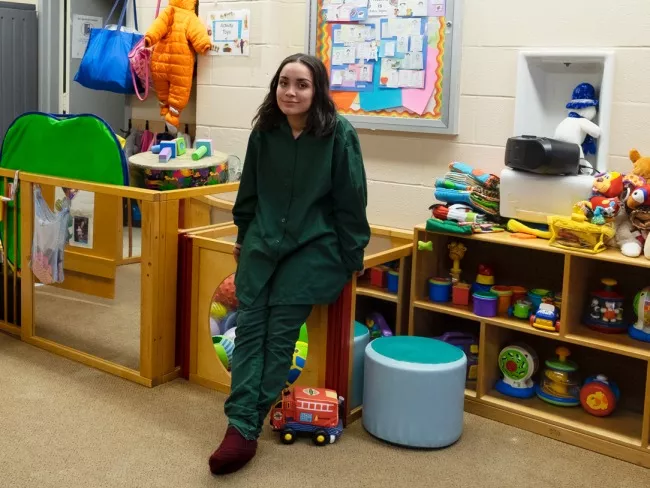
JENNIFER, 21, sentenced to 19 years to life at the age of 17. (Bedford Hills, NY 2014). Photo by Sara Bennett.
Over the past quarter century, there has been a profound change in the involvement of women within the criminal legal system. This is the result of more expansive law enforcement efforts, stiffer drug sentencing laws, and post-conviction barriers to reentry that uniquely affect women. The female incarcerated population is over seven times as high than in 1980. Over sixty percent (62%) of imprisoned women in state prisons have a child under the age of 18.1
Between 1980 and 2023, the number of incarcerated women increased by over 600%, rising from a total of 26,326 in 1980 to 186,244 in 2023. While 2020 saw a substantial downsizing due to the COVID-19 pandemic, this trend reversed with a 22% increase in 2023.
Rise in Women’s Incarceration, 1980-2023
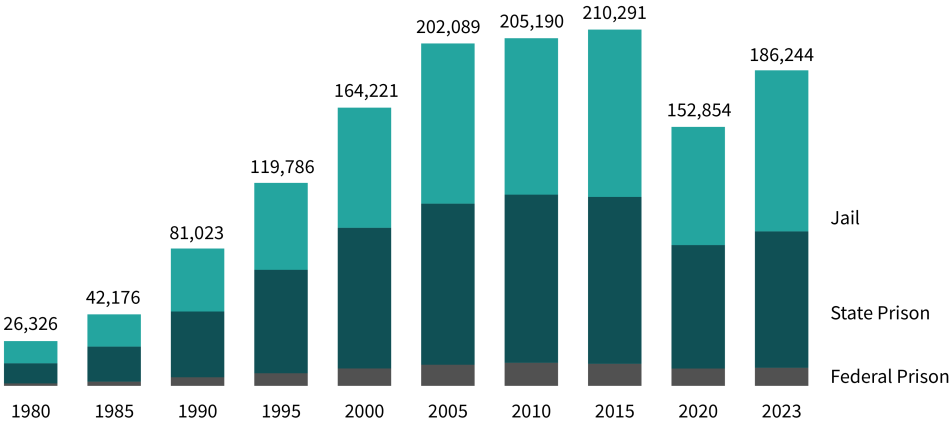
Sources: Historical Corrections Statistics in the United States 1850-1984 (1986); Prison and Jail Inmates at Midyear Series (1997- 2023), Prisoners Series (1980-2023). Bureau of Justice Statistics.
Though many more men are in prison than women, the rate of growth for female imprisonment has been twice as high as that of men since 1980. As of 2023, over 1 million women are under the supervision of the criminal legal system.
Women Under Control of the U.S. Corrections System, 2023
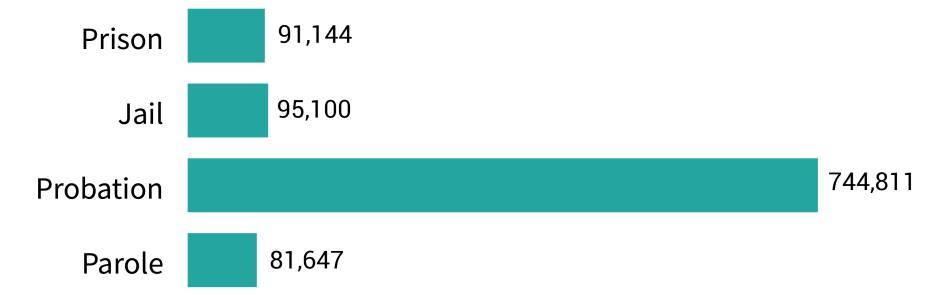
Sources: Mueller, D., & Klucklow, R. (2025). Prisoners in 2023 – Statistical tables. Bureau of Justice Statistics; Kaeble, D. (2025). Probation and Parole in the United States, 2023. Bureau of Justice Statistics; Zeng, Z. (2025). Jail Inmates in 2023 – Statistical tables. Bureau of Justice Statistics.
Race and Ethnicity in State and Federal Prisons
- In 2023, the imprisonment rate for Black women (68 per 100,000) was 1.7 times the rate of imprisonment for white women (41 per 100,000).
- Latina women were imprisoned at 1.2 times the rate of white women (51 vs. 41 per 100,000).
- Between 2000 and 2023, the rate of imprisonment declined by 69% for Black women, while the rate of imprisonment for white women rose by 18%. For Latina women, the rate of imprisonment has declined 15% between 2000 and 2023.
Female Imprisonment Rate per 100,000 by Race and Ethnicity, 2000-2023
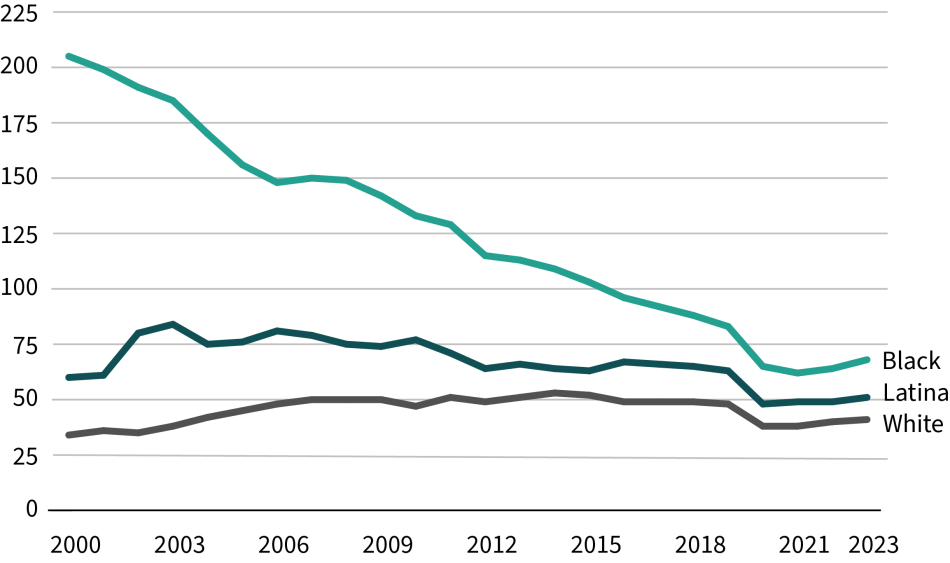
Source: Prisoners Series. Washington, DC: Bureau of Justice Statistics
| 2000 | 2023 | % Change | ||
|---|---|---|---|---|
| White | Women | 34 | 41 | 21% increase |
| Men | 449 | 341 | 24% decrease | |
| Black | Women | 205 | 68 | 67% decrease |
| Men | 3,547 | 1,862 | 46% decrease | |
| Latina | Women | 60 | 51 | 15% decrease |
| Latino | Men | 1,220 | 800 | 34% decrease |
Source: Prisoners Series. Washington, DC: Bureau of Justice Statistics
Female State Imprisonment Rates (per 100,000 U.S. Female Residents), 2023
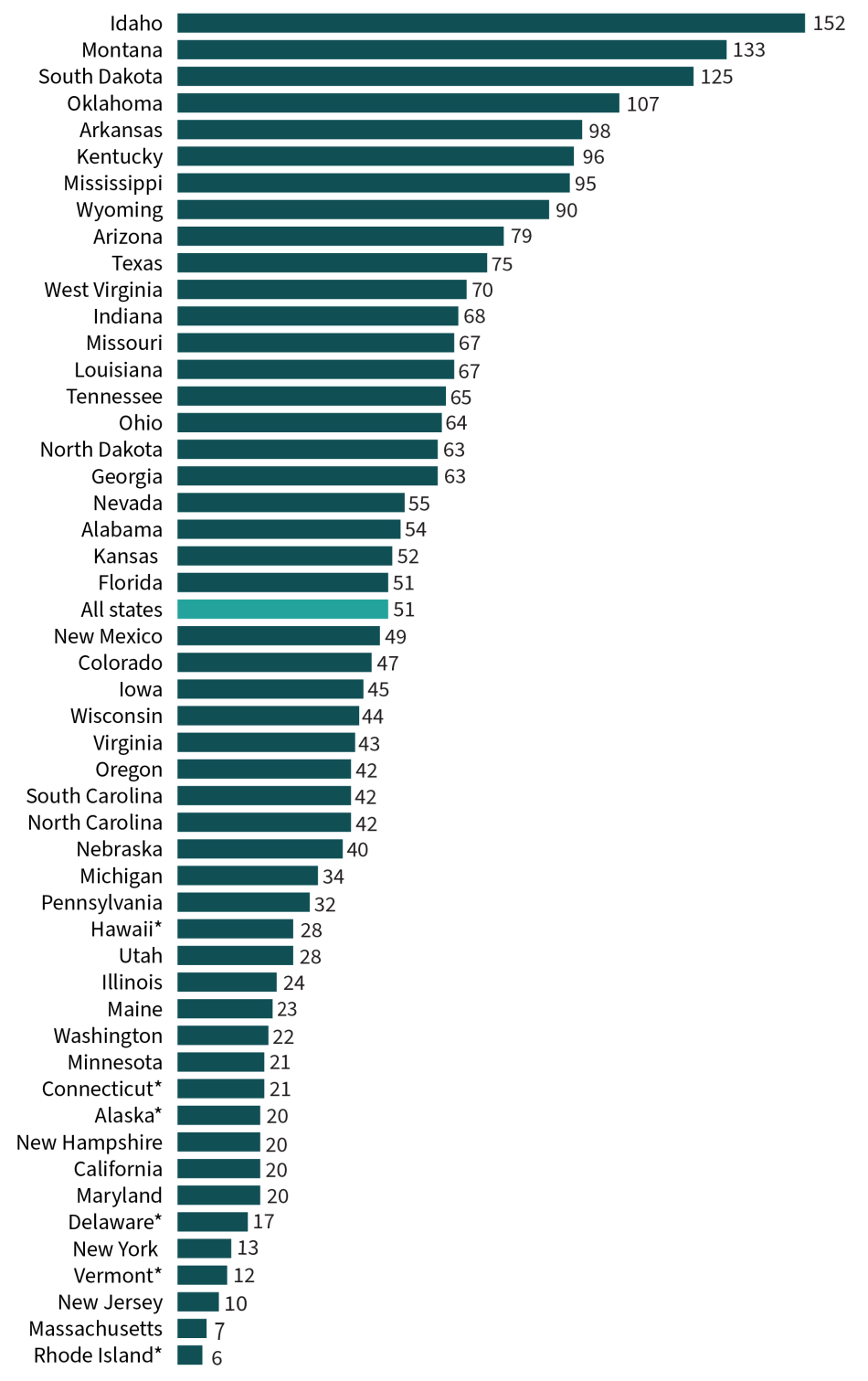
*In these states with integrated jail and prison systems, data include both jail and prison populations.
Source: Mueller, D., & Kluckow, R. (2025). Prisoners in 2023 – Statistical tables. Bureau of Justice Statistics; DC Corrections Information Council. (2023). Individuals incarcerated in the Bureau of Prisons under the DC Code as of October 1st, 2023. DC Corrections Information Council; U.S. Census Bureau. (2023). American Community Survey (ACS) 1-year estimates detailed tables, population by age and sex – table SO101. U.S. Census Bureau.
State Variation
The rate at which women are incarcerated varies greatly from state to state. At the national level, including both state and federal imprisonment, 51 out of every 100,000 women were in prison in 2023. The state with the highest rate of female imprisonment is Idaho (152) and the state with the lowest incarceration rate of women is Rhode Island (6).
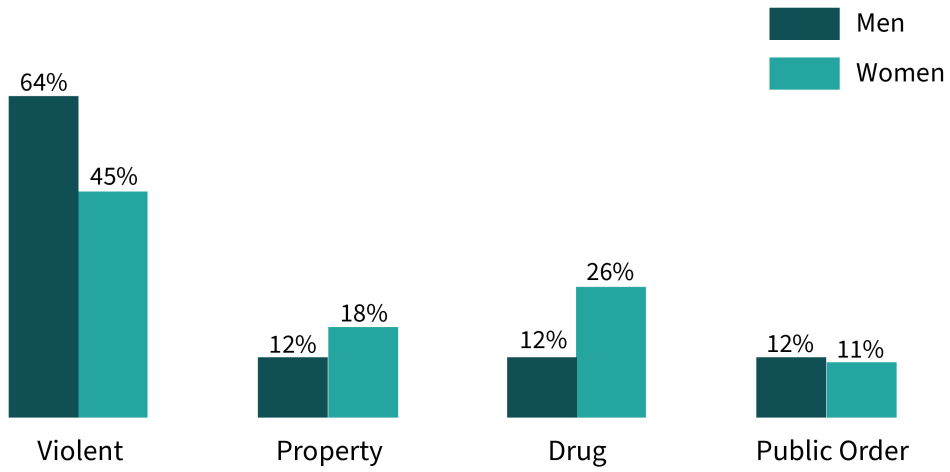
Offense Types for Men and Women in State Prisons
- Women in state prisons are more likely than men to be incarcerated for a drug or property offense. Twenty-six percent of women in prison have been convicted of a drug offense, compared to 12% of men in prison; 18% of incarcerated women have been convicted of a property crime, compared to 12% among incarcerated men.
- The proportion of imprisoned women convicted of a drug offense has increased from 12% in 1986 to 26% in 2022.
Offense Type by Gender in State Prisons, 2022
Source: Mueller, D., & Kluckow, R. (2025). Prisoners in 2023 – Statistical tables. Bureau of Justice Statistics.
Incarcerated Girls
- Of the 29,314 youth in residential placement on a typical day, 15% (4,349) are girls.2
- As with boys, girls are confined considerably less frequently than at the start of the century. In 2001, 15,104 girls were confined in residential placement settings on a typical day. By 2023, this figure had been cut by over 71%.3
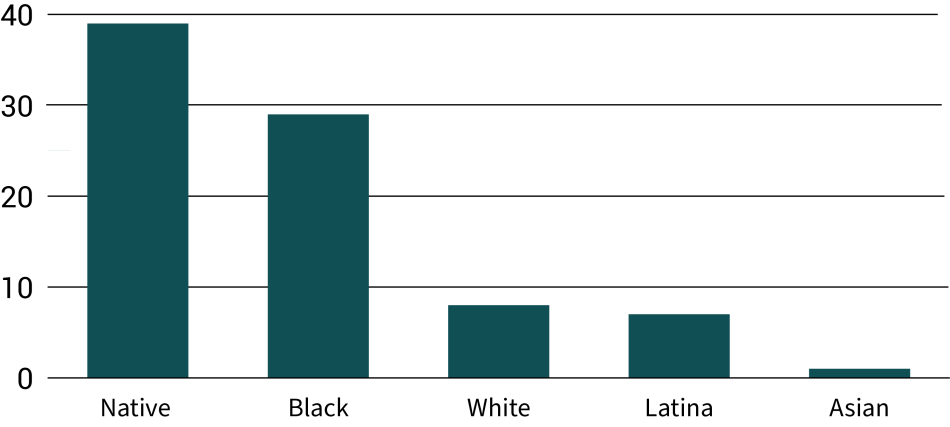
- The placement rate for all girls aged 17 or younger is 11 per 100,000 girls, yet Native and Black girls are much more likely to be incarcerated than their peers. Native girls have the highest incarceration rate, over 4 times the rate of white girls (39 per 100,000). Black girls are also disproportionately incarcerated at over 3 times the rate of white girls (29 per 100,000).4
- Though just 15% of youth incarcerated on a typical day are girls, they make up a much higher proportion of those incarcerated for the lowest level offenses. Forty percent of youth in placement for status offenses (such as truancy and curfew violations) are girls. Overall, 26% of incarcerated girls are held for status offenses or for violating the terms of their probation.5
- In 2022, girls in the youth justice system were detained after their arrest 29,540 times and committed to out-of-home placement after their adjudication 6,413 times.6
Rate of Incarceration for Girls by Race and Ethnicity, 2023
Source: Puzzanchera, C., Sladky, T. J., & Kang, W. (2025). Easy Access to the Census of Juveniles in Residential Placement. Office of Juvenile Justice and Delinquency Prevention (OJJDP).
| State | Rate |
|---|---|
| West Virginia |
139 |
| Washington, DC | 120 |
| South Dakota | 103 |
| Wyoming | 88 |
| Alaska | 70 |
| State | Rate |
|---|---|
| Vermont | 0 |
| New Hampshire | 5 |
| New Jersey | 5 |
| Maine | 5 |
| Rhode Island | 6 |
Source: Puzzanchera, C., Sladky, T. J., and Kang, W. (2025). Easy Access to the Census of Juveniles in Residential Placement. Office of Juvenile Justice and Delinquency Prevention.
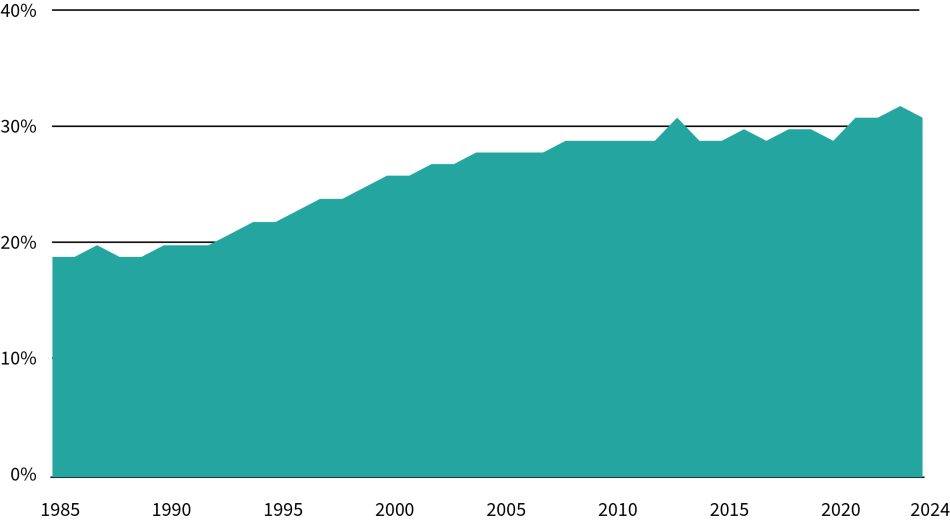
Girls Comprise a Growing Proportion of All Youth Arrests, 1985-2024
Source: FBI Crime Data Explorer (2025). Female Arrests by Age. FBI Uniform Crime Reporting Program.
In 1985, girls comprised 19% of all youth arrests, a proportion that grew to 31% by 2024.7
| 1. | Maruschak, L. M., Bronson, J., & Alper, M. (2021). Parents in prison and their minor children: Survey of prison inmates, 2016. Bureau of Justice Statistics. https://bjs.ojp.gov/library/publications/parents-prison-and-their-minor-childrensurvey-prison-inmates-2016 |
|---|---|
| 2. | Puzzanchera, C., Sladky, T. J., & Kang, W (2025). Easy access to the census of juveniles in residential placement. Office of Juvenile Justice and Delinquency Prevention (OJJDP). https://www.ojjdp.gov/ojstatbb/ezacjrp/ |
| 3. | Puzzanchera, C., Sladky, T. J., & Kang, W. (2025). Easy access to the census of juveniles in residential placement. Office of Juvenile Justice and Delinquency Prevention (OJJDP). https://www.ojjdp.gov/ojstatbb/ezacjrp/ |
| 4. | Puzzanchera, C., Sladky, T. J., & Kang, W. (2025). Easy access to the census of juveniles in residential placement. Office of Juvenile Justice and Delinquency Prevention (OJJDP). https://www.ojjdp.gov/ojstatbb/ezacjrp/. The calculations of girls’ placement rates by race and ethnicity are based on the total US population for girls aged17 or younger. |
| 5. | Puzzanchera, C., Sladky, T. J., & Kang, W. (2025). Easy access to the census of juveniles in residential placement. Office of Juvenile Justice and Delinquency Prevention (OJJDP). https://www.ojjdp.gov/ojstatbb/ezacjrp/ |
| 6. | Puzzanchera, C., Sladky, A., & Kang, W. (2025). Easy access to juvenile court statistics: 1985-2022. OJJDP. https://ojjdp.ojp.gov/statistical-briefing-book/data-analysis-tools/ezajcs/ |
| 7. | FBI Crime Data Explorer. (2025). Female arrests by age. FBI Uniform Crime Reporting Program. |

