
Youth Courts vs. Adult Courts: Why the Juvenile Justice System Works Better
Despite their many flaws, juvenile courts are better for youth who break the law than adult courts.
Related to: Youth Justice
Despite their many flaws, juvenile courts are better for youth who break the law than are adult courts. Contrary to critics’ beliefs, juvenile courts regularly address serious and violent crimes. Juvenile courts do not offer a “slap on the wrist;” they often issue harsh punishments. The frequent alternative, sending youth to adult courts, is a dangerous and counterproductive response.
Introduction
Teenagers value risk-taking but struggle to weigh the consequences of their actions.1 Temple University psychologist Laurence Steinberg has described the teenaged brain as “a car with a sensitive gas pedal and bad brakes.”2 Adolescence offers a welcoming platform for lawbreaking. Efforts to reduce offending and reoffending by young people must start with the understanding that teenagers are different from adults.
Fortunately, youth offending — lawbreaking as measured by arrests3 and self-reported behavior4 — has dropped considerably this century. Crime has fallen overall, and a shrinking proportion of it is committed by youth. Between 2000 and 2024, the proportion of all arrests that involve people under 18 has fallen by more than half, from 15% to 7%.5 Still, more than 650,000 arrests landed in juvenile courts in 2023,6 in addition to the cases of youth who violated the terms of their probation or committed a status offense.7
Public understanding of both crime trends and what follows a teenager’s arrest is battered by misinformation, anecdotes, and ignorance. Moreover, the juvenile justice system values confidentiality and utilizes a vocabulary that masks its purposes and outcomes. It’s easy to be confused.
The juvenile justice system aims to address both the young person and the harm they caused. The court’s flexibility allows tailored approaches.
A pervasive cliche defines juvenile justice as an ineffectual “slap on the wrist.” Media, especially television news, overstate the role of youth offending in overall public safety,8 leading some to desire crackdowns on teenagers.9 But the evidence rebuts the narrative: youth typically age out of their risky behaviors, including lawbreaking.10 In fact, for roughly two in three youth (63%) referred to juvenile court, their first visit will be their only visit.11 Harsh responses are more likely to lead to deeper levels of reoffending12 because those responses do not confront the underlying behaviors and conditions that led to lawbreaking.
Instead of addressing the real needs of teenagers or recognizing how juvenile courts work, some legislators seek to send more youth cases to courts built for adults,13 a strategy that harms public safety and youth development.14 The question for the public and policymakers is how best to respond when teenagers do break the law. And, as discussed below, the juvenile justice system, despite its many and significant flaws, is the correct venue for youth adjudications.
List of Key Terms
- Adjudication refers to the juvenile court’s process that determines guilt.
- Delinquency offense is the juvenile justice system’s equivalent of a criminal act.
- Delinquent refers to youth who are convicted in juvenile court. Juvenile courts do not find youth to be “guilty” or “innocent,” nor are they termed “criminal” upon their adjudication.
- Detention refers to youth confined upon arrest and before their court disposition. Some youth in detention have completed their judicial proceedings and are awaiting the location of their long-term incarceration. Such youth are generally held in facilities called juvenile detention centers. Youth in detention are suspected of delinquent acts or status offenses (such as incorrigibility, truancy or running away) or are awaiting the result of their court hearings.
- Commitment refers to youth confined in residential facilities after their adjudication. Commitment facilities often have ambiguous names such as training schools, residential treatment centers, or academies. The largest of these commitment facilities, typically state-run, are sometimes informally called “youth prisons.” Youth can also be committed to non-carceral facilities, such as group homes, wilderness camps or residential treatment centers.
- Placement can refer to the status of a committed youth as well as other kinds of out-of-home settings. This can be a confusing term because placement refers to post-adjudication placement as well as all placements, including detained youth.
- Referral to juvenile court equates to arrest. Juvenile court cases begin with a referral.
- Status offense is an act that is illegal for underage individuals, but not for adults. Examples of status offenses include truancy, running away from home, incorrigibility/ungovernability.
An Imperfect System for Kids and Teens
How Does Juvenile Justice Work?
States typically emphasize the need for a balanced and restorative approach when defining the purpose of their respective juvenile systems: balancing public safety, helping youth develop skills to address their lawbreaking, and providing accountability to the victims and community harmed.15 By comparison, the adult criminal justice system — with its focus on punishment — often lacks these aspirations.
Instead of seeking a one-size-fits-all approach to justice and accountability, discretion ripples through the juvenile justice system. The system is designed to address the young person and the harm they caused. This approach allows tailored approaches, which have a higher likelihood of eventual success. A recurring challenge: this discretion often leads to measurable racial and ethnic disparities because youth of color are treated more harshly by those with power.16
There are many off-ramps from deeper system involvement:
- Youth offending is typically low-level (such as simple assault, drug possession, and disorderly conduct), so police often have discretion as to whether to arrest a youth violating a law: a schoolyard fight could just as easily be termed a simple assault as a cause for a trip to the principal’s office.
- Police and intake officers have discretion to divert youth to community providers or refer them to formal court processing.
- Youth may or may not be detained upon their arrest, but there is no bail in the juvenile system. Arrested teens are often brought to a juvenile detention center for review by intake staff, often using guidance offered by risk assessment instruments that seek to offer fairness to this decision.17 Risk instruments consider the severity of the charge and the youth’s offending history.
- Juvenile courts can issue an array of consequences for delinquent youth (i.e., those convicted in juvenile court), ranging from a warning, writing a letter of apology to the victim, community service, probation, to terms of juvenile incarceration that might last to age 21. There are no mandatory minimum sentences in juvenile courts.
These forms of discretion lead to harsher outcomes for youth of color. For example, among those youth referred to juvenile court for delinquency offenses, Black youth are 60% more likely to be detained and 64% more likely to be committed than white youth.18
Exceptions to the typical practices abound.
Massachusetts is the only state that has juvenile bail. Washington is the only state with determinative juvenile sentences, mimicking the mandatory minimum sentences of the adult criminal justice system. Extended ages of juvenile court jurisdiction generally means that supervision in the juvenile system generally stops at age 21, though Oklahoma and Texas draw that line at age 18, whereas Connecticut, Colorado, Hawaii, and New Jersey have no limits on extended post-conviction jurisdiction.
What We Know About Arrests and Adolescent Offending
The number of arrests of people under 18 years old peaked in 1995 and has declined more than 75% since (see Figure 1). Most youth arrests are for non-violent offenses. In 2024, just 8.5% of youth arrests were for offenses categorized by the FBI as Part 1 violent crimes (aggravated assault, robbery, rape, and murder).19 Violent crime arrests are predominantly adults; just under 10% of violent crime arrests in the US are of people under 18.20 Youth arrests increased from 2021 to 2023 before falling in 2024; the most recent arrest levels remain well below pre-pandemic levels.21
Figure 1: Youth Arrests, 1985-2024
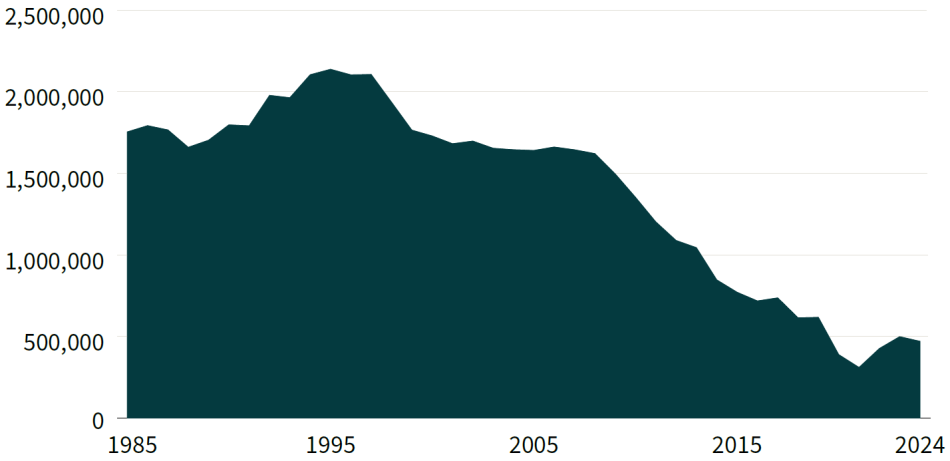
These drops in arrests largely echo drops in reported adolescent offending, including ongoing drops in illicit drug and alcohol use22 as well as behaviors like getting into fights23 and carrying guns.24
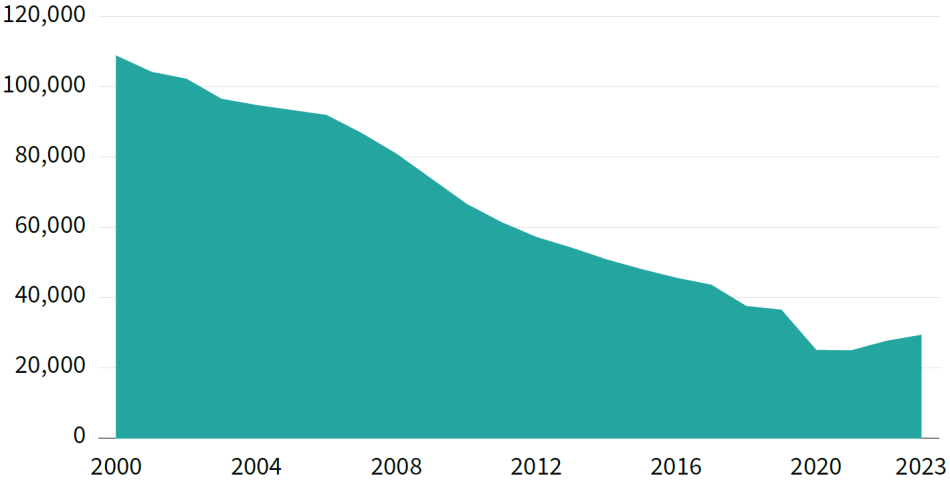
This century’s drop in youth arrests has meant fewer youth are incarcerated in the juvenile system, as shown in Figure 2. Declines in arrests and placements (the number of youth incarcerated on juvenile charges) in juvenile facilities meant that states and localities have been able to close near-empty facilities. At the turn of the century, there were more than 3,000 juvenile facilities, a number that dropped by about 60% by 2022.25 The most significant drops have been among the largest facilities, those with at least 100 beds: there were 264 large facilities in 2000 and 42 in 2022.26
Figure 2: Youth Placements in Juvenile Facilities
Placement count does not include youth held in adult facilities
Juvenile Courts Address All Levels of Charges
A widespread cliche asserts juvenile justice amounts to a slap on the wrist.27 This ignores the reality of the system’s harshness. Probation is burdensome, with a long list of required behaviors.28 Detention upon arrest affects 25% of youth referred to juvenile court — youth who have not been convicted of any crime. Incarcerated youth are abused by staff with appalling frequency, including physical and sexual abuse and solitary confinement.29 This is not a gentle system but an often abusive and destructive one.
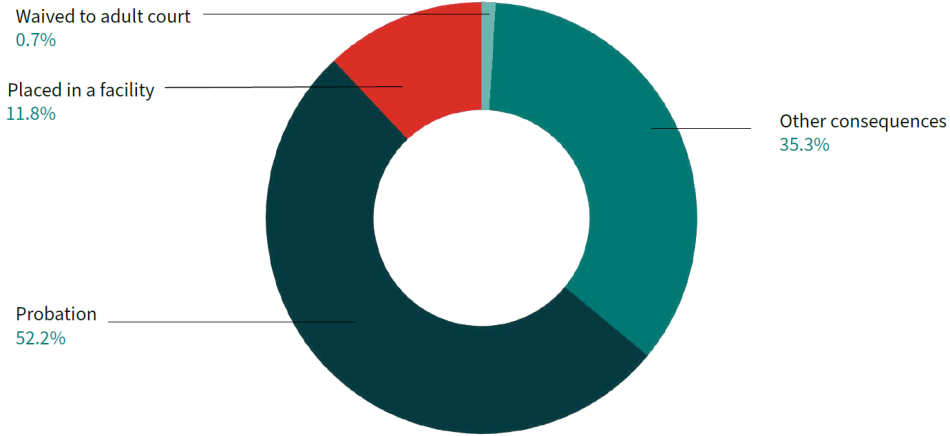
Outcomes data demonstrate that juvenile courts do punish youth who receive a juvenile conviction. Over the 10 last years for which there are available data, one-third (33%) of youth sent to juvenile court had their cases dismissed (equivalent to a not guilty finding). Among those cases that resulted in a juvenile conviction, 35% received other consequences (such as community service), and one-half received probation (52%); 12% were incarcerated and less than 1% were waived to adult criminal court (Figure 3).30 (Far more youth charged in adult court are victims of jurisdictional boundaries (defining “adult” to include 17-year olds), automatic adult charging, or prosecutorial discretion than a juvenile court judge’s ruling.)31
Figure 3. Juvenile Court Outcomes, 2013-2022
Among cases that resulted in a juvenile conviction
Youth of color are treated more harshly at each point of contact with the justice system, though differences in offending patterns contribute to these disparities as well.32 Over the last 10 years, 20% of white youth were detained upon their arrest, much lower than the proportion for their Latino (31%), Black (28%), Native (25%), or Asian (25%) peers. Disparities like these pervade most points of contact.33
Juvenile courts handle all manner of lawbreaking, including serious and violent charges; the largest plurality (40%) of cases in juvenile court are person offenses (wherein a person was physically harmed), followed by property offenses (28%), public order offenses (22%), and drug offenses (11%). In 2023, roughly 250,000 person offenses were referred to juvenile courts, generally simple assault; 66,500 referrals involved youth accused of the FBI’s list of serious violent offenses: aggravated assault, robbery, rape, and murder.34
Out-of-home placement for less serious offenses is common, too. Out of 138,900 youth who were sentenced to incarceration for a new juvenile conviction in 2022, only 9,400 (6.8%) were there for a serious, violent offense.35 Still others were locked up for violating the terms of their probation. Annual admissions totals are not available for this cohort, but 14% of youth incarcerated in the juvenile system on a typical day were not convicted of a new delinquency offense; they committed a status offense (charges such as truancy, running away, and incorrigibility that are only leveled against people under 18) or violated the terms of their probation.36
That’s not a slap on the wrist.
Ebbs and Flows of Youth Justice Reform
Juvenile courts were first created in Chicago in 1899, spreading nationally, motivated by the indefensible excesses of the criminal justice system, such as a 10-year-old boy accused of stealing a pair of shoes who sat in an adult jail for almost two weeks.37 Though an age-appropriate improvement over adult criminal courts, juvenile courts were informal and often issued arbitrary punishments. The initial, paternalistic, era of juvenile justice ended with 1967’s Gault decision from the U.S. Supreme Court, which protected the due process rights of children and teens. “Under our Constitution,” wrote an 8-1 majority, “the condition of being a boy does not justify a kangaroo court.”38
Carveouts from the juvenile courts for the most serious cases evolved slowly, and age parameters — minimum and maximum ages of youth under the juvenile courts’ purview — differed by state. Georgia gave its prosecutors the power to charge youth as if they were adults in 1911. Pennsylvania created automatic adult charges (solely for homicide) in 1933. For decades, these were not common practices. By 1986, only 14 states automatically charged some youth as if they were adults, and seven states left that decision in the hands of prosecutors.39 Absent other pathways, youth could be sent to adult court, but only after a decision by a juvenile court judge. In 1985, this occurred quite often — 9,000 times.40
By the mid-90s, with youth offending and arrests on the rise,41 many believed the juvenile justice system was too lenient and inept to face the challenge. Political scientist John DiIulio predicted a coming wave of remorseless urban youth and (along with urging more religious piety) argued for “genuine get-tough law-enforcement strategies against the super-predators.”42 It is a bitter irony that youth arrests declined as DiIullio made his confident — and wrong — prediction.
Thus described the end of the procedural reform era and the transition to a “tough-on-crime” era.43 Throughout the 1980s and 1990s, states passed laws to encourage more out-of-home placements, built cruel boot camps, and sent more youth into adult courts, jails, and prisons.44
Research in adolescent brain development and its relevance to youth justice from experts such as Lawrent Steinberg and Elizabeth Scott45 pushed a needed recalibration of how to respond to teens’ misbehavior. In 2005, the Supreme Court banned the death penalty for people under 18. Given that adolescent brains were not fully developed, subjecting teenagers to the death penalty was an unconstitutional cruel and unusual punishment.46 That ruling and others limiting extreme sentencing that followed47 rippled through state legislatures which reconsidered their harsh juvenile laws. The pulling back from the tough on crime era did not increase crime. In fact, youth offending fell.
Parents and Juvenile Courts
A foundational difference between juvenile and adult criminal court is the role of parents. Parents are included in courts’ procedures (e.g., alerting about court dates) and responses, such as family functional therapy. Laws that charge youth as if they were adults exclude parents from the process, as would be the case for actual adults. Though parents often feel belittled and harassed by both juvenile and criminal court proceedings,48 policymakers who demand parental accountability for their children’s actions should oppose the use of adult charges. The National Council of Juvenile and Family Court Judges has guidance for more effective involvement of families,49 as does the federal Office of Juvenile Justice and Delinquency Prevention.50
The failed alternative: Youth in adult courts, jails, and prisons
Largely due to ignorance of how juvenile courts function, politicians often envision sending more youth to adult courts. For example, Kentucky once started all youth cases in juvenile court, but made felonies committed with a gun adult charges starting in 2024.51 North Carolina, which charged all 16- and 17-year olds as if they were adults until 2019, quickly tinkered with its automatic charging provisions and, starting Dec. 2024,52 automatically charges 16- and 17-year-olds as adults if they are alleged to have committed most classes of felonies.
It takes much longer to try a case in adult court than juvenile court; lengths of stay in North Carolina’s juvenile detention center last 27 days for youth charged in juvenile court and 200 days for youth charged as adults.53 North Carolina’s detention facilities are now overcrowded and the state is considered building more detention centers,54 an option that would cost tens of millions of dollars. Louisiana raised the upper age of juvenile court jurisdiction from 16 to 17 in 2017 (with full implementation in 2020), then reversed itself with the election of a new governor in 2024, largely impacting 17-year olds charged with non-violent offenses.55 Louisiana has set aside over $150 million to build new detention facilities, most of them for the juvenile population.56
Advocates of these policies argue they are being tough on crime, but the evidence shows that youth charged as adults are more likely to reoffend,57 and more likely to commit more serious crimes when they do.58 In short, so-called “tough on crime” policies against youth create more youth crime.
Still, the appeal of adult charges is built on a political catchphrase about “adult crime, adult time,” regardless of whether that instinct is effective. In 2000, while with the Urban Institute, sociologist Jeffrey A. Butts wrote:
[T]he public still views the juvenile court as a weak and inadequate response to juvenile crime. As always, the most popular response to this perception is to send more juveniles to [adult] criminal court. Not because criminal courts have been found to be more effective than juvenile courts, but because the adult system offers a more potent symbol of crime control than does the juvenile court.59
Conclusion and recommendations
Complaints about teenagers are timeless, and it’s not surprising that each generation of adults seems to believe that today’s youth are worse than any generation that came before it. Measurable improvements in youth behavior leading to drops in youth arrests and incarceration are often ignored by elected officials. A 2025 survey of mayors found that 44% saw “crimes involving juveniles” as the biggest crime problem their city faces,60 easily the most popular answer, despite long-term declines in violence and arrests and the modest role youth play in overall crime.
None of which is to say that youth are without their challenges. In 2021, the U.S. Surgeon General found depression and anxiety common among teens, along with more emergency room visits for mental health issues.61 The interplay of mental health challenges along with the prevalence of other adverse childhood experiences among the justice-involved population62 points to the opportunity to address youth well-being outside of the justice system in ways that will benefit public safety and positive adolescent development. Unaddressed mental health challenges and substance use disorders can lead to higher rates of reoffending.63 Investing in public health remedies is an investment in public safety.
Juvenile courts have the capacity to address teen misbehavior, but no one should expect a 100% success rate. Despite their many flaws (particularly when courts choose to incarcerate),64 juvenile courts still have better outcomes than adult courts for youth who break the law.65 Localities can minimize court involvement by funding and expanding the use of diversion programs, which have shown excellent outcomes for those who do come into contact with the police.66
Cases involving people under 18 do not belong in adult courts. States should raise the age of juvenile court jurisdiction to include all people under 18, regardless of the initial charge. Moreover, the decision to transfer to adult court should never lay solely in the hands of prosecutors.
Juvenile justice systems are a deeply flawed model, but a necessary alternative to adult courts.
| 1. | Cavanagh, C. (2022). Healthy adolescent development and the juvenile justice system: Challenges and solutions. Child Development Perspectives, 16(3), 141–147. |
|---|---|
| 2. | Quoted in Puzzanchera, C., Hockenberry, S., & Sickmund, M. (2022). Youth and the juvenile justice system: 2022 national report. National Center for Juvenile Justice, p. 80. |
| 3. | Rovner, J. (2025). Youth justice by the numbers. The Sentencing Project. |
| 4. | For example, the percent of youth who reported being in a physical fight fell from 33.2% to 19.2% from 2001 to 2023, according to the 2023 Youth Risk Behavior Survey, conducted by the Centers for Disease Control and Prevention. |
| 5. | Council on Criminal Justice. (2025). Who gets arrested in America: Trends across four decades, 1980–2024. |
| 6. | Puzzanchera, C., Sladky, A., & Kang, W. (2025). Easy access to juvenile court statistics: 1985-2022. |
| 7. | There are no readily available national data on youth referred to juvenile court for such non-delinquency offenses. |
| 8. | Dorfman, L., & Schiraldi, V. (2001). Off balance: Youth, race & crime in the news. Building Blocks for Youth. |
| 9. | Mendel, R. (2024). The real cost of ‘bad news’: How misinformation is undermining youth justice policy in Baltimore. The Sentencing Project. |
| 10. | National Research Council. (2013). Reforming juvenile justice: A developmental approach. The National Academies Press. |
| 11. | Puzzanchera, C., & Hockenberry, S. (2022). Patterns of juvenile court referrals of youth born in 2000. Office of Juvenile Justice and Delinquency Prevention. |
| 12. | Aizer, A., & Doyle, J.J., Jr. (2013). Juvenile incarceration, human capital and future crime: Evidence from randomly-assigned judges (NBER Working Paper No. 19102). National Bureau of Economic Research. |
| 13. | Bernstein, N. (2025, June 30). Reversing a national trend, DAs and state lawmakers push to treat youth who’ve committed crimes as adults. The Imprint. |
| 14. | Naugel, O. (2025). Automatically charging youth as adults. The Sentencing Project. |
| 15. | Puzzanchera, C., Hockenberry, S., & Sickmund, M. (2022). Youth and the juvenile justice system: 2022 national report. National Center for Juvenile Justice. |
| 16. | Office of Juvenile Justice and Delinquency Prevention (2024). Ratio of rates between minority youth and white youth by decision point and offense, 2021. |
| 17. | Steinhart, D. (2006). Juvenile detention risk assessment: A practice guide to juvenile detention reform. The Annie E. Casey Foundation. |
| 18. | Rovner, J. (2025). Youth justice by the numbers. The Sentencing Project. See Table 1, “Cumulative Racial and Ethnic Disparities.” |
| 19. | Rovner, J. (2025). Youth justice by the numbers. The Sentencing Project. |
| 20. | Council on Criminal Justice. (2025). Who gets arrested in America: Trends across four decades, 1980–2024. |
| 21. | Rovner, J. (2025). Youth justice by the numbers. The Sentencing Project. |
| 22. | Miech, R. A., Patrick, M. E., O’Malley, P. M., Jager, J. O., & Jang, J. B. (2026). Monitoring the Future national survey results on drug use, 1975–2025: Overview and key findings for secondary school students. Institute for Social Research, University of Michigan. |
| 23. | Centers for Disease Control and Prevention. (n.d.). 1991-2023 high school Youth Risk Behavior Survey data: Data on high school students who were in a physical fight, 1991-2023. |
| 24. | Centers for Disease Control and Prevention. (n.d.). 1991-2023 high school Youth Risk Behavior Survey data: Data on high school students who carried a gun, 2017-2023. |
| 25. | Puzzanchera, C., Hockenberry, S., Sladky, T.J., & Kang, W. (2024). Juvenile residential facility census databook. National Center for Juvenile Justice. |
| 26. | Puzzanchera, C., Hockenberry, S., Sladky, T.J., & Kang, W. (2024). Juvenile residential facility census databook. National Center for Juvenile Justice. |
| 27. | For example, see Smith, Z. (2024). Juvenile crime is out of control in too many cities. The Heritage Foundation. |
| 28. | The Annie E. Casey Foundation (2024). Experiencing probation: Insights from young people and families. |
| 29. | Mendel, R. (2015). Maltreatment of youth in U.S. juvenile corrections facilities. The Annie E. Casey Foundation. |
| 30. | Puzzanchera, C., Sladky, A., & Kang, W. (2025). Easy access to juvenile court statistics: 1985-2022. National Center for Juvenile Justice. Author’s calculations. |
| 31. | Puzzanchera, C., Sickmund, M., & Hurst, H. (2023). Youth younger than 18 prosecuted in criminal court: National estimate, 2019 cases. National Center for Juvenile Justice. |
| 32. | Bishop, D.M., & Leiber, M.J. (2011). Racial and ethnic differences in delinquency and justice system responses. In D.M. Bishop & B.C. Feld (Eds.), The Oxford handbook of juvenile crime and juvenile justice (pp. 445-484). Oxford University Press. |
| 33. | Puzzanchera, C., Sladky, A., & Kang, W. (2025). Easy access to juvenile court statistics: 1985-2022. National Center for Juvenile Justice. |
| 34. | Hockenberry, S., & Puzzanchera, C. (2025). Juvenile court statistics 2023. National Center for Juvenile Justice. |
| 35. | Puzzanchera, C., Sladky, A., & Kang, W. (2025). Easy access to juvenile court statistics: 1985-2022. National Center for Juvenile Justice. |
| 36. | Puzzanchera, C., Sladky, T.J., & Kang, W. (2025). Easy access to the census of juveniles in residential placement. National Center for Juvenile Justice. |
| 37. | Myers, Q. (2019, May 13). How Chicago women created the world’s first juvenile justice system. WBEZ Chicago. |
| 38. | In re Gault, 387 U.S. 1, 28 (1967). |
| 39. | Feld, B.C. (1987). The juvenile court meets the principle of the offense: Legislative changes to juvenile waiver statutes. Journal of Criminal Law and Criminology, 78(3), 471-533. |
| 40. | Snyder, H.N., Finnegan, T.A., Nimick, E.H., Sickmund, M.H., Sullivan, D.P., & Tierney, N.J. (1989). Juvenile court statistics 1985. Office of Juvenile Justice and Delinquency Prevention. |
| 41. | Office of Juvenile Justice and Delinquency Prevention. (2022). Trends in the number of arrests by age group for all offenses. |
| 42. | DiIulio, J.J., Jr. (1995, November). The coming of the super-predators. The Weekly Standard. |
| 43. | Torbet, P., Gable, R., Hurst, H., IV, Montgomery, I., Szymanski, L., & Thomas, D. (1996). State responses to serious and violent juvenile crime. National Center for Juvenile Justice. |
| 44. | United States General Accounting Office General Government Division. (1995). Juvenile justice: Juveniles processed in criminal court and case dispositions. |
| 45. | Steinberg, L. (2018). Understanding adolescent development, reforming juvenile justice. MacArthur Foundation. Scott, E. S., & Steinberg, L. D. (2008). Rethinking juvenile justice. Harvard University Press. |
| 46. | Roper v. Simmons, 543 U.S. 551 (2005). |
| 47. | Rovner, J. (2023). Juvenile life without parole: An overview. The Sentencing Project. |
| 48. | Fedders, B. (2022). The anti-parent juvenile court. UCLA Law Review, 69, 746-806. |
| 49. | Pearce, J. (Ed.). (2018). Enhanced juvenile justice guidelines. National Council of Juvenile and Family Court Judges. |
| 50. | Office of Juvenile Justice and Delinquency Prevention (2018). Family engagement in juvenile justice. |
| 51. | Demers, J., & Hicks, J. (2024, June 24). A new Kentucky law will send more youth to adult court — Black kids face highest risk. Louisville Public Media. |
| 52. | H.B. 834, S.L. 2024-17 (N.C. 2024). |
| 53. | North Carolina Department of Public Safety. (2024). 2024 annual report: Juvenile justice and delinquency prevention. |
| 54. | Krueger, S. (2026, January 21). Understaffed and overcrowded: What the state found in juvenile detention facilities. WRAL New |
| 55. | Webster, R.A. (2025, October 3). A law was meant to target teen violence. Instead, 17-year-olds are being charged as adults for lesser offenses. Verite News and ProPublica. |
| 56. | Chrastil, N. (2024, December 16). Towns across Louisiana clamor to build new juvenile detention centers. The Lens. |
| 57. | McGowan, A., Hahn, R., Liberman, A., Crosby, A., Fullilove, M., Johnson, R., … & Task Force on Community Preventive Services. (2007). Effects on violence of laws and policies facilitating the transfer of juveniles from the juvenile justice system to the adult justice system: A systematic review. American Journal of Preventive Medicine, 32(4), 7–28. |
| 58. | Community Preventive Services Task Force. (2023). Violence prevention: Policies facilitating the transfer of juveniles to adult justice systems. Centers for Disease Control and Prevention |
| 59. | Butts, J.A. (2000). Can we do without juvenile justice? The Urban Institute. |
| 60. | U.S. Conference of Mayors. (2025, September). Crime and policing in America’s major cities: A 60-city survey. |
| 61. | Richtel, M. (2021, December 7). Surgeon General warns of youth mental health crisis. The New York Times. |
| 62. | Astridge, B., Li, W. W., McDermott, B., & Longhitano, C. (2023). A systematic review and meta-analysis on adverse childhood experiences: Prevalence in youth offenders and their effects on youth recidivism. Child Abuse & Neglect, 140, 106055. |
| 63. | Stanley, J. N., DeLucca, S. C., Belenko, S., & Robertson, A. (2025). The impact of mental health and substance use issues on recidivism among youth on probation. The American Journal of Drug and Alcohol Abuse, 51(3), 372–382. |
| 64. | Mendel, R. (2023). Why youth incarceration fails. The Sentencing Project. |
| 65. | Centers for Disease Control and Prevention. (2007). Effects on violence of laws and policies facilitating the transfer of youth from the juvenile to the adult justice system: A report on recommendations of the task force on community preventive services; Redding, R. (2008). Juvenile transfer laws: an effective deterrent to delinquency? Juvenile Justice Bulletin. |
| 66. | Mendel, R. (2022). Diversion: A hidden key to combating racial and ethnic disparities in juvenile justice. The Sentencing Project. |

