
Running With Conviction: Eligibility for Elected Office With a Felony Conviction
This report examines the legal barriers that people with felony convictions may encounter when seeking to run for public office across the United States and its territories, and whether eligibility to run for office with a felony conviction coincides with eligibility to vote with a felony conviction in each jurisdiction.
Related to: Voting Rights

Overview
People with felony convictions — including formerly incarcerated people and, in rare instances, those still serving prison sentences — have been elected to state and local office.1 People with prior felony convictions currently serve in state legislatures including Nevada, Virginia,2 and Washington. They also serve as elected members of numerous local bodies including city councils, school boards, and neighborhood commissions.
However, far too often, people with felony convictions are excluded from representing their communities in state legislatures, city councils, school boards, and neighborhood commissions. While eligibility to run for federal office is set by the U.S. Constitution, which does not bar individuals with felony convictions from running for the presidency or U.S. Congress, eligibility to run for state and local offices varies widely. It is notable that President Donald Trump, while eligible for federal office, would not be allowed to run for a state legislative or city council seat in many states due to his felony convictions.
This report analyzes the patchwork of statutes and constitutional requirements that govern whether people with felony convictions can run for elected office across the 50 states, the District of Columbia, American Samoa, Guam, Northern Mariana Islands, Puerto Rico, and the U.S. Virgin Islands. There is significant ambiguity about eligibility in many jurisdictions, and this report should not be interpreted as legal advice or determinative of whether someone with a felony conviction can run for office. If one is unclear about their eligibility to run for office, they should seek legal counsel in their jurisdiction. Our analysis reveals:
- Only three jurisdictions — Maine, Vermont, and DC — place no restrictions on eligibility to run for office for most people with a felony conviction,3 which means that in many instances currently incarcerated people can seek elected office.
- 11 jurisdictions restrict eligibility only while an individual is incarcerated for a felony conviction. This means that people on felony parole or probation are eligible to run for office in these states.
- 10 jurisdictions restrict eligibility while an individual with a felony conviction is incarcerated and while they are on probation or parole.4
- 32 jurisdictions restrict eligibility beyond incarceration, parole, and probation, to include “post-sentence” requirements before restoration of rights. These requirements may include a gubernatorial pardon, a waiting period, or judicial restoration.
We also looked at whether eligibility to run for office with a felony conviction coincides with eligibility to vote with a felony conviction in each jurisdiction. In other words, if a person with a felony conviction is eligible to vote in the state or territory, are they also eligible to run for office? We found:
- In 25 jurisdictions, eligibility to run for office is generally the same as voting rights eligibility for most individuals with felony convictions.
- In 31 other jurisdictions, the granting of voting rights and eligibility to run for office are substantially different. Most commonly, eligibility to seek public office lags behind the restoration of the right to vote.
We profiled three elected officials with felony convictions — Nevada Assemblymember Jovan Jackson; Hopkinsville, Kentucky Councilmember Brittanie Bogard; and District of Columbia Advisory Neighborhood Commissioner Harold Cunningham Jr. They detail how their experiences have impacted their policymaking, including serving as a voice for communities impacted by the criminal legal system. Assemblymember Jackson describes his public service, saying “I’m able to bring a voice to a population that went unheard for decades with mass incarceration.”
The Sentencing Project recommends: (1) Jurisdictions eliminate candidacy bans for individuals with felony convictions, leaving representative selection to the voters; (2) if a jurisdiction is to maintain restrictions, then it should expand candidacy requirements to align with voting eligibility to remove ambiguity; and (3) jurisdictions should publish clear public guidance on eligibility to run for office with a felony conviction.
Legal Framework
In U.S. Term Limits, Inc. v. Thornton, the Supreme Court held that states cannot impose additional qualifications on federal officeholding beyond those stated in the U.S. Constitution.5 Individuals with felony convictions — including incarcerated people — are eligible to run for U.S. Congress, the Senate, and the presidency.
When Incarcerated People Have Run for Office
District of Columbia Advisory Neighborhood Commissioner Harold Cunningham is believed to be the only currently incarcerated elected official in the United States. He is the fourth incarcerated DC resident to serve Advisory Neighborhood Commission (ANC) District 7F since 2020. Previous incarcerated ANC 7F commissioners were Joel Castón,6 Leonard Bishop, and Shameka Haynes.
While there is little documented history of incarcerated people running for state and local offices, there is a long and interesting history of imprisoned candidates running for federal office in the United States. In 1798, Vermont Congressman Matthew Lyon won reelection to Congress while incarcerated under the Sedition Act for criticizing then-President John Adams.7 In 1920, Eugene V. Debs received 913,693 votes for president as the Socialist Party candidate. He had also been incarcerated under Sedition Act offenses after a speech criticizing World War I, and campaigned with materials asking people to vote “For President, Convict 9653,” his federal prison number.8 Eight-time presidential candidate Lyndon LaRouche ran as a candidate for the Economic Recovery Party in 1992 while he was incarcerated.9 Native American activist Leonard Peltier also ran for president while incarcerated, for the Peace and Freedom Party in 2004.10
While eligibility to run for federal office regardless of felony conviction status is set by the U.S. Constitution, which does not bar individuals with felony convictions from running for office, eligibility to run for office in state and localities varies widely. Within each jurisdiction, its own constitution often sets parameters around eligibility to run for office. The contours of eligibility are further defined by statute.
Local governments can add stricter rules barring individuals with felony convictions from running for office if state law leaves room for them to do so. Vermont is one of the states in which individuals with a felony conviction are not disqualified from running for state office, but municipal charters set their own eligibility requirements for running for local office. Some states also have absolute bars on people with felony convictions holding certain positions, such as sheriff.
Many jurisdictions restrict an individual’s eligibility to run for office until their sentence is completed. In some jurisdictions, “completion of sentence” means release from incarceration. In other jurisdictions, it means release from confinement as well as discharge from post-sentence supervision, such as felony parole and probation. It is unclear in many jurisdictions whether fines, fees, and restitution must also be paid in addition to serving a sentence of incarceration and any post-release community supervision to constitute “completion” of a sentence, although some state statutes make this requirement explicit.
In jurisdictions that restrict eligibility to run for office, a pardon by the governor will often restore full rights of citizenship for individuals with a felony conviction, including the ability to run for public office.
Many jurisdictions restrict eligibility for public office following convictions for election-related offenses, including embezzlement, bribery, perjury, fraud, and misuse of public funds. The scope of these restrictions varies by jurisdiction and may include extended waiting periods before a person can again become eligible to seek elected office, or, in some cases, a bar on holding public office. For example, in Nevada the right to hold office is restored for those convicted of a felony four years after their completion of imprisonment, probation, or parole, unless they are unconditionally pardoned.11 In contrast, people in Nevada who were convicted of embezzlement of public funds or bribery to procure office are disqualified by law.12
In some jurisdictions that restrict eligibility to run for office due to a felony conviction, an individual may still run if they would be eligible to run in the state where the conviction occurred. For example, in Nebraska, an individual with a felony conviction may only run for office if they’ve received a pardon.13 However, any person who has been convicted of a felony in a state other than Nebraska, and had their civil rights restored under the laws of that state, may run for and hold public office in Nebraska.14
Misdemeanor Convictions and No Contest Pleas
In some jurisdictions, misdemeanor convictions and nolo contendere, or “no contest,” pleas15 have the same effect as a felony conviction. For example, in Rhode Island, a nolo contendere plea to a felony or misdemeanor resulting in a sentence of six months or more, either suspended or served, precludes a person from holding office until three years after the completion of their sentence, including probation or parole.16
“You cannot lock away your problems. Having a position like this is the best thing that can happen in a prison."

Harold Cunningham Jr.
Position: District of Columbia Advisory Neighborhood Commissioner, 7F-08
Year first elected: 2025
District of Columbia Advisory Neighborhood Commissioner Harold Cunningham Jr.,17 age 56, was elected in a nonpartisan election to represent part of the Hill East community on DC’s Advisory Neighborhood Commission (ANC), District 7F. The ANC is a local government body that considers policies that impact neighborhoods and advises the DC government.
Cunningham, who may be the nation’s only currently incarcerated elected official, represents the single-member district that includes the DC Jail and the Correctional Treatment Facility, both secure incarceration facilities, and the Harriet Tubman Women’s Shelter. He is the fourth incarcerated person to serve on the ANC since 2021. He was elected as vice chair of the ANC 7F by his peers on the commission.
Cunningham has been incarcerated for 34 years and served 20 of those years in solitary confinement. He served most of his sentence in the Federal Bureau of Prisons, although he is currently incarcerated in the DC jail system because he is appealing his sentence. Prior to running for office, he led efforts to unite and educate people behind bars and participated in a winning jail debate program.
As Neighborhood Commissioner, Cunningham has advocated for better conditions in the DC jail and for DC’s EASE Act, which would expand the ability of incarcerated residents to testify before and engage with the DC Council. He also hears updates and provides input on developments in the community surrounding the jail. Cunningham has further used his position to bring people into the jail, including active judges, to engage with incarcerated people.
According to Cunningham, having currently incarcerated people in elected office benefits both incarcerated people and correctional communities more broadly. “You cannot lock away your problems. Having a position like this is the best thing that can happen in a prison. It brings the administration closer to the people in the jail. They get an understanding on how to make things better — reduce violence and minimize drugs. And that minimizes the costs, which means that you can invest in programming which is going to help people out in the long-run.”
Jurisdiction Restrictions on Eligibility to Run for Office
Table 1: Restrictions on Eligibility to Run for Office18
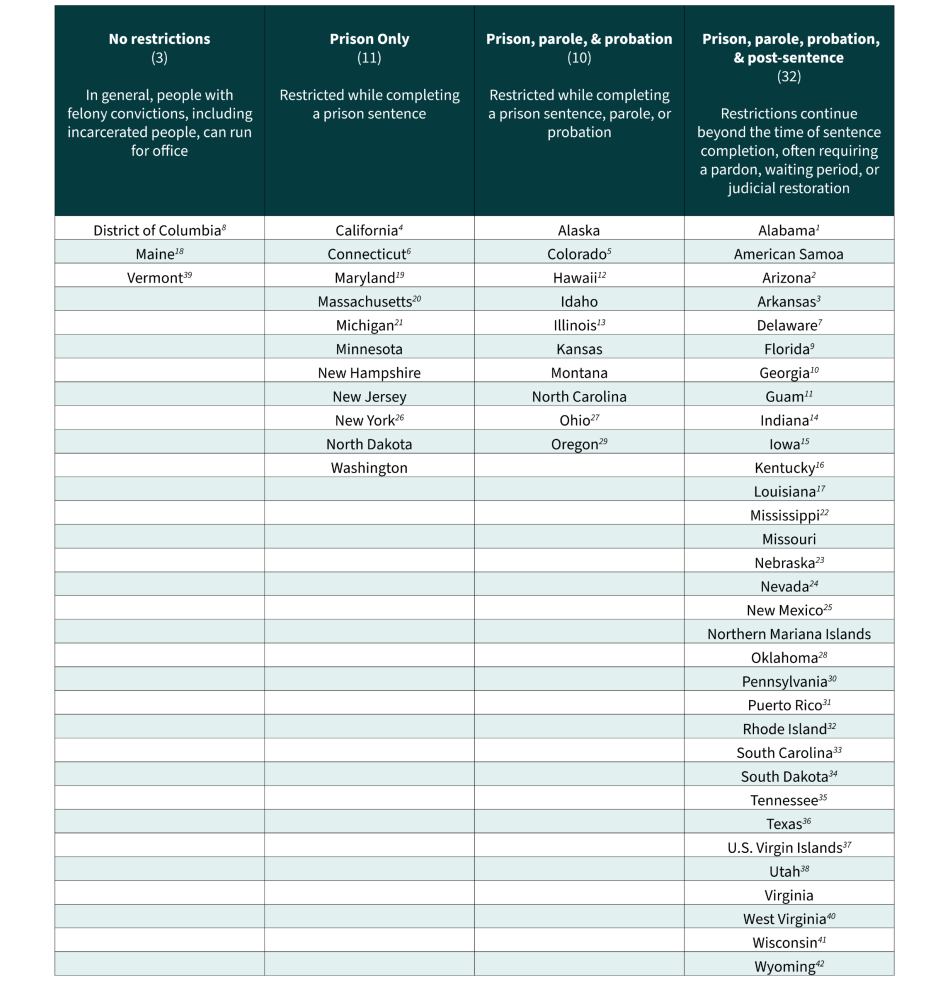
Notes on jurisdiction restrictions on eligibility to run for office:
1Alabama — Restriction is conviction-specific and is keyed to two overlapping categories — disqualification of anyone convicted of “embezzlement of the public money, bribery, perjury, or other infamous crime” and disqualification for those convicted of “treason, embezzlement of public funds, malfeasance in office, larceny, bribery or any other crime punishable by imprisonment in the state or federal penitentiary,” which sweeps in essentially all felonies. Restoration requires an affirmative pardon from the Alabama Board of Pardons and Paroles which may be granted only after sentence expiration or at least three years of parole.
2Arizona — Individuals who have more than one felony conviction or have not paid all restitution may apply to the superior court to have their civil rights restored upon completion of sentence. For individuals with one felony conviction, eligibility to run for office is automatically restored upon completion of the term of probation, or upon an absolute discharge from imprisonment, and upon payment of any restitution.
3Arkansas — Eligibility requires having a conviction record sealed or expunged.
4California — Disqualification applies only to specific felony convictions such as bribery, perjury, forgery, malfeasance in office, and other offenses related to public office.
5Colorado — Individuals currently incarcerated or on parole are ineligible to run for office, while those on probation are eligible. For five enumerated offenses related to embezzlement, bribery, and perjury, a bar applies unless a person has received a pardon.
6Connecticut — Individuals convicted of election-related offenses may face additional requirements before becoming eligible.
7Delaware — A person convicted of “embezzlement of the public money, bribery, perjury or other infamous crime” is ineligible to hold “any office of trust, honor, or profit” in the state. A pardon does not remove this bar.
8District of Columbia — Those convicted of a felony while holding specific public offices are excluded.
9Florida — In 2021, the Florida Board of Executive Clemency approved a change that allows eligible people with past felony convictions to run for public office automatically upon completing their sentences and paying all court-ordered financial obligations. Those with unpaid court-ordered fines and fees, active warrants, pending criminal charges, outstanding detainers, or those convicted of murder or a felony sexual offense do not have their civil rights automatically restored.
10Georgia — A felony involving moral turpitude bars a candidate from holding office unless civil rights have been restored and at least ten years have elapsed from completion of sentence. Eligibility can be restored through a pardon.
11Guam — Disqualifying convictions include felonies, misdemeanors involving criminal sexual conduct, and crimes of moral turpitude.
12Hawaii — Persons convicted of any act, attempt, or conspiracy to overthrow the government are barred from officeholding.
13Illinois — Persons convicted of a felony, bribery, perjury, or other infamous crime are ineligible to hold state office until completion of sentence. A stricter bar limits access to state and local office for persons convicted of such offenses while serving as a public official, removable only by pardon, reversal, or restoration of rights by the Governor. Individuals with felony convictions are also barred from holding municipal office unless they receive a pardon or their rights have been restored by the Governor.
14Indiana — A person may become eligible for office again if their conviction is reversed, vacated, set aside, expunged, or pardoned.
15Iowa -– Since August 2020, Governor Kim Reynolds’s Executive Order 7 automatically restores rights for many with felony convictions upon completion of sentence. Those convicted of homicide and other related crimes under chapter 707 of the Iowa Code must apply directly to the Office of the Governor for rights restoration.
16Kentucky — In 2019, Governor Andy Beshear issued an executive order restoring voting rights and the right to run for office to those who had completed sentences for Kentucky nonviolent offenses. For those convicted of felonies under Kentucky state law that don’t meet the criteria for automatic restoration, as well as those convicted of out-of-state or federal felonies, petition to the Governor is still required. Election-law Class A misdemeanors require a five-year waiting period from conviction.
17Louisiana — Eligibility to run for office is restored if more than five years have elapsed since completion of sentence, including any term of parole or probation.
18Maine — Some local offices restrict candidacy based on convictions. Maine law dictates that candidates for sheriff cannot have a conviction for a Class C or higher crime, covering essentially all felony-level offenses.
19Maryland — Candidacy eligibility is tied to registered-voter status. However, unless they are pardoned, the Maryland Constitution disqualifies persons from running for office if they were convicted of bribery at elections, bribery of public officials, and violation of the constitutional oath of office.
20Massachusetts — In Massachusetts, voting rights and candidacy eligibility are automatically restored upon release from prison. Exceptions include corrupt-practices convictions, which result in a three-year removal from voter rolls, and convictions for bribery or corruption in obtaining office, which result in a bar to holding office. Local home-rule charters may impose additional bars for municipal offices.
21Michigan — Those convicted of a felony involving dishonesty, deceit, fraud, or a breach of the public trust related to their office are barred from running for office for 20 years.
22Mississippi — Mississippi Constitution disqualifies from officeholding any person convicted of “bribery, perjury, or other infamous crime,” i.e., all felonies, except those specifically excluded (manslaughter, IRS violations, state tax violations unless involving misuse or abuse of office), unless pardoned.
23Nebraska — While voting rights are now automatically restored upon completion of a felony sentence, including any parole term, eligibility for office requires an additional step: a pardon from the Nebraska Board of Pardons.
24Nevada — For those convicted of a felony, the right to hold office is not restored until four years after release from prison or discharge from parole or probation, unless unconditionally pardoned. Those convicted of embezzlement of public funds or bribery to procure office are disqualified.
25New Mexico — New Mexico statute contains language that individuals with felony convictions are ineligible to hold public office unless they receive a gubernatorial pardon or a certificate restoring full rights of citizenship. The New Mexico Supreme Court has determined that there are at least two pathways to rights restoration. One pathway is for those who receive and complete criminal sentences.The other is for those who satisfactorily complete the conditions of a deferred sentence and have their charges dismissed. For these individuals, rights are restored without a gubernatorial pardon or certificate. At least one district court has allowed a candidate with a felony conviction to run for office because he was a registered voter. Since 2023, people are eligible to vote immediately after they are released from prison.
26New York — Candidacy bars for people convicted of bribery involving public servants, corrupting the government, or defrauding the government. New York City also disqualifies people convicted of enumerated felonies related to public corruption.
27Ohio — Any felony triggers temporary ineligibility that is restored at final discharge of sentence or by pardon; theft in office and bribery result in a bar on officeholding; and election-related bribery imposes a five-year bar.
28Oklahoma — Fifteen-year wait is required following completion of sentence, except for those who are pardoned. The restriction also applies to misdemeanor embezzlement convictions. Prohibition on running for office for a public officer convicted of receiving a bribe in office.
29Oregon — Eligibility for legislative office is suspended upon conviction and remains suspended until the full sentence has been completed, including any probation, post-prison supervision, and payment of fines. Eligibility is restored for most other offices upon release from prison.
30Pennsylvania — Those convicted of infamous crimes, which have been interpreted to include all felonies, are ineligible to hold any office of trust or profit in the Commonwealth without governor’s pardon.
31Puerto Rico — The Electoral Code requires an affidavit declaring no felony or misdemeanor convictions involving moral turpitude to qualify to run for office.
32Rhode Island — A conviction of or a nolo contendere plea to a felony or conviction of or nolo contendere plea to a misdemeanor resulting in a sentence of six months or more, either suspended or served, is a bar on holding office until three years after the completion of sentence, including probation and parole.
33South Carolina — A person convicted of a felony or specific enumerated election offenses — including if they pled guilty or nolo contendere to any enumerated offense — are disqualified until 15 years or more after the completion of their sentence, including probation and parole, unless pardoned.
34South Dakota — Bar from serving in the legislature for persons convicted of bribery, perjury, or other infamous crime. Bar from any public office for those convicted of bribery, corrupt solicitation of officers, or those impeached.
35Tennessee — A person convicted of a felony is disqualified from running for office until a court restores full rights of citizenship via petition. The right to run for office cannot be restored if convicted of a felony while holding office and the felony was related to the duties of the office.
36Texas — A person finally convicted of a felony that is not currently being appealed may be eligible to run for state or local office only if they have been pardoned or otherwise “released from the resulting disabilities” of their felony conviction. The Texas attorney general issued an opinion19 that a person may be released from disabilities resulting from a conviction: by (1) judicial clemency, (2) an executive pardon, or (3) a certificate of restoration of civil rights, for certain federal offenses and offenses under the laws of another country.
37U.S. Virgin Islands – A conviction of a felony or a crime of moral turpitude restricts office-holding until restoration of rights through a pardon.
38Utah — Eligibility to hold elective office is generally restored if the felony conviction has been expunged or 10 years have passed since the most recent felony conviction; the individual has paid all court-ordered fines and restitution; and for each felony conviction that has not been expunged, the individual has completed probation, been granted parole, or completed the applicable term of incarceration.
39Vermont — Municipal charters set their own eligibility requirements for running for local office.
40Virginia — Qualification for office requires gubernatorial restoration of the individual’s civil rights. A constitutional amendment being considered in November 2026 would, if passed, automatically restore an individual’s civil rights, including voting rights and running for elected office, upon release from prison.
41West Virginia — An individual convicted of a felony can run for office, excluding the state legislature and magistrate, following the completion of their sentence. Those convicted of giving or receiving bribes are disqualified from holding office.
42Wyoming — A felony conviction creates a bar on officeholding. If the felony is a first-time conviction and is nonviolent, a person can have officeholding rights restored after five years.
“As an elected official, I want to show other people who are like me that they can do this too."

Brittanie Bogard
Position: Hopkinsville City Councilmember, Ward 9
Year first elected: 2024
Hopkinsville, Kentucky Councilmember Brittanie Bogard,20 age 40, represents Ward 9 on the Hopkinsville City Council. She is among the first justice-impacted elected officials in the Commonwealth of Kentucky and a member of the Republican Party.
Councilmember Bogard’s early life was marked by multiple traumas. She eventually completed a three-year prison sentence following a parole violation and multiple felony convictions. After her release, she learned welding, survived cancer, and returned to school to earn an associate’s degree. Bogard served as the student regent for the Kentucky Community and Technical College System, where she advocated for policy changes to expand educational opportunities for incarcerated people and people with convictions.
Encouraged by a college professor to share her personal history, Councilmember Bogard’s story resonated with state lawmakers. This access led to legislative testimony and her participation in a high-profile campaign advertisement for Republican gubernatorial candidate Daniel Cameron. Despite their political differences, Governor Andy Beshear ultimately granted Councilmember Bogard a full pardon, a move that enabled her to run for the Hopkinsville City Council. The pardon also restored her voting rights.
Today, she leverages her lived experience to advocate for justice-impacted populations. She has helped over 400 individuals secure expungements and pardons. “As an elected official, I want to show other people who are like me that they can do this too. Running for office was all about the people standing behind me. I serve amongst people who don’t have those lived experiences and cannot advocate for people that have been oppressed by the justice system. When more people like me sit in these seats, they start respecting us.”
Eligibility to Run for Office Compared to Eligibility to Vote
We also looked at how eligibility to run for office in jurisdictions compared to eligibility to vote. Since 1997, 27 states and the District of Columbia have expanded voting rights to some or all people with felony convictions, with over 2 million Americans regaining the right to vote.21
Table 2 shows that in 25 jurisdictions, eligibility to run for office is generally the same as the ability to vote for most people with felony convictions. In the other 31 jurisdictions, eligibility to run for office was substantially different from the eligibility to vote, with candidacy eligibility most often more restrictive than voter eligibility.
For example, in 2026, Missouri restored voting rights to many individuals completing parole and felony probation sentences in their communities.22 For those same individuals, eligibility to seek public office remains effectively out of reach: In Missouri, individuals with felony convictions are ineligible to run for public office23 — a restriction that persists even if they have received a pardon if they pled guilty.24
Table 2: Eligibility to Run for Office Compared to Eligibility to Vote
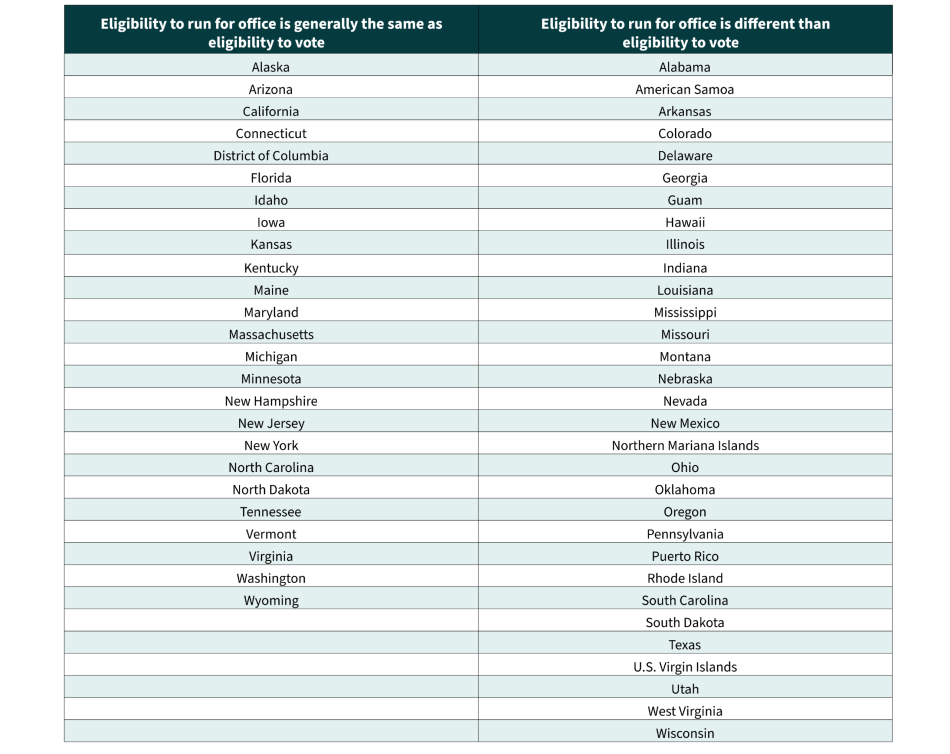
Many states listed under “Eligibility to run for office is generally the same as eligibility to vote” may have narrow exceptions from eligibility to run for office, including disallowing people with convictions related to bribery, theft of public funds, or other crimes related to holding public office.
Most states listed under “Eligibility to run for office is different than eligibility to vote” subject eligibility to run for office to stricter criteria, longer bars, or bars that apply to more offenses than they do to eligibility to vote.
"I’m able to bring a voice to a population that went unheard for decades with mass incarceration.”

Jovan Jackson
Position: Nevada State Assembly, District 6
Year first elected: 2024
Nevada Assemblymember Jovan Jackson,25 age 34, has represented Las Vegas’s historic Westside and North Town in Nevada’s Lower House since 2024. He is the first formerly incarcerated member of the Nevada Assembly and a member of the Democratic Party.
Prior to his incarceration from charges stemming from substance use problems, Jackson worked to connect veterans and others to mental health services. Jackson was released from prison in 2018. Even though he could not vote at the time, he began volunteering on political campaigns and with community organizing efforts, including with Mass Liberation NV, a grassroots criminal justice reform organization. He cites his own experience and desire to advocate for people with criminal justice involvement as a key motivator for running for office. He ran unsuccessfully for Las Vegas City Council in 2022 before being elected to the State Assembly in 2024.
As a legislator, Assemblymember Jackson has prioritized breaking down barriers in employment, housing, and education for those coming out of incarceration. In addition to his work as an Assemblymember, Jackson founded Free to Lead, a nonprofit organization encouraging other justice-impacted people to run for office.
“I was someone who had a mental breakdown with substance abuse; I understand what that person feels like. I understand incarceration. I understand being displaced from your family. You lead with lived experience. I’m able to bring a voice to a population that went unheard for decades with mass incarceration.”
Recommendations
The Sentencing Project recommends that jurisdictions take the following steps to reduce barriers for people with felony convictions who intend to run for office.
1. Remove candidacy bans for people with felony convictions.
Voters should choose their state and local representatives based on the merits of their campaigns and accomplishments. Eligibility to run for state and local office, much like eligibility to run for federal office, should not be determined by conviction or incarceration status. Removing candidacy bans can expand representation to include people with convictions, incarcerated people, and their communities, while encouraging pro-social civic engagement.26
2. Align candidacy eligibility with voting eligibility.
If a jurisdiction is to maintain restrictions, then we recommend eliminating the gap between voting eligibility and candidacy eligibility to reduce public confusion and ensure consistent civil rights restoration. Ultimately, states should end candidacy bans based on conviction status. However, even reducing the lag between voting rights and eligibility to run for office in many states would represent a welcome reform.
3. Clarify statutes and provide public guidance on eligibility to run for office.
In some states, eligibility to run for office is unclear or disputed.27 States should publish clear guidance on who is eligible to vote and to hold public office.
Methodology
This report examines the legal barriers that people with felony convictions may encounter when seeking to run for public office in the United States. To further this research, we enlisted the law firm King & Spaulding to review state constitutions, statutes, election codes, case law, and other relevant legal materials governing eligibility for public office.
The information presented in this report reflects the laws and publicly available information reviewed during the research period between February and May 2026. Because election laws and individual circumstances can change and may be subject to conflicting interpretation, this report should not be understood as legal advice or as a substitute for consulting the laws and election authorities applicable to a particular candidate or jurisdiction.
To determine how the eligibility of individuals with felony convictions to run for public office coincides with their eligibility to vote, we relied heavily on felony disenfranchisement restrictions noted in The Sentencing Project’s Locked Out report.28
| 1. | While this report deals with eligibility of people with convictions to run and serve as elected officials, people with felony convictions also serve as public officials in appointed positions. One example is Foster Bates, who is currently incarcerated in Maine and has served as an appointed member of the Maine Criminal Records Review Committee. See: Maine State Legislature, Office of Policy and Legal Analysis. (2024). Criminal Records Review Committee. |
|---|---|
| 2. | Don Scott, Virginia’s Speaker of the House of Delegates, served eight years in prison in the 1990s for a drug conviction before beginning his career as an elected official. Larché, J. (2025, January 20). ‘God does not give up on any of us’: Don Scott grateful for presidential pardon. WTKR. |
| 3. | In Maine and Vermont, some localities set restrictions on who may run for local office. In DC, those who were convicted of a felony while holding specific public offices are excluded from running for local office. |
| 4. | It is unclear in many jurisdictions whether fines, fees, and restitution must also be paid in addition to serving a sentence of incarceration and post-release community supervision to constitute “completion” of a sentence, although some state statutes make this requirement explicit. |
| 5. | U.S. Term Limits, Inc. v. Thornton, 514 U.S. 779 (1995). |
| 6. | After his release from incarceration, Mr. Castón was appointed to the DC Sentencing Commission. Glasgow, A. (2024, February 26). Joel Castón was incarcerated for 27 years. Then he won a seat on D.C.’s Sentencing Commission. Fast Company. |
| 7. | Office of the Historian, U.S. House of Representatives. (n.d.). The life of Representative Matthew Lyon of Vermont and Kentucky. History, Art & Archives. |
| 8. | Doherty, T. (2023, April 21). Eugene Debs: When a prisoner ran for president. BrandeisNOW. |
| 9. | Panella, C., Berman, T., & Griffiths, B. D. (2024, May 30). You can run for president from prison as a felon. Here’s what happened when 2 candidates campaigned from behind bars. Business Insider. |
| 10. | Indianz.com. (2004, August 3). Peace and Freedom Party selects Peltier as candidate. |
| 11. | Nevada Office of the Attorney General. (n.d.). Voting rights. |
| 12. | Nev. Const. art. IV, § 10. |
| 13. | Neb. Rev. Stat. § 29-112. |
| 14. | Neb. Rev. Stat. § 29-113 (2024). |
| 15. | A nolo contendere or “no contest” plea is one in which an individual does not admit guilt or dispute the charge, but accepts the punishment imposed by the court. |
| 16. | R.I. Const. art. III, § 2. |
| 17. | H. Cunningham (personal communication, May 5, 2026). |
| 18. | Many of these jurisdictions place longer or even permanent restrictions on running for office for individuals convicted of offenses involving a breach of public trust, such as embezzlement, bribery, perjury, fraud, or misuse of public funds. Additional restrictions on running for office may apply at the municipal level or target specific offices and positions, such as sheriff. |
| 19. | Texas Attorney General Opinion No. KP-0251 (2019). |
| 20. | B. Bogard (personal communication, June 15, 2026). |
| 21. | These reforms include: restoration of voting rights to persons completing felony sentences in prison in Washington, DC; expansion of voting rights to individuals on felony probation or parole in at least 13 states; and elimination of lifetime bans or post-sentence “waiting periods” in several other jurisdictions. Twenty-six state changes are documented by Porter, N. D., & McLeod, M. (2023). Expanding the vote: State felony disenfranchisement reform, 1997-2023. The Sentencing Project. In 2024, Nebraska, which had previously ended lifetime disenfranchisement, ended a two-year waiting period for people who have completed their sentence. See: The Sentencing Project. (2024, October 16.) Nebraska Supreme Court upholds law restoring voting rights to thousands. Missouri ended disenfranchisement for many people on parole and felony probation in 2026. See: The Sentencing Project. (2026, July 14). Missouri restores voting rights to thousands, but gaps remain. |
| 22. | House Bill No. 1871, 103rd Gen. Assemb., 2nd Reg. Sess. (Mo. 2026). |
| 23. | Mo. Rev. Stat. § 561.021(2) (2025). |
| 24. | Fletcher v. Young, 689 S.W.3d 161 (Mo. 2024). |
| 25. | J. Jackson (personal communication, March 12, 2026). |
| 26. | While we are not aware of research on eligibility to run for office and recidivism rates, research shows a correlation between eligibility to vote, voting, and positive public safety outcomes. See Budd, K. M., & Monazzam, N. (2023). Increasing public safety by restoring voting rights. The Sentencing Project. |
| 27. | For example, in Texas, a person who has completed their full felony sentence, including probation and parole, is eligible to vote. However, state law disallows those who have not “been pardoned or otherwise released from the resulting disabilities,” a standard that has proven difficult to understand and been unevenly administered. See for instance: Imerman, T. (2021, February 7). Can felons run for public office in Texas? Houston lawmaker trying to clarify the law. Killeen Daily Herald. |
| 28. | Uggen, C., Larson, R., Shannon, S., Stewart, R., & Hauf, M. (2024). Locked out 2024: Four million denied voting rights due to a felony conviction. The Sentencing Project. |


