
Restorative Justice Diversion: A Better Way to Provide Meaningful Accountability for Youth
Restorative justice diversion programs deliver better outcomes for both victims and youth than the traditional juvenile court system—reducing reoffending, increasing victim satisfaction, and promoting meaningful accountability. Yet despite strong evidence, access to these programs remains limited nationwide.
Related to: Youth Justice
Executive Summary
Restorative justice (RJ) diversion programs address adolescent lawbreaking outside the court system using a process designed to address victims’ needs and repair the harm caused by youth misconduct. RJ diversion programs yield far better results, including lower recidivism rates, than juvenile courts which focus on ascertaining guilt and assigning punishments. Nonetheless, restorative justice diversion opportunities remain rare for youth nationwide. This report presents the evidence base that overwhelmingly supports broadening eligibility criteria and making substantial investments to expand the use of RJ diversion, particularly for Black youth, and making it a commonplace approach to addressing adolescent lawbreaking.
Restorative justice refers to a collaborative process for repairing the harm caused by criminal or delinquent offenses rather than determining guilt and imposing punishments. Unlike formal courts, restorative justice interventions bring people together – the person who caused harm and those most affected by it – in a nonadversarial process. The process creates a response plan that addresses the needs of the person(s) harmed and connects the youth to individualized services that support their success and minimize their likelihood of future offending.
RJ diversion involves the use of RJ conferencing as an alternative to formal involvement in the justice system. It can be initiated either before an arrest is made or when court intake officials choose to employ RJ instead of filing a formal case against youth after they have been referred to court on delinquency charges.
Restorative justice diversion is a far more promising approach than formal processing in juvenile courts. Compared to traditional juvenile courts, restorative justice diversion:
- Lowers recidivism and improves youth development outcomes. Controlled evaluations of restorative justice mediation programs in multiple jurisdictions across the United States found reoffense rates were roughly one-third lower than among comparable youth who did not participate, and that subsequent crimes were less severe.1 RJ diversion participants also give it high ratings for fairness.2 Many studies show that higher perceptions of fairness are linked to lower future offending.3
- Imposes meaningful accountability for youth misconduct. The term “accountability” is often conflated with punishment in American discussions of juvenile and criminal justice.4 However, true accountability is not about punishing young people for their misconduct but rather about enabling youth to take responsibility for their behavior, make genuine apologies, repair the harms they have caused, and take steps to get on track and avoid victimizing others.5 All of these elements of accountability are far stronger in restorative justice diversion than in the formal court system.6
- Boosts the satisfaction and well-being of those harmed by youth offending. Research consistently finds victims participating in restorative justice conferencing report far higher rates of satisfaction and far higher perceptions of fairness than victims in conventional court processes.7 Multiple studies have also shown that restorative justice conferencing improves victims’ mental health8 and emotional well-being.9
But restorative justice diversion remains rare for youth; perhaps 150 programs operate nationwide.10 Many programs are small, serving fewer than 25 youth per year. As a result, restorative justice diversion remains unavailable to the vast majority of youth who might benefit.
State support for RJ programming is limited.11 Just seven states – Colorado, Connecticut, Maine, Minnesota, Nebraska, North Dakota, and Vermont – provide significant funding and policy support for RJ diversion. Also, there is reason to believe that RJ diversion opportunities are especially limited for Black youth and other youth of color.12
The time has come for a major investment of time, energy, and money to make restorative justice diversion a common response to adolescent lawbreaking. State legislatures, courts, prosecutors, and probation agencies – as well as philanthropies, human service agencies, and civic organizations – should broaden RJ diversion eligibility criteria and make substantial investments to expand the use of restorative justice diversion, especially for Black youth and other youth of color. Specifically:
- States should emulate pioneers like Colorado, Connecticut, Maine, Minnesota, Nebraska, North Dakota, and Vermont that provide direct funding to develop and support restorative justice diversion programs in local jurisdictions.
- Local justice systems (including courts, prosecutors, and probation agencies) should prioritize restorative justice diversion by expanding eligibility to include youth accused of serious and repeat offenses, referring a substantial number of appropriate youth to RJ diversion programs, and ensuring that RJ diversion programs have reliable and adequate funding.
- Community organizations and their partners in philanthropy and local government should build capacity and provide ongoing support for local providers to offer effective restorative justice programming for youth as an alternative to formal involvement in the justice system.
Part One: Restorative Justice Diversion – A Promising But Underutilized Response to Adolescent Lawbreaking
This report focuses on victim-centered restorative justice diversion. It does so for two reasons: because the outcomes evidence is highly promising; and because this type of intervention offers unique capacity to hold youth accountable in meaningful ways for delinquent behavior while improving the satisfaction and well-being of those harmed by youth misconduct.
A. What is restorative justice diversion, and who is it for?
What is restorative justice? As a general concept, restorative justice (RJ) refers to a collaborative process for repairing the harm caused by criminal or delinquent offenses rather than determining guilt and imposing punishments. Unlike formal courts, restorative justice interventions bring people together –the person who caused harm and those most affected by it – in a nonadversarial process. The process results in a response plan that addresses the needs of the person(s) harmed and connects the youth who committed the offense to individualized services that support their success and minimize their likelihood of future offending.
First introduced in Western democracies 50 years ago,13 restorative justice has been adopted in the court systems of numerous jurisdictions throughout the United States, Europe, and Oceania, primarily for youth, though sometimes for adults as well.14 The definition of restorative justice has broadened over time, and the term is used now to describe a wide variety of interventions that employ related restorative principles and practices. This report focuses only on victim-centered restorative justice interventions that include direct meetings between youth and the persons they have harmed – or at least, surrogate victims who stand in when those harmed choose not to participate.15
| Restorative Justice | Formal Court System |
|---|---|
| Crime violates people and relationships | Crime violates the state and its laws |
| Justice focuses on needs and obligations so things can be made right | Justice focuses on establishing guilt so punishment can be applied |
| The central parties are the victim and the person who caused harm |
The central parties are the state and the defendant |
| Justice is sought through dialogue and mutual agreement |
Justice is sought through a conflict between adversaries |
| Accountability is achieved by making amends and repairing harm |
Accountability is achieved by punishing those who commit crimes |
Sources: Adapted from Seacrest, L. (2023). Justice for all: How restorative justce mutually benefits victims and youth. R Street
What is restorative justice diversion? Restorative justice can work either within the traditional justice system or as an alternative to it when young people’s alleged misconduct is addressed outside of the formal justice system, an option known as diversion or informal processing. This report focuses on the latter. Just under half of delinquency cases referred to juvenile court in the United States are handled informally,16 and overwhelming evidence shows that diversion leads to better youth development outcomes and lower reoffending rates than formal involvement in the court system.17
Restorative justice is just one of several ways that diversion cases can be managed. Often, diverted youth are supervised by a probation department or court services unit and required to adhere to rules and conditions similar (though typically less intensive) to those followed by youth on formal probation caseloads.18 These youth face the threat of being returned to court if they do not comply. Some diverted youth are given warnings and released without any intervention. Others receive a “light touch” diversion such as being required to write an apology letter or attend a workshop.19 In some jurisdictions, a panel of community members20 hears the cases of diverted youth and determines appropriate responses.21
Restorative justice diversion can be initiated by police, schools, or courts. The most established and widely employed restorative justice model is called Victim Offender Mediation, where victims and youth meet and discuss the crime in a safe, structured setting, supported by one or more trained mediators.22 In these meetings, youth explain the circumstances that led to their misconduct, hear from victims about the physical, emotional, and financial impact of the offense; and answer victims’ questions about the incident. The participants then develop a plan for the youth to repair the harm caused by the misconduct and to undertake other activities to minimize the likelihood that the youth will harm others in the future. Other models include Restorative Community Conferencing, Family Group Conferencing, and Sentencing Circles, which focus more on community well-being and include a wider range of participants, either as interested community members, representatives of the criminal legal system, or additional circle keepers.23
For which youth should restorative justice diversion be used? Victim-centered restorative justice diversion is appropriate only when there is:
- an identifiable victim;
- an agreement on the essential facts of the case;
- a willingness by the young person to take responsibility for the offense and to participate in a meeting with the person(s) they have harmed.
RJ diversion is only appropriate in cases where the young person has committed a significant offense that would otherwise be adjudicated in court. Too often, restorative justice diversion programs are limited only to youth accused of minor or first-time offenses.24 Indeed, several state restorative justice statutes restrict restorative justice to first-time, low-level, nonviolent offenses.25 Such restrictions are counterproductive.26 Most youth accused of low-level offenses never return to the justice system.27
A 2017 meta-analysis found that, for young people facing their first charges and those assessed as low-risk, warnings and less intensive diversion responses were more effective than restorative justice models.28 Meanwhile, many studies show that restorative justice diversion can be especially effective with youth accused of serious offenses.29
B. How widely available is restorative justice diversion for youth?
How many programs nationwide offer restorative justice diversion for youth? Unfortunately, no comprehensive database is available to show how many youth participate in RJ diversion, nor the number of RJ diversion programs operating across the United States. The most recent national survey of restorative justice programs, which focused only on victim offender mediation, was completed in 1996. It identified 116 programs nationwide that provided restorative justice diversion to roughly 4,300 youth.30 Today, available evidence suggests that perhaps 150 RJ diversion programs for youth operate nationwide.31 In vast swaths of the nation, RJ diversion is entirely unavailable. Even where RJ diversion programs do operate, many or most programs remain small, serving fewer than 25 youth per year. As a result, restorative justice diversion remains out of reach for the vast majority of youth nationwide who might benefit.
How robustly do states support restorative justice diversion? As of 2020, 42 states and the District of Columbia had enacted 206 statutes to support the use of restorative justice for youth and to embed it in state law.32 However, most of these laws were aspirational. They concentrated primarily on making restorative justice processes an option for system decisionmakers rather than ensuring their widespread use.33 Only a small number of states provide dedicated funding to support RJ diversion programming for youth.34
The Sentencing Project’s review of youth justice systems nationwide found just seven states that offer restorative justice diversion to youth on anything close to a statewide basis.
- Colorado funded an ambitious restorative justice diversion pilot program from 2014-2020, and restorative justice diversion programs are operating in at least 15 judicial districts (as of September 2025).35
- Connecticut has trained more than 2,000 staff and volunteers on restorative justice since 2020.36 In 2025, the state issued new protocols that will make restorative justice a core element in diversion programs statewide.37
- Maine provided grants totaling more than $1 million in 2024 to six restorative justice provider organizations providing restorative justice diversion for youth.38
- Minnesota created a new Office of Restorative Practices in 2023,39 and it distributed $4 million per year in 2024 and 2025 for local RJ programming.40 A statewide report on restorative justice programming found that RJ diversion programs served more than 900 youth statewide in fiscal years 2021 through 2024.41
- Nebraska has provided funding for six regional restorative justice programs since 2018 as part of its statewide Victim Youth Conferencing program. In the first three years, half of the programs included programming for youth at the diversion stage.42
- North Dakota’s state Supreme Court has funded a statewide restorative justice program since 199943 that involves more than 200 accused youth per year in victim-centered restorative diversion.44
- Vermont, which has long given restorative justice a central place in its justice system,45 will begin for the first time in 2026 to provide funds specifically for pre-charge restorative justice diversion programming – with $1.2 million allocated in year one to support diversion programs for youth and adults programs in 14 of the state’s 16 counties.46
(See linked resource, “Noteworthy State Investments in Restorative Justice Diversion,” for more details about state support.)
Limited restorative justice diversion opportunities for Black youth and other youth of color. Though nationwide data are unavailable on participation in RJ diversion by race, there is reason to believe that expanding RJ diversion is particularly important for Black youth and other youth of color. Regarding the use of diversion generally, compelling evidence shows that Black youth are significantly less likely to be diverted than their white peers, even after controlling for their offending histories and other characteristics.47 These disparities in diversion play an important role in exacerbating racial disparities in youth incarceration.48 And in all seven of the states that provide substantial support for RJ diversion, Black youths’ share of the youth population is lower than the national average.49 Equal Justice USA, which coordinated a national network of RJ diversion programs before closing its doors in 2025 due to cuts from the Trump Administration,50 argued that reducing the criminalization of Black, Indigenous and other youth of color should be “one of the primary goals” of RJ diversion.51
Part two: What does research say about the results of restorative justice diversion?
The available research provides strong evidence that restorative justice diversion for youth yields better results than formal processing in juvenile courts. This evidence derives from two sources. First are studies directly tracking outcomes specifically among youth in restorative justice diversion programs. Second is the larger body of research on all types of diversion, which shows that steering youth away from the formal justice system leads to better youth development outcomes and lower recidivism.
Restorative justice diversion programs for youth tend to lower recidivism. Fairly evaluating the impact of restorative justice diversion is difficult due to the risk of selection bias – disproportionately focusing on those youth most likely to succeed. Nonetheless, a preponderance of evidence from an extensive body of research spanning several decades shows that diverting youth away from the justice system and into well-run restorative justice diversion programs can reduce the likelihood of future offending.52
Controlled evaluations of victim offender mediation programs for youth in multiple jurisdictions across the United States have found that participants’ reoffense rate was roughly one-third lower than for comparable youth who did not participate, and that subsequent crimes were less severe.53 A 2016 meta-analysis involving 21 outcome studies, most of them in the United States, found that diversionary restorative justice conferencing programs for youth “are generally effective at reducing juvenile recidivism.”54
A small share of studies on restorative justice diversion show no statistically significant difference, and a few studies actually show worse outcomes.55 This inconsistency is predictable given that the success of restorative justice conferencing depends heavily on careful preparation of youth and persons harmed ahead of the conference and skillful mediation during the conference.56 Historically, the quality of RJ programs has been uneven.57
Studies of several strong programs that are still operating today find that youth diverted to quality restorative justice programming are far less likely to reoffend than comparable youth sent to delinquency court. For instance, a 2023 study in Hennepin County (Minneapolis), Minnesota, found that youth referred to RJ diversion – including those who failed in diversion and those who succeeded – were only half as likely to be rearrested (18% vs. 36%) as youth in a comparison group processed in juvenile court.58 A 2022 study of a restorative conferencing diversion program in San Francisco found that participating youth – all of them accused of felony offenses – were 44% less likely to be rearrested within six months than youth prosecuted in court.59 Strong evidence has also been documented for current RJ diversion programs in Los Angeles, Oakland, and Philadelphia.60
Benefits of diversion generally. As The Sentencing Project documented in two recent reports,61 the evidence is now overwhelming that youth who are diverted from court are far more successful than comparable youth who get arrested and have cases filed in juvenile court. Diversion reduces subsequent justice system involvement.62 In addition, diversion leads to far better education and career outcomes than arrests and formal processing in court.63
Added benefits of restorative justice diversion. Participating in restorative justice offers important benefits beyond those offered by other diversion approaches. Restorative justice diversion participants have given it high ratings for fairness.64 Many studies show that higher perceptions of fairness are linked to lower future offending.65 Also, the experiences of meeting the persons they’ve harmed, issuing a genuine apology, and working with victims to craft a reparative response help youth in RJ diversion programs develop empathy and build psychosocial maturity66– which have been identified as critical factors in desisting from delinquency.67
Indeed, studies generally find restorative justice diversion programs achieve even better outcomes than other diversion alternatives. In New Mexico, for instance, youth participating in restorative justice diversion proved 36% less likely to recidivate than a comparison group participating in a non-restorative diversion program.68 In Indianapolis, youth randomly assigned to restorative justice diversion were 33% less likely to be arrested than youth assigned to other diversion programs.69
New Study Shows Powerful Success of RJ Diversion in St. Paul
A new study finds that a restorative justice diversion initiative in Ramsey County, Minnesota (St. Paul), is sharply lowering recidivism and reducing disparities in the local youth justice system.
Released in early 2026, the study evaluated the success of Ramsey County’s revamped community accountability program, a diversion alternative that now includes restorative justice. The authors found that among youth arrested on first-time assault charges, those who participated in restorative justice diversion were two-thirds less likely to recidivate than those whose cases were processed in juvenile court. Among youth facing more serious charges (felony or gross misdemeanor), RJ diversion participants were half as likely to recidivate. Also, thanks to the new RJ diversion track and other changes introduced as part of its “(Re)Imagining Youth Justice” initiative in 2021, Ramsey County has increased the use of diversion for felony cases, and it has reduced racial disparities in the share of youth participating and succeeding in diversion.
“[O]ur findings add to a growing evidence base that community-based restorative justice diversion… is one of the most effective options for responding to youth with legal system contact whose cases might otherwise be processed through the traditional court system,” the study concludes.
Source: Beckman, K. and Freese, R. (2026). (Re)Imagining justice for youth impact report. Center for Healthy Youth Development, University of Minnesota Medical School.
Part three: What are restorative justice’s advantages over courts regarding accountability?
A number of factors help explain why replication of restorative justice diversion has remained limited within U.S. youth justice systems. These factors include: low public awareness and support for either restorative justice or diversion in the general population;70 lack of dedicated funding for restorative justice diversion providers;71 lack of consistent case referrals from police and justice systems partners;72 difficulty sustaining a cadre of well-trained volunteer moderators, upon which many programs rely;73 and skepticism on the part of judges, prosecutors, and other members of the legal profession.74
Arguably the biggest barrier to wholesale expansion of restorative justice diversion, however, is a media and political environment that often fuels perceptions that restorative justice and diversion in general are soft responses to delinquent conduct75 that fail to hold youth accountable or to deter continued lawbreaking.76
Restorative justice “is often portrayed negatively in the media, seen as a soft option and a means for those in power to avoid punitive measures,” argued researcher Lauren Boos and Sociologist James Tuttle, both at the University of Montana, in 2024.77 Echoing similar concerns from other scholars,78 the authors lamented that the heavy focus on crime and violence in American media “inflates public fear, generates support for punitive policies, and allows politicians to benefit from using fear of crime as a political platform.”79
A. What is accountability?
In American discussions of juvenile and criminal justice, the term “accountability” is often conflated with punishment.80 Yet, an overemphasis on punishment can undermine the imposition of meaningful accountability. True accountability is not about punishing young people for their misconduct but rather about enabling youth to take responsibility for their behavior, make genuine apologies, repair the harms they have caused, and take steps to get on track and avoid victimizing others. All of these elements of accountability are far stronger in restorative justice diversion than in the formal court system.
“[A]ccountability practices in juvenile justice should be designed specifically for juvenile justice… and should be designed to promote healthy social learning, moral development, and legal socialization during adolescence,” the National Academy of Sciences has written. Furthermore, the National Academy argued, harsh interventions and negative interactions with justice system officials can “undermine respect for the law” among young people and “reinforce a deviant identity and social disaffection.”81
Danielle Sered, a leader in the U.S. restorative justice movement, explains that “Being punished only requires that people sustain the suffering imposed upon them for their transgression. It is passive… It requires neither agency nor dignity, nor does it require work.”82 By contrast, Sered says, accountability requires action from those who have committed offenses. Specifically, Sered argues that accountability requires those who have caused harm to acknowledge responsibility for their actions and their impact on others; express genuine remorse; take actions to repair the harm to the degree possible; and desist from causing similar harm in the future.83
These steps toward accountability are especially important for youth. Adolescent lawbreaking is closely linked to emotional (or psychosocial) maturity – the abilities to control impulses, delay gratification, resist peer pressure and – most importantly – consider the impact of one’s behavior on others.84 Restorative justice approaches meet youths’ developmental needs by allowing them to hear directly from victims, as well as their own family members and other caring adults in the community, about the harm their behavior caused. RJ approaches also give youth opportunities to “take accountability while also practicing empathy.”85
B. Absence of accountability in juvenile courts
The conventional process followed in juvenile courts nationwide is poorly configured to deliver any of the core elements of accountability detailed above.
- Acknowledging responsibility. Youth who go through the formal court process are seldom required to acknowledge responsibility for their actions. Rather, most cases are resolved prior to court through plea agreements between prosecutors and defense attorneys. Youth rarely participate in the process in any meaningful way.86
- Acknowledging the harms of their behavior. Because victims play only a tangential role in the process, youth in the court process are seldom asked to grapple with the impact of their misbehavior on those harmed by their offenses, or on their parents, families, and communities.
- Expressing genuine remorse. The court process rarely offers opportunity or support for youth to make meaningful apologies to those they have harmed.
- Repairing harms. Neither probation supervision nor placement into a residential facility typically involve youth in repairing the harms they have caused. Probation supervision requires young people to comply with an often long list of rules and conditions and to participate in required activities.87 Youth on probation may be ordered to pay restitution, but compliance with those orders is typically low.88 Youth sent to residential placement are rarely assigned to complete any action to repair the harms of their offenses – only to endure their period of confinement.89
- Reducing recidivism: While probation and residential confinement facilities both seek to minimize reoffending, overwhelming research shows that neither is effective. Research on juvenile probation supervision shows that it is less effective than diversion in reducing the likelihood of reoffending,90 and probation is no more effective than other community sanctions such as fines or community services.91 Research on juvenile confinement shows that, despite exorbitant costs of confinement, incarceration during adolescence actually undermines young people’s future success and well-being, and it increases their likelihood of recidivism.92
Juvenile courts and corrections systems are poorly aligned with recent findings about adolescent brain development and behavior. Juvenile court hearings typically follow complex rules and employ confusing legal terminology.93 This complexity can feel demeaning for young people, and it can violate their sense of procedural fairness and therefore increase their odds of reoffending.94 Slow court processes often leave a long time gap between the date of the offense and any tangible response in the young person’s life.95 This gap can “limit an adolescent’s ability to connect consequences with [their] initial behavior”96 and increase their likelihood of reoffense.97 Juvenile probation, the most common outcome for delinquency court cases, contradicts many of the principle lessons of adolescent behavior and brain research with its heavy emphasis on rule compliance.98
Appropriately, many youth formally processed in juvenile court do not face additional consequences. Only about half of all delinquency cases referred to juvenile courts nationwide each year are adjudicated delinquent (the equivalent of being found guilty in criminal court).99 More than half of the remaining cases are dismissed without any official disposition or sanction.100 These figures reflect the reality that many delinquency cases involve only minor misconduct,101 which judges and other court officials understand can be best addressed outside the court system.
C. Restorative justice diversion provides more developmentally appropriate accountability for youth
In a 2024 research brief, the Council of State Governments concluded that “Restorative justice practices that involve direct victim engagement or mediation… are more effective at ‘holding youth accountable’ than punitive approaches, such as a long list of probation conditions, detention, or electronic monitoring, that don’t provide any proven benefits for public safety, youth outcomes, or victims.”102 Specifically, restorative justice diversion offers several advantages over the standard process employed by juvenile courts:
- High likelihood of a meaningful consequence. The large majority of youth who enroll in restorative justice diversion programs participate in a restorative conference where they forge an agreement to repair the harms of their offense and complete other activities to help them avoid reoffending. In Nebraska, for instance, 677 of 871 youth (78%) referred for restorative justice diversion from 2018 to 2021 participated in a conference, and virtually all of them (99%) forged a restorative agreement.103
- Community involvement and support. Community members can play an important role in restorative diversion, often mentoring youth after the conference and supporting them to complete their restorative agreements. A study by criminologist Nancy Rodriguez, professor at the University of California, Irvine, concluded that, as a result, youth “realize the harm produced by their crime and also recognize they are part of a larger community that seeks to identify the services and treatment they need to cease criminal activity.”104
- Opportunities to meet their victims and make things right. In a 2011 study examining a restorative justice diversion program in the Midwest, scholars found that the experience of meeting their victims had a positive and profound impact: “[T]he youths were able to construct a new meaning of their crimes after hearing the victims’ reality, which helped them develop a sense of empathy for their victims.”105 Youth participating in restorative justice diversion also benefit from the opportunity to make genuine and meaningful apologies to their victims: in one study, youth in restorative justice programs were three times as likely to apologize to their victims than youth in court, and victims were twice as likely to forgive the youth.106
- Far greater compliance with restitution and community service. Reflecting the greater emotional salience that restorative justice diversion holds for youth,107 those who participate in restorative justice programs complete restitution and community service at far higher rates than youth ordered to do so by courts. In one California evaluation, youth in restorative justice diversion paid more restitution than youth charged in court in all six counties studied.108 Another California restorative justice diversion program evaluated in 2018 found that youth restorative justice diversion paid 74% of their required restitution, versus just 6% for youth required to pay restitution by the juvenile court.109
- Stronger sense of procedural justice. Youth who participate in restorative justice conferencing give it high ratings for fairness. Evaluation studies consistently find that perceptions of fairness are substantially higher in restorative justice programs than in juvenile courts.110
In their own words: Youth talk about restorative justice diversion
“[The restorative conference] kind of gave me good punishment … being able to converse with victims and seeing their point of view, because that really changes your perspective… it makes you feel bad, but then makes you want to help repairs [sic] and it just makes you feel good.”
‘‘Instead of just sitting there and talking, yelling at us and alright that was our punishment [in court]… [the restorative conference] shows you what was wrong with what you did… You just didn’t take your punishment, you learned from it.’’
– Two youths who vandalized a neighboring family’s mailbox
Source for both quotes: Choi, J., Green, D., & Gilbert, M. (2011). Putting a human face on crimes: A qualitative study on restorative justice processes for youths. Child and Adolescent Social Work Journal 28(5), 335-355.
Part four: What is best for victims?
In addition to its many benefits for youth, public safety, and accountability, restorative justice diversion is also a superior approach for the victims of adolescents’ crimes.
Victim Satisfaction. Research consistently finds that victims participating in restorative justice conferencing report far higher rates of satisfaction and far higher perceptions of fairness than victims in conventional courts processes.111 A 2017 meta-analysis of research on restorative justice programs for youth found that: “Victims have improved perceptions of fairness, greater satisfaction, improved attitudes toward the juvenile offender, are more willing to forgive the offender, and are more likely to feel that the outcome was just than victims of youth processed by the traditional juvenile justice system.”112
Studies of current programs further highlight the high degree of victim satisfaction routinely achieved by restorative justice diversion programs. At Centinela Youth Services in Los Angeles, 97% of victims surveyed after participating in restorative justice diversion rated the program as either excellent or good.113 In the Community Works West RJ diversion program in Oakland, California, 97% of victims rated the conferencing process as fair, and 94% called it meaningful.114
Giving Victims What They Really Want and Need. Contrary to the popular perception that victims are motivated primarily by desire for harsh punishments,115 victims report that they care far less about punishments than about how they themselves are treated in the justice process.116 Specifically, research finds that victims’ primary concerns are:117
- Information about developments in their cases. Victims whose cases go to court often express frustration at the failure of criminal justice authorities to provide information about their cases.118
- Meaningful participation in their cases. “The chance to be heard at all is usually the crucial aspect for victims in achieving a sense of satisfaction with the justice system,“ found one study, and participating in restorative conferencing allows victims “to feel in control, well informed and empowered as a relevant party when decisions [are] being made regarding their case.”119
- Emotional restoration and healing, ideally through a genuine apology from the young person who committed the offense.120
- Material reparation for any lost or damaged property, ideally from the person who caused the harm, rather than from the state.121
- Reducing the likelihood of reoffense. Many victims’ primary motivation in the justice process is to minimize the likelihood that the person who victimized them will harm others in the future.122
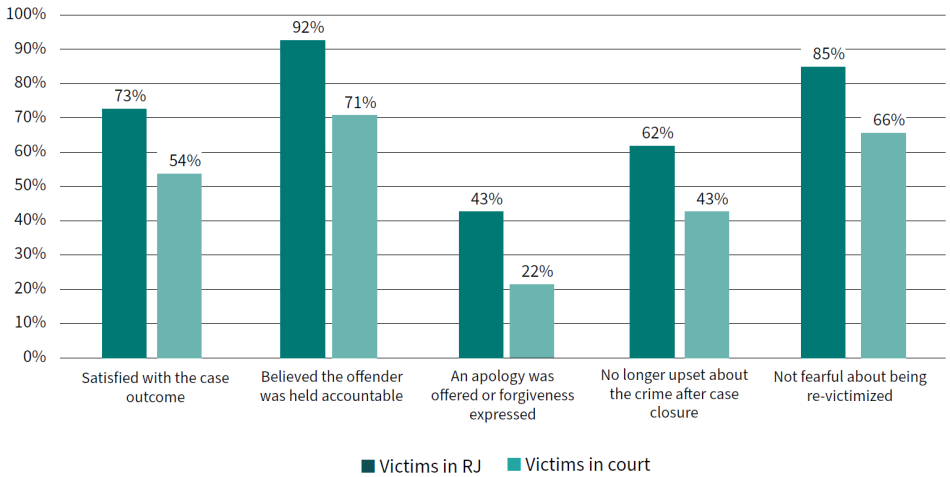
Improving Victims’ Mental Health and Well-Being. Restorative justice conferencing has been shown in multiple studies to improve victims’ mental health and emotional well-being. Several evaluations show that after participating in restorative justice mediation programs, victims are far less likely than victims whose cases went to court to feel angry or fear being revictimized by the young person who harmed them (see Figure below).123
Victim Satisfaction: Restorative Justice vs. Standard Court Processing
Source: Adapted from Poulson, B. (2003). A third voice: A review of empirical research on the psychological outcomes of restorative justice. Utah Law Review, 167–204.
A 2023 review of research on the psychological impact of restorative justice found that participating in restorative justice led to significant reductions in symptoms of post-traumatic stress disorder as well as decreases in negative emotions such as fear, anger, guilt, anxiety, and distress.124 Victims who participated in restorative justice also had less desire for revenge against their assailants, and a greater sense of security and empowerment.125
Summing up the research on victims’ positive experiences in youth restorative justice conferencing cases, a team of scholars led by Mark Umbreit, a professor of social work at the University of Minnesota, reported that “Across multiple sites and cultures, among many different kinds of victims, on the whole, victims who choose to participate in [restorative justice conferencing] walk away quite satisfied with the process and the results of their encounter with the criminal justice system.”126
Conclusions and recommendations
On one metric after another, the evidence all points in the same direction: restorative justice diversion is a far more promising approach than formal processing in juvenile courts. Restorative justice diversion reduces youth reoffending. It improves educational outcomes for youth. It does a better job than the courts of boosting both the satisfaction and well-being of those harmed by youth offending. Most importantly, RJ diversion does much more than the courts to impose meaningful accountability for youth misconduct.
State legislatures, courts, prosecutors, and probation agencies – as well as philanthropies, human service agencies, and civic organizations – should prioritize broadening RJ diversion eligibility criteria and make substantial investments to expand the use of restorative justice diversion. All stakeholders should work together to make RJ diversion a commonplace approach to addressing adolescent lawbreaking, especially for Black youth and other youth of color. Specifically:
- States should emulate pioneers like Colorado, Connecticut, Maine, Minnesota, Nebraska, North Dakota, and Vermont that have provided direct funding to develop and support restorative justice diversion programs in local jurisdictions.
- Local justice systems (including courts, prosecutors, and probation agencies) should prioritize restorative justice diversion by expanding eligibility to include youth accused of serious and repeat offenses, increase youth referrals substantially – especially for Black youth and other youth of color – to RJ diversion programs, and ensure that RJ diversion programs have reliable and adequate funding.
- Community organizations and their partners in philanthropy and local government should build capacity and provide ongoing support that enables local providers to offer effective restorative justice programming for youth as an alternative to formal involvement in the justice system.
Together, these investments and reforms to expand the use of restorative justice diversion can improve outcomes and bring real accountability to youth justice systems nationwide.
| 1. | Umbreit, M. S. & Coates, R. B. (1993). Cross-site analysis of victim-offender mediation in four states. Crime & Delinquency, 39(4), 565-585. https://doi.org/10.1177/0011128793039004010; Nugent, W. R., Umbreit, M. S., Wiinamaki, L., & Paddock, J. (2001). Participation in victim-offender mediation and reoffense: Successful replications? Research on Social Work Practice, 11(1), 5-23. https://doi.org/10.1177/104973150101100101. |
|---|---|
| 2. | Poulson, B. (2003). A third voice: A review of empirical research on the psychological outcomes of restorative justice. Utah Law Review, 167–204; Kimbrell, C. S., Wilson, D. B., & Olaghere, A. (2023). Restorative justice programs and practices in juvenile justice: An updated systematic review and meta‐analysis for effectiveness. Criminology & Public Policy, 22(1), 161-195. DOI:10.1111/1745-9133.12613. |
| 3. | Fagan, J. & Tyler, T. R. (2005). Legal socialization of children and adolescents. Social Justice Research, 18(3), 217-241. DOI:10.1007/s11211-005-6823-3. |
| 4. | National Research Council. (2013). Reforming juvenile justice: A developmental approach. National Academies Press, p. 183. DOI: 10.17226/9629. |
| 5. | Sered, D. (2017). Accounting for violence: How to increase safety and break our failed reliance on mass incarceration. Common Justice & Vera Institute of Justice, p.17. |
| 6. | Weber, J. (2024). Restorative justice practices and credible messengers: Promising, innovative approaches for improving outcomes for youth in the juvenile justice system: A review of current research. Council of State Governments Justice Center. |
| 7. | Poulson, B. (2003). A third voice: A review of empirical research on the psychological outcomes of restorative justice. Utah Law Review, 167–204; Kimbrell, C. S., Wilson, D. B., & Olaghere, A. (2023). Restorative justice programs and practices in juvenile justice: An updated systematic review and meta‐analysis for effectiveness. Criminology & Public Policy, 22(1), 161-195. DOI:10.1111/1745-9133.12613. |
| 8. | Nascimento, A. M., Andrade, J., & de Castro Rodrigues, A. (2023). The psychological impact of restorative justice practices on victims of crimes—a systematic review. Trauma, Violence, & Abuse, 24(3), 1929-1947. DOI:10.1177/15248380221082085. |
| 9. | Poulson, B. (2003). A third voice: A review of empirical research on the psychological outcomes of restorative justice. Utah Law Review, 167–204. |
| 10. | This estimate is based on a review of the 197 restorative justice service providers in a list compiled by the National Association of Community and Restorative Justice (NACRJ). Of these, 66 organizations clearly operate RJ diversion programs for youth. Another 19 may offer RJ diversion for youth. (Neither their websites nor an internet search provided sufficient information to determine if these organizations offer RJ programming for youth at the point of diversion.) If half of these 19 organizations provide RJ diversion for youth, then 75 organizations from this list operate RJ diversion for youth. The remaining 112 entities on the list did not provide RJ diversion services for youth (and were oriented instead to adults or in non-court settings such as schools and communities, or to youth but only as part of a court process rather than diversion). The NACRJ list is substantially incomplete, however. Comparing the full NACRJ list of 197 RJ providers to known RJ diversion program providers in selected jurisdictions revealed that approximately half of the providers were included. For instance, the NACRJ list included just three of the six RJ diversion program providers in Maine that were identified in a 2025 report. Also, the list included providers in just seven of the 15 judicial districts in Colorado that are known to offer RJ diversion programming for youth. Likewise in Nebraska, the list included three of six agencies receiving state support for RJ programming for youth, as identified in a 2021 evaluation report. We therefore doubled the provided number of 75 organizations to estimate that roughly 150 organizations nationwide provide RJ diversion for youth. Sources: National Association of Community and Restorative Justice (n.d.) Restorative Justice Map and Directory; Permanent Commission on the Status of Racial, Indigenous, and Tribal Populations gonzal(2025). Restorative justice: An examination: A report to the Maine legislature; Jimenez, A. C. (2021). Victim youth conferencing evaluation. State of Nebraska Judicial Branch, Office of Dispute Resolution. |
| 11. | González, T. (2020). The state of restorative justice in American criminal law. Wisconsin Law Review, 6, 1147; Koza, M., Kokkalera, S. S., & Navarro, J. C. (2024). The promise of alternatives for youths: An analysis of restorative justice practices in the United States. Juvenile and Family Court Journal, 75(3), 23-36. DOI:10.1111/jfcj.12268. |
| 12. | Nationwide among youth referred to courts on delinquency charges, Black youth are far less likely than their white peers to be offered any type of diversion. And in all seven of the states that provide significant support for RJ diversion, the Black share of the youth population is below the national average. |
| 13. | McCold, P. (2001). Primary restorative justice practices. Restorative Justice for Juveniles. In A Morris & G. Maxwell (eds.), Restorative Justice for Juveniles: Conferencing, Mediation and Circles, Hart Publishing, Oxford, 41-58. |
| 14. | Hansen, T. & Umbreit, M. (2018). State of knowledge: Four decades of victim‐offender mediation research and practice: The evidence. Conflict Resolution Quarterly, 36(2), 99-113. DOI:10.1002/crq.21234. |
| 15. | Sometimes the label “restorative justice” is applied to community panels and other interventions that incorporate restorative principles such as repairing harm, but do not involve direct meetings with victims or their surrogates. Those interventions are not the focus of this report. |
| 16. | Puzzanchera, C., Sladky, A., & Kang, W. (2024). Easy access to juvenile court statistics(EZAJCS): 1985-2022 U.S. Office of Juvenile Justice and Delinquency Prevention. |
| 17. | Mendel, R. A. (2022). Diversion: A Hidden Key to Combating Racial and Ethnic Disparities in Juvenile Justice. The Sentencing Project. |
| 18. | These diversion agreements might include restitution or community service, individual or family counseling, anger management or other cognitive–behavioral training, mandatory school attendance, and regular meetings with a probation or court diversion worker. |
| 19. | Mendel, R. A. (2018). Transforming juvenile probation: A vision for getting it right. Annie E. Casey Foundation. |
| 20. | Children First (2025). Juvenile diversion: A smart approach to reducing crime; Tow Youth Justice Institute (2021). Issue brief: JJ reform and the importance of the community based diversion system. |
| 21. | See for instance, Connecticut Youth Services Association (2016). Juvenile review board policies and procedures. |
| 22. | Hansen, T. & Umbreit, M. (2018). State of knowledge: Four decades of victim‐offender mediation research and practice: The evidence. Conflict Resolution Quarterly, 36(2), 99-113. DOI:10.1002/crq.21234. |
| 23. | Kimbrell, C. S., Wilson, D. B., & Olaghere, A. (2023). Restorative justice programs and practices in juvenile justice: An updated systematic review and meta‐analysis for effectiveness. Criminology & Public Policy, 22(1), 161-195. DOI:10.1111/1745-9133.12613. |
| 24. | Koza, M., Kokkalera, S. S., & Navarro, J. C. (2024). The promise of alternatives for youths: An analysis of restorative justice practices in the United States. Juvenile and Family Court Journal, 75(3), 23-36. DOI:10.1111/jfcj.12268. |
| 25. | Koza, M., Kokkalera, S. S., & Navarro, J. C. (2024). The promise of alternatives for youths: An analysis of restorative justice practices in the United States. Juvenile and Family Court Journal, 75(3), 23-36. DOI:10.1111/jfcj.12268. |
| 26. | Seigle, E., Walsh, N., & Weber, J. (2014). Core principles for reducing recidivism and improving other outcomes for youth in the juvenile justice system. Council of State Governments Justice Center; and Béchard, S., Ireland, C., Berg, B., & Vogel, B. (2011). Arbitrary arbitration: Diverting juveniles into the justice system–A reexamination after 22 years. International Journal of Offender Therapy and Comparative Criminology, 55(4), 605-625. |
| 27. | 63% of youth referred to juvenile courts for a first offense never return to court for a subsequent charge. Puzzanchera, C. & Hockenberry, S. (2022). Patterns of juvenile court referrals of youth born in 2000. US Department of Justice, Office of Justice Programs, Office of Juvenile Justice and Delinquency Prevention. |
| 28. | Wilson, D. B., Olaghere, A., & Kimbrell, C. S. (2017). Effectiveness of restorative justice principles in juvenile justice: A meta-analysis. George Mason University. |
| 29. | Beckman, K., Hanson, A., & McMorris, B. J. (2025). Reimagining youth justice in Hennepin County: Modeling the impact and effectiveness of prosecutorial responses. Division of General Pediatrics and Adolescent Health, School of Medicine, University of Minnesota; Sherman, L. W., Strang, H., Barnes, G., Woods, D. J., Bennett, S., Inkpen, N., Newberry-Birch, D., Rossner, M., Angel, C., Mearns, M., & Slothower, M. (2015). Twelve experiments in restorative justice: the Jerry Lee program of randomized trials of restorative justice conferences. Journal of Experimental Criminology, 11(4), 501-540. DOI:10.1007/s11292-015-9247-6. |
| 30. | Umbreit, M. S., & Greenwood, J. (1999). National survey of victim‐offender mediation programs in the United States. Mediation Quarterly, 16(3), 235-251. |
| 31. | See note 10. |
| 32. | González, T. (2020). The state of restorative justice in American criminal law. Wisconsin Law Review, 1147. |
| 33. | González, T. (2020). The state of restorative justice in American criminal law. Wisconsin Law Review, 1147; Koza, M., Kokkalera, S. S., & Navarro, J. C. (2024). The promise of alternatives for youths: An analysis of restorative justice practices in the United States. Juvenile and Family Court Journal, 75(3), 23-36. DOI:10.1111/jfcj.12268. |
| 34. | Koza, M., Kokkalera, S. S., & Navarro, J. C. (2024). The promise of alternatives for youths: An analysis of restorative justice practices in the United States. Juvenile and Family Court Journal, 75(3), 23-36. DOI:10.1111/jfcj.12268. |
| 35. | These 15 programs were found online in September 2025 using links found on the National District Attorney’s Association’s “Mapping Prosecutor-Led Diversion” webpage; an online listing of “Colorado Diversion Programs and Contacts” posted by the Colorado Judicial Branch, the National Association of Community and Restorative Justice’s Restorative Justice Map & Directory or the Prison Fellowship or the Prison Fellowship’s Restorative Justice Programs in Your State webpage. |
| 36. | Email to the author from Erica Bromley, Connecticut Youth Services Association, September 24, 2025. |
| 37. | Connecticut Youth Services Association (2025). Trauma-informed restorative diversion: Standard protocols and procedures for youth diversion teams. |
| 38. | Permanent Commission on the Status of Racial, Indigenous, and Tribal Populations (2025). Restorative Justice: An Examination: A Report to the Maine Legislature. |
| 39. | |
| 40. | Minnesota Department of Children Youth, and Families (n.d.). Restorative Practices (webpage). This allocation was reduced to $1 million per year beginning in FY 2026. Minnesota Department of Children Youth, and Families Office of Restorative Practices Division(2025). Request for Proposals for a Grantee to Provide Restorative Practices Initiatives through collaborative and inclusive approaches. |
| 41. | Liberation Lab. (2025). The State of Restorative Practice in Minnesota in 2025. Department of Pediatrics and School of Social Work, University of Minnesota, Minneapolis, MN. |
| 42. | Jimenez, C. A. (2021). Victim youth conferencing evaluation. State of Nebraska Judicial Branch, Office of Dispute Resolution. |
| 43. | Friesz, Joel (July 22, 2020). Testimony Related to Restorative Justice. Judiciary Committee, North Dakota State Legislature. |
| 44. | In addition, North Dakota requires many diverted youth to participate in victim empathy seminars, which served 181 young people in 2024. North Dakota Juvenile Court (n.d.). 2024 Annual Report. |
| 45. | Who We Are (n.d.), Vermont Community Justice Network. |
| 46. | Emails to the author from Willa Farrell, Community Justice Unit Director, Vermont Association of Court Diversion and Pretrial Services, September 10, 2025 and September 15, 2025. |
| 47. | Mendel, R. A. (2022). Diversion: A Hidden Key to Combating Racial and Ethnic Disparities in Juvenile Justice. The Sentencing Project; and Mendel, R. A. (2024). Protect and Redirect: America’s Growing Movement to Divert Youth Out of the Justice System. The Sentencing Project. |
| 48. | Mendel, R. A. (2022). Diversion: A Hidden Key to Combating Racial and Ethnic Disparities in Juvenile Justice. The Sentencing Project. |
| 49. | In 2024, Black youth made up 2% of the youth population ages 12-17 in Vermont, 4% each in Colorado, Maine, and North Dakota; 6% in Nebraska; 11% in Minnesota; and 12% in Connecticut – compared to 14% nationwide. Kids Count Data Center (2025). Child population by race and ethnicity and age group in United States. Annie E. Casey Foundation. |
| 50. | Barber, R. (2025, July 31). Equal Justice USA to close amid federal funding cuts. Nonprofit Quarterly. |
| 51. | Equal Justice USA (n.d.). A restorative justice toolkit for communities: Step 1D. What is our approach to RJD?. [This resource has been taken offline since the organization closed.] |
| 52. | Sherman, L. W., Strang, H., Barnes, G., Woods, D. J., Bennett, S., Inkpen, N., … & Slothower, M. (2015). Twelve experiments in restorative justice: the Jerry Lee program of randomized trials of restorative justice conferences. Journal of Experimental Criminology, 11(4), 501-540. DOI:10.1007/s11292-015-9247-6. |
| 53. | Not all, but the large majority (85%) of these cases were diverted from court or pre-adjudication. Umbreit, M. S. & Coates, R. B. (1993). Cross-site analysis of victim-offender mediation in four states. Crime & Delinquency, 39(4), 565-585. https://doi.org/10.1177/0011128793039004010; Nugent, W. R., Umbreit, M. S., Wiinamaki, L., & Paddock, J. (2001). Participation in victim-offender mediation and reoffense: Successful replications? Research on Social Work Practice, 11(1), 5-23. https://doi.org/10.1177/104973150101100101. |
| 54. | Wong, J. S., Bouchard, J., Gravel, J., Bouchard, M., & Morselli, C. (2016). Can at-risk youth be diverted from crime? A meta-analysis of restorative diversion programs. Criminal Justice and Behavior, 43(10), 1322. DOI:10.1177/0093854816640835. |
| 55. | Livingstone, N., Macdonald, G., & Carr, N. (2013). Restorative justice conferencing for reducing recidivism in young offenders (aged 7 to 21). Cochrane Database of Systematic Reviews, (2). DOI: 10.1002/14651858.CD008898.pub2. |
| 56. | Hansen, T. & Umbreit, M. (2018). State of knowledge: Four decades of victim‐offender mediation research and practice: The evidence. Conflict Resolution Quarterly, 36(2), 99-113. DOI:10.1002/crq.21234. |
| 57. | For instance, veteran restorative justice scholar John Braithwaite has observed that “None of those most intimately involved in the development of restorative justice ever predicted huge crime reduction effects because we all saw badly managed conferences that made things worse rather than better.” Braithwaite, J. (2014). Evidence for restorative justice. Vermont Bar Journal, 40(2), 18-27. |
| 58. | Author’s calculation using data from: Beckman, K. J., Jewett, P. I., Gaҫad, A., & Borowsky, I. W. (2024). Reducing re-arrest through community-led, police-initiated restorative justice diversion tailored for youth. Crime & Delinquency, 70(10), 2780-2802. https://doi.org/10.1177/00111287231158569. |
| 59. | Shem‐Tov, Y., Raphael, S., & Skog, A. (2022). Can restorative justice conferencing reduce recidivism? Evidence from the make‐it‐right program. National Bureau of Economic Research. DOI:10.3982/ECTA20996. |
| 60. | Cushman, R. C., & Evje, A. (2000). Summary of the evaluations of six California victim offender reconciliation programs – Report to the California legislature. The Judicial Council of California; Baliga, S., Henry, S., & Valentine, G. (2017). Restorative community conferencing: a study of Community Works West’s restorative justice youth diversion program in Alameda County. Impact Justice; and Mason, Hanae V. (2025). Healing Futures: A Restorative Justice Response to Philadelphia’s Youth Punishment System. Youth Art & Self-Empowerment Project. |
| 61. | Mendel, R. A. (2022). Diversion: A Hidden Key to Combating Racial and Ethnic Disparities in Juvenile Justice. The Sentencing Project; and Mendel, R. A. (2024). Protect and Redirect: America’s Growing Movement to Divert Youth Out of the Justice System. The Sentencing Project. |
| 62. | Wilson, H. A. & Hoge, R. D. (2013). The effect of youth diversion programs on recidivism: A meta-analytic review. Criminal Justice and Behavior, 40(5), 497-518. DOI:10.1177/0093854812451089; Petrosino, A., Turpin‐Petrosino, C., & Guckenburg, S. (2010). Formal system processing of juveniles: Effects on delinquency. Campbell Systematic Reviews, 6(1), 1-88. DOI:10.4073/csr.2010.1. |
| 63. | Annie E. Casey Foundation (2020). Research in Brief to Transform Juvenile Probation: Expand the Use of Diversion From the Juvenile Justice System; Mendel, R. A. (2022). Diversion: A Hidden Key to Combating Racial and Ethnic Disparities in Juvenile Justice. The Sentencing Project. |
| 64. | Poulson, B. (2003). A third voice: A review of empirical research on the psychological outcomes of restorative justice. Utah Law Review, 167–204. |
| 65. | Fagan, J. & Tyler, T. R. (2005). Legal socialization of children and adolescents. Social justice research, 18(3), 217-241. DOI:10.1007/s11211-005-6823-3. |
| 66. | Choi, J., Green, D., & Gilbert, M. (2011). Putting a human face on crimes: A qualitative study on restorative justice processes for youths. Child and Adolescent Social Work Journal 28(5), 335-355. https://doi.org/10.1007/s10560-011-0238-9. |
| 67. | Monahan, K. C., Steinberg, L., Cauffman, E., & Mulvey, E. P. (2009). Trajectories of antisocial behavior and psychosocial maturity from adolescence to young adulthood. Developmental psychology, 45(6), 1654. DOI:10.1037/a0015862. |
| 68. | De Beus, K. & Rodriguez, N. (2007). Restorative justice practice: An examination of program completion and recidivism. Journal of Criminal Justice, 35(3), 337-347. https://doi.org/10.1016/j.jcrimjus.2007.03.009. |
| 69. | McGarrell, E. F. & Hipple, N. K. (2007). Family group conferencing and re‐offending among first‐time juvenile offenders: The Indianapolis experiment. Justice Quarterly, 24(2), 221-246. DOI: 10.1080/07418820701294789. |
| 70. | Annie E. Casey Foundation (2022). Talking about youth probation, diversion, and restorative justice: A messaging toolkit; Evans, J. (2024). Public perceptions of restorative justice in Canada. Research and Statistics Division, Canada Department of Justice. |
| 71. | Karp, D. R. & Frank, O. (2016). Anxiously awaiting the future of restorative justice in the United States. Victims & Offenders, 11(1), 50-70. DOI:10.1080/15564886.2015.1107796; Koza, M., Kokkalera, S. S., & Navarro, J. C. (2024). The promise of alternatives for youths: An analysis of restorative justice practices in the United States. Juvenile and Family Court Journal, 75(3), 23-36. DOI:10.1111/jfcj.12268. |
| 72. | Interviews with: Erica Washington, Senior Restorative Justice Strategist, Equal Justice USA (EJUSA), March 28, 2025; Sondra Santana, Restorative Conferencing Coordinator, Community Works West, September 8, 2025; and Liane Rozelle, Co-Chair of the Board, Restorative Arlington, September 4, 2025. |
| 73. | Umbreit, M. S. & Greenwood, J. (1999). National survey of victim‐offender mediation programs in the United States. Mediation Quarterly, 16(3), 235-251. https://doi.org/10.1002/crq.3890160304. |
| 74. | Reimund, M. E. (2004). The law and restorative justice: Friend or Foe-A systemic look at the legal issues in restorative justice. Drake Law Review, 53, 667. |
| 75. | Two recent examples include: an August 2025 editorial in the Washington Post, which lauded a recent decrease in the share of delinquency cases diverted from prosecution, and called for diverting even fewer cases. Editorial: Fighting crime in D.C. cannot end with Trump’s show of force (2025, Aug. 11). Washington Post; and an October 2, 2025 TV news story in Wichita, Kansas which cited a local official falsely claiming that the state’s progressive law mandating diversion for all youth referred to court on first-time misdemeanor charges “makes it nearly impossible to convict kids of crimes.” Wilson, B. (2025, Oct. 2). Rise in youth violence prompts effort to change juvenile justice laws in Kansas. 12 News (KWCH) Wichita, KS. |
| 76. | Boos, L. & Tuttle, J. (2024). Community perceptions of restorative justice programs: Liability or asset to broader implementation? Sociation, 23(2), 7. |
| 77. | Boos, L. & Tuttle, J. (2024). Community perceptions of restorative justice programs: Liability or asset to broader implementation? Sociation, 23(2), 7. |
| 78. | Beale, S. S. (2003). Still tough on crime-prospects for restorative justice in the United States. Utah Law Review, 432. |
| 79. | Boos, L. & Tuttle, J. (2024). Community perceptions of restorative justice programs: Liability or asset to broader implementation? Sociation, 23(2), 7. |
| 80. | National Research Council. (2013). Reforming juvenile justice: A developmental approach. National Academies Press, p. 183. |
| 81. | National Research Council. (2013). Reforming juvenile justice: A developmental approach. National Academies Press, p.185. |
| 82. | Sered, D. (2017). Accounting for violence: How to increase safety and break our failed reliance on mass incarceration. Common Justice & Vera Institute of Justice, p.17. |
| 83. | Sered, D. (2017). Accounting for violence: How to increase safety and break our failed reliance on mass incarceration. Common Justice & Vera Institute of Justice, p.17. |
| 84. | Monahan, K. C., Steinberg, L., Cauffman, E., & Mulvey, E. P. (2009). Trajectories of antisocial behavior and psychosocial maturity from adolescence to young adulthood. Developmental psychology, 45(6), 1654. DOI:10.1037/a0015862. |
| 85. | Cavanagh, C. (2022). Healthy adolescent development and the juvenile justice system: Challenges and solutions. Child Development Perspectives, 16(3), 145. DOI:10.1111/cdep.12461. |
| 86. | Buss, E. (2011). Failing juvenile courts and what lawyers and judges can do about it. Northwestern Journal of Law & Social Policy, 6, 318. |
| 87. | Mendel, R. A. (2018). Transforming juvenile probation: A vision for getting it right. Annie E. Casey Foundation. |
| 88. | Poulson, B. (2003). A third voice: A review of empirical research on the psychological outcomes of restorative justice. Utah Law Review, 167–204. |
| 89. | Sered, D. (2017). Accounting for violence: How to increase safety and break our failed reliance on mass incarceration. Common Justice & Vera Institute of Justice. |
| 90. | Latessa, E. J., Smith, P., Schweitzer, M. & Labrecque, R. M. (2013). Evaluation of the effective practices in community supervision model (EPICS) in Ohio (Draft Report). University of Cincinnati School of Criminal Justice. |
| 91. | Bonta, J., Rugge, T. Scott, T.L., Bourgon, G. & Yessine, A. K. (2008). Exploring the black box of community supervision. Journal of Offender Rehabilitation, 47(3), 248-270. |
| 92. | Mendel, R. A. (2023). Why youth incarceration fails: An updated review of the evidence. The Sentencing Project. |
| 93. | National Juvenile Defender Center (2014). Using Developmentally Appropriate Language to Communicate with Court-Involved Youth; and Buss, E. (2011). Failing juvenile courts and what lawyers and judges can do about it. Northwestern Journal of Law & Social Policy, 6, 318. |
| 94. | National Juvenile Defender Center (2014). Using Developmentally Appropriate Language to Communicate with Court-Involved Youth. |
| 95. | Butts, J. A., Cusick, G.R. & Adams, B. (2009). Delays in youth justice. Chapin Hall at the University of Chicago. |
| 96. | Novak, A. & Hartsell, E. (2022). Does speed matter? The association between case processing time in juvenile court and rearrest. Criminal justice policy review, 33(3), 317-343. https://doi.org/10.1177/08874034211035500. |
| 97. | Novak, A. & Hartsell, E. (2022). Does speed matter? The association between case processing time in juvenile court and rearrest. Criminal justice policy review, 33(3), 317-343. https://doi.org/10.1177/08874034211035500. |
| 98. | Goldstein, N. E., NeMoyer, A., Gale-Bentz, E., Levick, M., & Feierman, J. (2015). You’re on the right track: Using graduated response systems to address immaturity of judgment and enhance youths’ capacities to successfully complete probation. Temple Law Review, 88, 803; Cavanagh, C. (2022). Healthy adolescent development and the juvenile justice system: Challenges and solutions. Child Development Perspectives, 16(3), 141-147. DOI:10.1111/cdep.12461. |
| 99. | This figure excludes 3,000 youth whose cases were waived to adult courts. Puzzanchera, C., Sladky, A., & Kang, W. (2024). “Easy access to juvenile court statistics(EZAJCS): 1985-2022” U.S. Office of Juvenile Justice and Delinquency Prevention. |
| 100. | Puzzanchera, C., Sladky, A., and Kang, W. (2024). Easy access to juvenile court statistics: 1985-2022. National Center for Juvenile Justice. |
| 101. | For instance, nearly half of all delinquency cases nationwide in 2022 involved trespassing, vandalism, disorderly conduct, larceny/theft, or simple assault. Puzzanchera, C., Sladky, A., & Kang, W. (2024). “Easy access to juvenile court statistics(EZAJCS): 1985-2022” U.S. Office of Juvenile Justice and Delinquency Prevention. |
| 102. | Weber, J. (2024). Restorative justice practices and credible messengers: Promising, innovative approaches for improving outcomes for youth in the juvenile justice system: A Review of Current Research. Council of State Governments Justice Center. |
| 103. | Jimenez, C. A. (2021). Victim Youth Conferencing Evaluation. State of Nebraska Judicial Branch, Office of Dispute Resolution. |
| 104. | Rodriguez, N. (2007). Restorative justice at work: Examining the impact of restorative justice resolutions on juvenile recidivism. Crime & Delinquency, 53(3), 355-379. DOI:10.1177/0011128705285983. |
| 105. | Choi, J., Green, D., & Gilbert, M. (2011). Putting a human face on crimes: A qualitative study on restorative justice processes for youths. Child and Adolescent Social Work Journal 28(5), 335-355. https://doi.org/10.1007/s10560-011-0238-9. |
| 106. | Poulson, B. (2003). A third voice: A review of empirical research on the psychological outcomes of restorative justice. Utah Law Review, 167–204. |
| 107. | Choi, J., Green, D., & Gilbert, M. (2011). Putting a human face on crimes: A qualitative study on restorative justice processes for youths. Child and Adolescent Social Work Journal 28(5), 335-355. https://doi.org/10.1007/s10560-011-0238-9. |
| 108. | In one of the counties, youth in restorative justice diversion paid 65% of their restitution obligations (an average of $82 per youth), whereas youth in the comparison group paid 1% (an average of less than $1 per youth). Evje, A. (2000). A summary of the evaluations of six California victim offender reconciliation programs. Judicial Council of California, Administrative Office of the Courts. |
| 109. | Frampton, M. L. (2018). Finding common ground in restorative justice: Transforming our juvenile justice systems. UC Davis Journal of Juvenile Law & Policy, 22, 101. |
| 110. | Rossner, M. (2017). Restorative justice and victims of crime: Directions and developments. In Handbook of victims and victimology (pp. 229-246). Routledge. DOI:10.4324/9781315712871-16. |
| 111. | Poulson, B. (2003). A third voice: A review of empirical research on the psychological outcomes of restorative justice. Utah Law Review, 167–204; Kimbrell, C. S., Wilson, D. B., & Olaghere, A. (2023). Restorative justice programs and practices in juvenile justice: An updated systematic review and meta‐analysis for effectiveness. Criminology & Public Policy, 22(1), 161-195. DOI:10.1111/1745-9133.12613. |
| 112. | Wilson, D. B., Olaghere, A., & Kimbrell, C. S. (2017). Effectiveness of restorative justice principles in juvenile justice: A meta-analysis. George Mason University. DOI:10.3886/icpsr37000.v1. |
| 113. | Centinela Youth Services (n.d.). VORS Mediation Survey (IMPACTED PERSON). Provided via email by Jessica Ellis, executive director, Centinela Youth Services on January 31, 2025. |
| 114. | Baliga, S., Henry, S., & Valentine, G. (2017). Restorative community conferencing: A study of Community Works West’s restorative justice youth diversion program in Alameda County. Impact Justice. |
| 115. | In a 2022 national survey of crime victims, respondents preferred restorative justice and other rehabilitative options for offenders over prison by a more than 3-to-1 margin (72% to 22%). Alliance for Safety and Justice (2022). Crime survivors speak 2022: National survey on victims’ views on safety and justice. |
| 116. | Strang, H. & Sherman, L. W. (2003). Repairing the harm: Victims and restorative justice. Utah Law Review, 15. |
| 117. | Strang, H. & Sherman, L. W. (2003). Repairing the harm: Victims and restorative justice. Utah Law Review, 15. |
| 118. | Strang, H. & Sherman, L. W. (2003). Repairing the harm: Victims and restorative justice. Utah Law Review, 15. |
| 119. | Armstrong, J. (2012). Factors contributing to victims’ satisfaction with restorative justice practice: A qualitative examination. British Journal of Community Justice, 10(2), 39. |
| 120. | Armstrong, J. (2012). Factors contributing to victims’ satisfaction with restorative justice practice: A qualitative examination. British Journal of Community Justice, 10(2), 39. |
| 121. | Strang, H. & Sherman, L. W. (2003). Repairing the harm: Victims and restorative justice. Utah Law Review, 15. |
| 122. | Sered, Danielle (July 4, 2022). Comments to the Encounters With Dignity podcast. |
| 123. | Poulson, B. (2003). A third voice: A review of empirical research on the psychological outcomes of restorative justice. Utah Law Review, 167–204. |
| 124. | Nascimento, A. M., Andrade, J., & de Castro Rodrigues, A. (2023). The psychological impact of restorative justice practices on victims of crimes—a systematic review. Trauma, Violence, & Abuse, 24(3), 1929-1947. DOI:10.1177/15248380221082085. |
| 125. | Nascimento, A. M., Andrade, J., & de Castro Rodrigues, A. (2023). The psychological impact of restorative justice practices on victims of crimes—a systematic review. Trauma, Violence, & Abuse, 24(3), 1929-1947. DOI:10.1177/15248380221082085. |
| 126. | Umbreit, M. S., Coates, R. B., & Vos, B. (2001). Victim impact of meeting with young offenders: Two decades of victim offender mediation practice and research. Restorative justice for juveniles: Conferencing, mediation and circles, 121-143. |

