
Learning life all over again: Reentry after long-term imprisonment
Report highlights the experiences and challenges of 33 formerly incarcerated people released after decades of imprisonment in California, Colorado, Louisiana, Nevada, New York, Oregon and Washington, D.C, as they attempt to rebuild their lives.
Related to: Sentencing Reform, Incarceration
Executive Summary
More than 450,000 people across the United States were released from prison in 2023, over four times the number 50 years ago.1 Today, a growing proportion of people are returning home after long-term confinement due to our nation’s harsh sentencing laws.2 Black Americans, who are not only disproportionately incarcerated, but disproportionately incarcerated for longer periods of time, comprise a large share of this population.3 As the sentencing reform movement scales back extreme sentences, it is critical to understand the obstacles to returning home after decades of imprisonment.4
Reentry, defined as the “process by which a person in corrections confinement prepares for release and transitions back into the community,”5 is often fraught with obstacles after shorter terms of incarceration. These challenges are compounded for people returning home after long-term imprisonment, because they have been isolated from their families and communities for prolonged durations.
For this in-depth study of reentry after long-term imprisonment, The Sentencing Project interviewed 33 people from seven jurisdictions: California, Colorado, Louisiana, Nevada, New York, Oregon, and Washington, DC. They served anywhere from 20 up to 43 years in prison and were 40 to 67 years old when they spoke with us. At the time of the interviews, they had been home as little as three months up to 42 months.
Based on a self-reported measurement of well-being, 45% were “thriving,” 33% “surviving,” and 21% “suffering.”6 Their stories give voice to and make visible the long and often challenging path to prepare for reentry after completing a long-term sentence – both during incarceration and as they transitioned to life outside of prison. To illustrate their anxieties about coming home to an uncertain future, one participant who served 30 years in prison said: “To be honest with you, I was scared. Because I was coming to a new world, man. We talking about a long time… I was given another chance, you know, another chance to change the narrative about my life. But I was scared, man, like – and at times I’m still scared.” From our interviews, we learned:
- Departments of corrections7 routinely limited or denied access to rehabilitative programming due to long sentence lengths, which led our participants to find alternatives to support their own personal transformations. They faced long waitlists or were denied access to rehabilitative programming. Sentence length also excluded our participants from certain job opportunities, trade programs, and educational opportunities. Importantly, when sentenced to prison, 85% of our participants were “emerging adults” (aged 18-25) – a developmental period when people can be highly amenable to rehabilitation.8 Yet, rehabilitative offerings were denied or delayed.
- Departments of corrections provided little to no meaningful assistance with reentry planning. This included help accessing important documents such as birth certificates and Social Security cards, guidance on obtaining a valid state ID after release, and information or contact details for critical reentry needs, such as public benefits, employment, housing, and healthcare.
- Social support networks – both in and outside of prison – contributed significantly to rehabilitation and reentry progress. Participation in self-help and other groups run by incarcerated peers, programming offered by community organizations and volunteers, and serving as a volunteer played a vital role in building life skills and transforming identities. External social networks played a pivotal role in supporting our participants’ reentry by providing basic needs like clothing, food, and financial support, and help in navigating the housing and employment landscapes.
- Returning home with limited financial resources created financial instability and strain for many. Gate money, or discretionary funds given by the prison to a person upon their release, helps with immediate needs such as transportation and meals. Despite the perpetually rising cost of living and inflation, over 50% of our participants were released with zero gate money. Our remaining participants received as little as $32 to $200 in gate money. Prison wages also failed to provide a foundation for financial stability.9 As a result, many participants faced, and some continue to face, immediate economic pressure as part of their ongoing reentry process.
- Felony probation and parole travel restrictions created obstacles to employment and building social bonds with family. Travel restrictions for those on felony probation or parole supervision – either due to logistic complications in requesting a travel pass or parole officer discretion – frequently interfered with the execution of job duties, including seeking out promotions. In-person contact with family members, an important contributor to reentry success, was also limited by travel pass restrictions.
- Technology was the most discussed obstacle to navigating the world today. The lack of access to evolving technology in prisons caused our participants to struggle in navigating today’s digital society. Examples of obstacles they faced included the use of credit cards and touchless pay, smartphones and apps, knowledge of computers and web-based programs, and the transition to a world heavily dominated by online applications and forms (e.g., healthcare portals).
According to national estimates, nearly one in five people – 20% of the U.S. prison population – has already completed at least 10 years in confinement.10 As sentencing trends reevaluating the efficacy of long sentences gain traction, opportunities for release for those previously thought to be destined to die in prison will also likely increase. To help support people undergoing reentry after long-term imprisonment, whose preparedness will be crucial, The Sentencing Project recommends the following:
- Remove the sentence length requirements for accessing rehabilitative programming in prisons and expand access to rehabilitative, educational, and vocational opportunities. By immediately opening up and expanding access to programming, long-term incarcerated people can start their rehabilitation and reentry journey on day one. Immediate access matters for numerous reasons. People who enter prison as emerging adults are in a developmental stage that increases amenability to rehabilitation. Increasing educational opportunities, apprenticeships, career readiness programming, workforce development programs, and vocational training helps incarcerated individuals develop marketable, transferable skills and better prepares them for reintegration upon release.
- Establish embedded institutional reentry services within prison facilities. States and the federal government should follow the lead of places like Virginia and Missouri that have embedded reentry services within their departments of corrections.11 Washington state also created a resentencing unit with specialists to assist individuals with pre- and post-release reentry support who are released early through resentencing or commutation.12 All long-term incarcerated people should be able to participate in comprehensive reentry services before leaving prison. This is particularly relevant for people who return home to rural areas where there is a comparative lack of access to service providers versus urban areas.
- Create tailored reentry programming specifically for individuals who have been incarcerated for 10 years or more that is responsive to their specific needs. One or more tailored programs in each prison facility should address the reentry needs of people who have been incarcerated for a decade or more. That these individuals have been absent from larger society for so long, in combination with the limited information streams within prisons, renders it essential that they participate in realistic and transparent discussions about social and cultural changes and more specific reentry obstacles. Participants also desired a focus on developing soft skills to navigate more varied and complex social interactions as well as technology training. This programming should include recognizing the unique reentry needs of women, older people (55+), people with disabilities, people with mental health needs, and those who face deportation.13 Tailoring reentry approaches for those who have served extreme sentences are fundamental to improving reentry outcomes, and would be an opportunity to confront and address the interconnecting cultural systems that create opportunity for some and disadvantage and oppression for others.
- Expand access to social support networks during incarceration that contribute to rehabilitation and reentry progress. Social support networks played a critical role in our participants’ rehabilitation and reentry process after coming home from long-term incarceration. Departments of corrections should not limit access for outside community groups and partners, including faith-based organizations, that foster rehabilitative programming in prison facilities. Increasing communication between incarcerated people and prosocial networks, like family members and friends, would also assist in their transitions home. When people return home knowing that they already have these social support networks put into place, this can help alleviate what can be a very stressful transition to community, as well as bolster rehabilitation both inside and outside of prison.
- Increase financial and economic stability upon reentry by paying non-exploitative prison wages and increasing gate money. Investing in reentry should include an investment in the returnee’s financial stability. After decades of imprisonment, most people are leaving prison with little to no financial resources to support their reentry transition. Without financial means, homelessness and other reentry challenges loom on the horizon. Paying incarcerated people at least their state’s minimum wage for the hours they work will allow people to build savings to use upon release, serving as a long-term investment in successful reentry and their future stability. Gate money helps individuals with immediate needs upon release, such as transportation and meals, but it does not go far enough. Given the rise in prices for goods and services, gate money should continuously be adjusted to reflect the reality of current economic times and cover at least two weeks of expenses.
- Streamline felony probation or parole policies and approvals for travel passes in order to limit interference with employment-related duties, career advancement, and rebuilding and creating new social bonds with family members. Because maintaining employment and building positive social bonds with family are critical components to successful reentry,14 such opportunities should neither be delayed nor denied due to travel pass constraints.
- Federal, state, and local governments must provide sufficient funding for both in-prison and community-based rehabilitation and reentry programs. Since the passage of the Second Chance Act in 2008, there have been years of bipartisan support for funding state- and local-level programs for people returning home after incarceration.15 These resources improve public safety and recognize the human dignity of people whose lives intersect with the criminal legal system. Then, in April 2025, the Trump administration terminated hundreds of grants from the Department of Justice’s Office of Justice Programs. It is critical that this funding be restored and this federal support be expanded.
The Sentencing Project advocates for a criminal legal system that prioritizes human dignity and racial equity. For those who enter prison, the presumption of release and reentry should be the default. All imprisoned people should have an opportunity, starting at the 10-year mark, for a sentence review.16 Maximum sentences should be capped at 20 years with few exceptions.17 Such benchmarks are critical and necessary given that research has consistently shown that lengthy sentences have a limited contribution to community safety.18 By eliminating long-term imprisonment, the resulting fiscal savings – our tax dollars – could then wisely be invested in social interventions, rehabilitation, and adequately addressing reentry needs.19 This type of investment benefits all of us, because it values each individual’s life and inherent worth while fostering public safety and uplifting the common good.
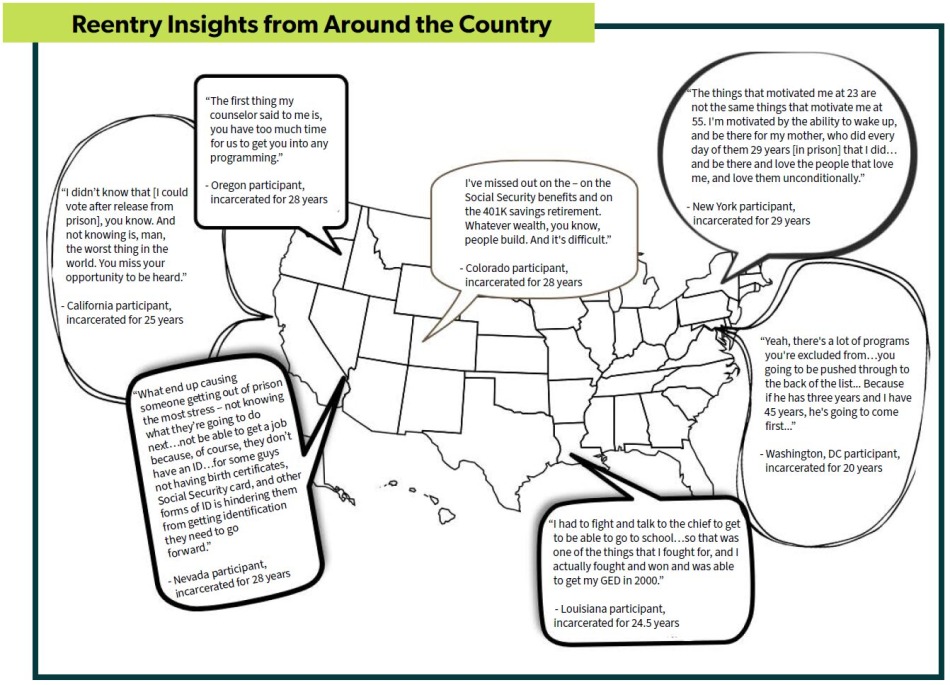
Introduction
931 years in prison. Collectively, that is how long the 33 men and women who shared their stories with us were confined within the United States penal system. Beginning in 2021, one by one, these individuals were released from prisons around the United States.20 Upon returning to life on the outside, the world had become vastly different from the one they had left. Behind prison bars for decades, they missed the full thrust of the digital revolution, the widespread use of smart phones, the boom of social media, and technological advancements such as touchless payment. The communities and cities they had once known felt and looked foreign to them – for some, as a result of gentrification. Others were released to places they did not know. As the years under confinement accumulated, connections had faded away, and family members and loved ones passed on. A few returned home utterly alone due to the length of their incarceration and age. In spite of all this, these 33 people remained hopeful for a better life ahead — a place in their communities, an opportunity to contribute, and a chance to heal, mend, and build relationships. As one Oregon participant so powerfully expressed after returning home from 28 years of incarceration: “Life is a gift. And I owe it. It does not owe me.”21
According to the National Institute of Justice, reentry is a “process by which a person in correctional confinement prepares for release and transitions back into the community.”22 This report details our research on reentry in an effort to better understand the experience of those returning to life on the outside after decades of confinement. Our findings stem from interviews with 33 people who returned home after long-term imprisonment, having been locked away from anywhere from 20 to 43 years (see Appendices 1 and 2 for methodology and a demographic overview of our participants). After being home for as little as 3 months up to roughly 3.5 years at the time of their interview, these 33 men and women are still navigating the complexities of the reentry process.23
What can we learn from their shared reentry stories in order to better support the success of those who will return home next?
As this report illustrates, and as human dignity demands, we must do better to prepare and support people as they transition from incarceration to community. The reentry process is a critical phase where freedom is gained, but success on the outside depends on many factors, such as securing basic needs, like housing and employment.24
Success also depends on social capital (e.g., social networks and supports), coordinated community and social services, attention to health and well-being, and the continued development of a positive identity.25 This is especially true for those returning home after decades of confinement in prison, which requires learning life all over again.
Intersectionality and Reentry Experiences26
People’s reentry experiences are influenced by interconnecting cultural systems that create opportunity for some and disadvantage and oppression for others. Social identities (e.g., race, gender, class, ability, citizenship), political and economic power (e.g., having the right to vote, employment), institutions (e.g., family, education, law), historical legacies (e.g., slavery, segregation), as well as access to resources and opportunities in a community all coalesce to create each person’s unique reentry experience. Our human experiences are shaped by much more than our individual choices. Individuals’ lives are influenced by the larger social and structural forces among which we all live.
Reentry by the numbers
Due to the sheer scale of mass incarceration in America, a substantial portion of people exit prisons every year – all of whom, along with their families and communities, will undergo reentry.27 This is especially true for Black Americans who are disproportionately incarcerated and for longer periods of time.28 To put the magnitude of reentry into perspective, in 2023 alone, over 450,000 people were released from state and federal prisons.29 This is over four times as many people who made their reentry journey 50 years ago.30
Number of People Released from Prison, 1973 vs. 2023
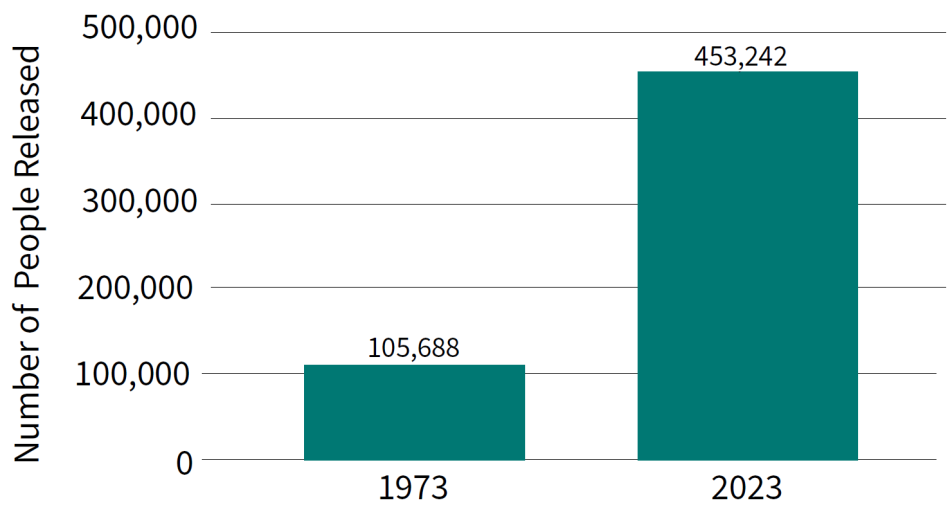
Source: Bureau of Justice Statistics “Prisoner Series,” digitized data for the year 1973.
The vast number of people who will experience reentry shows no signs of slowing down. Post-Covid, although crime rates have hit record lows, the prison population is once again on the rise.31 Based on the latest estimates, over 1.2 million people were incarcerated in state or federal prisons in 2023.32 Because the United States continues to rely on lengthy sentences and more time served before release, a growing proportion of people will be returning home after long-term confinement.33
33 Free: Thriving, Surviving, or Suffering
Because reentry is a significant life transition, especially after so many decades spent in prison environments, we wanted to get a sense of how participants assessed their lives and their circumstances in the present moment during their interview. To do this, we asked them to visualize a ladder (see Appendix 3 for the interview questionnaire). Step 0 was the worst possible life for them. Step 10 was the best possible life for them. We wanted to know on which step of the ladder they stood at the time of their interview.34
| Thriving | 45% |
| Surviving | 33% |
| Surviving | 21% |
Note: N=33 participants. Categories based on the Cantril Striving Scale.35
For those on step 4 or lower (the “suffering” category), barriers to stability were a prominent narrative thread. Barriers varied by person, although multiple obstacles existed for many, and included:
- the ability to obtain legal documents (e.g., birth certificates, Social Security cards);
- finding employment that paid a living wage;
- concerns about housing insecurity or the desire for alternative housing; and
- felony probation or parole supervision rules that limited travel (e.g., denials to see family).
To illustrate how one barrier to stability can impede progress during reentry, a participant from New York told us about their36 frustration trying to obtain their legal documents:
Well, right now my biggest challenge is, I’m waiting for my documents – I’m waiting for my birth certificate in order to obtain my Social [Security card], so that’s really like obstacles that I’m fighting with right now. Because without that, without my Social, I can only really do but so much because even if they [employers] hire me, how many jobs you know that are really gonna pay me checks, or they gonna create a way to pay me, do a cash app or something, you know? Like how many, how many jobs gonna do that? So I need my Social, and I need my Social to be able to open a bank account and get me going, you know, and I also need my Social in order to be able to get my place of residence.
Having legal documents would begin to “open doors for everything else,” yet, after five months of being home, obtaining them was still elusive (New York participant, incarcerated for 30 years).
Those on step 5 or 6 (the “surviving” category) reflected that there was more room for them to grow, more progress yet to make. “Well, I’ve come a long way from being at the very bottom of the rung, and I’m definitely not where I want to be yet. So I give myself that grace…there’s very, very definitive steps that I have to go through to get to the next rung on the ladder and to not hurry it” (Colorado participant, incarcerated for 32 years). There was a desire for greater independence and financial stability – finding work or a better paying job, having their own source of transportation (a car, an electric tricycle or e-bike), and finding suitable and affordable housing, which included goals of future home ownership.
One participant, in addition to the desire to have a car and “my own place,” had a goal to “be off parole…being more totally independent. I could do whatever I want. I can go anywhere I want, you know, as long as I’m obeying the law” (New York participant, incarcerated for 43 years). One participant spoke about wanting a family, but financial stability was their first priority – “I think that would put me up higher on the ladder. But I want to be able to – be able to protect and provide for my family so that they’re always safe, you know. I can give them that safety net, and if I can’t provide that, then I’m not ready” (California participant, incarcerated for 25 years).
Of those on step 7 or above (the “thriving” category), several participants spoke about feeling like they were in a place of financial stability, such as having secure housing and employment. A few mentioned having their own source of transportation. One participant from Louisiana, who was incarcerated for 24.5 years, said, “I think I’m blessed where I’m at, you know. I’m able to have my own apartment, my own transportation, paying bills, you know, getting insurance, doing stuff the legal way. You know, I was 24 when I came in, so cutting curves was what we did, but just to do stuff the legal way and work hard, and just sit back and be able to look at all that I accomplished.”
Many discussed rebuilding their relationships with family and loved ones. In a heartfelt description about their mother, one participant living in New York relayed, “The things that motivated me at 23 are not the same things that motivate me at 55. I’m motivated by the ability to wake up, and be there for my mother, who did every day of them 29 years [in prison] that I did…and be there and love the people that love me, and love them unconditionally.”
No matter where they put themselves on the ladder, all 33 people demonstrated resilience and determination to succeed regardless of life circumstances – a desire for continued progress.
The Influence of Early Life Experiences
For a more in-depth picture of the people who were trusting us with their reentry stories, we began our conversations by asking questions about their early years. Where were you raised? Tell us about your family. Tell us about the people who inspired you to be your best self. While some good memories were revealed, overall, the early life experiences that were shared with us were overshadowed and shaped by:
- Parental separation and divorce
- Parental abandonment
- The death of one or both parents or the death of one or more siblings
- Neglect and abuse (emotional, physical, sexual)
- Households experiencing drug addiction and alcohol misuse
- Witnessing or being a victim of household domestic violence or neighborhood violence
- Housing instability
- The incarceration of family members
- Having few or no positive role models growing up
Participants reflected on and spoke about how the environments of their youth influenced their life trajectory. Many of their childhood experiences correspond to the research that shows how early traumatic and adverse childhood experiences influence the likelihood of criminal legal involvement in youth and adulthood.37 It is against this backdrop of their powerful disclosures that we delve into where their reentry journey should have started – during their imprisonment. Yet, due to the length of their sentences, preparing for reentry on the inside came with its own set of obstacles.
The Prison Experience
It [the exclusion from programming] influences [your reentry] a lot, because there are certain things in prison programs that you can actually take home with you and actually become a viable part of the community.
The vast majority of our returning community members said that the departments of corrections (DOCs) did little to support their rehabilitation, which led them to find alternatives to DOC programming due to blocked access. Neither did the DOCs provide meaningful assistance with reentry planning.
Blocked opportunities to participate in programming
When we asked the participants if they had any experiences of long waitlists or being excluded from participating in programming due to their sentence length, 81% said yes.38 One participant in Oregon, who spent 28 years inside, reported that “the first thing my counselor said to me is, ‘You have too much time for us to get you into any programming.’” They pointed out the irony that individuals with long sentences who may have had to go before a parole board that expected evidence of rehabilitation were excluded from participating in those programs specifically because of their long sentences.39
Many spoke about being put on waiting lists, because those closest to release, typically with five years remaining or fewer, always took priority. The waiting lists were often for programming that would have contributed to rehabilitation, such as identity transformation, addressing trauma, and learning life skills. It also affected Family Reunion Programs (i.e., the ability to spend time with family in a private setting),40 certain jobs within the facilities, learning a trade, and educational opportunities including obtaining a GED or taking college courses.
Eventually individuals were able to participate in some programs. Doors opened as a result of self-advocacy and determination, as shown by one participant in Louisiana – “I had to fight and talk to the chief…to be able to go to school…so that was one of the things that I fought for, and I actually fought and won and was able to get my GED in 2000” (incarcerated for 24.5 years).
Some individuals developed good relationships with staff. Changes in security levels permitted more access to programming for some. Prison transfers also mattered – not all facilities offered the same programming or the same amount of programming. A prison transfer could become a blessing or a curse with respect to access. A few people mentioned departments of corrections’ (hereafter, DOC) rules started to change to allow more access, but such shifts did not come until they had already been incarcerated for a long time. Even with said changes, they still felt programming was too limited and that the DOC needed to do more.
In their own words: On programming waitlists and denials
“I was excluded, excluded from basically everything…even good quality jobs…even some of the college programs.”
— California participant, incarcerated for 31 years
“They wouldn’t let me participate in anything really. Yeah, every single class, group, whatever that I attempted, you know, to join. Put my name on the list. They shut the door on me. I couldn’t. I couldn’t attend. I could not participate…even a GED class.”
— Colorado participant, incarcerated for 32 years
“I wanted to participate in the Family Reunion Program…We get a chance to spend approximately 48 hours with your family and loved ones in a – like, a trailer home…I wanted to participate with my family, my mother and my children, but I was told I couldn’t participate in that unless I had ART [the Aggression Replacement Training program]. So, obviously in 2000, I wasn’t eligible to go into ART at that time until the year 2020.”
— New York participant, incarcerated for 24 years41
“Yeah, there’s a lot of programs you’re excluded from…you going to be pushed through to the back of the list. They consider you but you never – basically you still excluded. Because if he has three years and I have 45 years, he’s going to come first….you excluded from a lot of stuff.”
— Washington, DC participant, incarcerated for 20 years
Missed opportunities to engage emerging adults in rehabilitation
Because there were such long waits, or sometimes, outright denials for participation in programming upon entering prison, DOCs very often missed a pivotal rehabilitation window. When they were sentenced to prison, the vast majority (85%) of participants in our study were “emerging adults.”42 Within this unique developmental phase, typically up to age 25, individuals share more in common with their teenage selves versus the maturity of an adult – not yet having a fully developed prefrontal cortex, the part of the brain that improves the management of impulsive and risky behavior.43 This period of time provides a ripe opportunity for intervention as the brain continues to develop in the areas of executive functioning, judgment, impulse control, and emotional regulation. As noted in a report by the National Academies of Sciences, Engineering, and Medicine, emerging adults are “uniquely amenable to rehabilitation.”44 Yet, due to long sentences, many of these opportunities were systematically limited or denied by design.
Filling the DOC programming void
We heard story after story of personal transformation that occurred during decades of incarceration. These profound personal changes were largely driven by participating in self-help and other groups run by incarcerated peers. One participant in New York, who served 37 years, said, “I had sixty-two-and-a-half–years–to–life, and I said that if I couldn’t come home, if I couldn’t get out, at least I can help prepare the men that was leaving to go out to become assets to their community instead of liabilities.” Community organizations and volunteers – faith-based organizations, education providers, non-profit organizations, and formerly incarcerated people – offered programming and played pivotal roles in building skills and transforming lives. Involvement in programs and classes offered by outside entities (e.g., Alternatives to Violence)45 and volunteering to serve in programs (e.g., like the Youth Assistance Program, to provide guidance to at-risk youth)46 contributed to their personal growth.
Without these opportunities, reentry would have become an even more onerous endeavor. These groups and programs allowed our participants opportunities for self-exploration, to build skills they could use on the outside, and, above all, to begin to implement new “transferable” skills they could use as they returned home and faced the challenges of reentry. Still, similar to difficulties with access to DOC-run programming, some people had more access to these types of opportunities than others did.
In their own words: The importance of self-help groups and peer-led programs
“Well, when I went to prison I felt like…I had a lot of issues, and I was kind of broken. And so I knew that I needed to use this time to figure out what was going on and fix it. I spent a lot of time trying to take different kinds of classes to own, to address my issues.”
— Louisiana participant, incarcerated for 27 years
“It changed my whole mindset being in the self-help group and helping people…I learned that I have to take my time. I have to use all the tools that I learned…to succeed out here…I had to really get into my feelings so that I won’t do anything to jeopardize my freedom.”
— California participant, incarcerated for 34 years
“It [volunteering] gave me the experience to be able to deal with conflict resolution, to deal with different personalities. Because when you in prison, you’re dealing with people…from different walks of life. So that gave me the skill to be able to deal with different attitudes…to meet people where they are, to learn different learning styles of people, because everybody’s different.”
— Louisiana participant, incarcerated for 24.5 years
The Reentry Experience of Five Women
I can look back on my past, and that’s one thing I can gather my strengths from is that the fight that it took for me to get here, to come home. It was a long, long fight, and if I can fight that fight in there, I can definitely do it out here.
Although men and women in our study walked parallel paths through prison and reentry, the women described experiences that were not commonly reflected in the men’s accounts. This report features interviews with five women. What follows offers a glimpse into their reentry experiences in four states: California, Colorado, Louisiana and Oregon. The women were sentenced to a range of 60 years up to life without parole. They were released after serving between 24.5 and 32 years in prison; their average age at release was 57. Many women discussed their history of substance use disorder and trauma, including early sex work and sex trafficking. Most of the women are mothers.
The prison experience
Although it took DOCs a long time to give people with long sentences access to programming, the door to these opportunities opened even later for some women than for men. “Oregon is not real excited to have peer-led programming, especially in the women’s institutions. Men’s institutions – they got clubs in 1968. The women’s institution just got a club in 2022.” When provided, programming was sometimes male-centered and failed to address their specific needs. As one woman from Louisiana noted, “When I moved to LCIW [Louisiana Correctional Institute for Women], they had a lot of programs, but it wasn’t geared towards women. They had like, well, culinary arts, you can say, and they had office systems technology, but for the most part it was stuff like horticulture, and that was geared towards what the men’s prison had.” Throughout their decades of incarceration, the women participated in just a few DOC-run programs. One woman, in discussing the limited availability, expressed disappointment in the DOC for not preparing women to release “with knowledge of their worth and potential.” Access to programming opportunities for these women came through classes led by other incarcerated women, as well as those offered by community organizations. Classes attended by the women included those focused on trauma healing, domestic violence, mental health, codependency, self-esteem, self-care, community building, and parenting – classes that helped them learn to treat themselves and others better.
Because of the low wages paid for prison labor, incarcerated women emphasized the importance of saving and financially planning for reentry early in their incarceration. “I am always trying to talk to people about successful reentry from the day you get incarcerated, because you need to start planning. Because $77.90 [a month] is not a lot of money to save and buy tampons that are 10% of your pay and all of that… I’m trying to talk to all my friends who are in prison. ‘Please save money. Please save money.’ You need it out here. You will not be able to function if you don’t have some money, and so, I just – that to me, was important. Because shit, you know, you want toilet paper. You want to be able to buy things. You have to be able to provide for yourself.” Upon release, three out of the five women received zero gate money. Their prison accounts varied from $450 to $4,000.
Returning to community
The women discussed their challenges in reentering the family unit and reconnecting with their children. In reflecting on whether there was anything she would have done differently in terms of navigating her return home after release, one woman said, “I would have got my kids more involved in, you know, my inception from when I got home to where I’m at now. Just to give them that because they lived on the outside of my incarceration for so long, you know, and coming home, I kind of navigated my release with them on the outskirts, you know, so I probably would have wanted them to be in that journey with me… But me and my daughter are changing that, so I’m kinda including her in my everyday stuff now.” In recognizing the unique needs of women coming home from long-term imprisonment, one woman suggested discussing the release process to become more familiar with what it entails. “Because there are so many different aspects, you know, for women who have children. For people coming out where someone has been controlling their home, and now they have to step back in and try to take – try to take control of their home. Like, you know, their finances – their financial homes. And somebody [else has] been running it for years.”
All participants emphasized the importance of support from other women – particularly formerly incarcerated women and women from outside organizations, such as A New Way of Life, Louisiana Parole Project, and the Oregon Justice Resource Center. In some cases, they received support from women within the prison system, including case managers, and also attorneys. They all described providing support to other incarcerated women and women returning home. Even with all that they have experienced, the women look forward with hope for a brighter future, with aspirations that include home ownership, travel, going back to school, owning a car, starting a family, having more fun, planning for getting older, and spending more time with their children.
The Transition Experience
We spoke with all of the study participants about their transition – the period when they learned they were being released from prison until the moment they actually walked out of the prison gates: What support did you receive from the prison? In what ways did you feel prepared for release? What would have helped in your reentry process – either during the transition phase or overall? In short, they reported that not much help came from the DOCs; their feelings of preparedness varied drastically; and they had plenty to offer on what would have helped them with their reentry process.
Lack of assistance from departments of corrections
An overarching theme was the lack of assistance from DOCs in relation to reentry and certain supports to help them succeed. According to one participant in Colorado who was incarcerated for 32 years, “They pretty much just send you on your merry way, and it’s like, ‘Hey, bye. You gotta figure it out.’” We asked each person if the DOCs helped them with information or coaching on fundamentals such as obtaining valid identification, accessing public benefits, and locating contact information for other critical reentry needs like employment, housing, and services to address health and wellness. Most did not receive help in any of these areas.
While I was in prison, I couldn’t get any help with anything. But my biggest problem is that, for being in prison so long, I have no idea how the outside world works. I’m still running into that problem.
| Driver’s license or information on how to get one | Obtaining another form of identification | Availability of public benefits | Contact information for jobs, housing, health insurance, or mental health services | |
|---|---|---|---|---|
| Yes | 18% | 9% | 36% | 9% |
| No | 79% | 82% | 61% | 85% |
| Unknown | 3% | 9% | 3% | 6% |
Identification documentation: The majority walked out of prison with a prison ID. However, a prison ID is not recognized as a valid or official form of ID for basics such as employment, housing, and banking. In one rare instance, a prison provided access to the Department of Motor Vehicles so that, pre-release, one interviewee was able to obtain a valid state ID. Luckily, some had the foresight themselves or were encouraged by a case manager to order a Social Security card and birth certificate that were then held on file for them at the DOC. But, for others, it was a post-release endeavor and some were still trying to obtain their documentation at the time of the interview. In the words of a participant who had been incarcerated in Nevada and returned home with a prison ID after 28 years of incarceration, “What end up causing someone getting out of prison the most stress – not knowing what they’re going to do next…not be able to get a job because, of course, they don’t have an ID…for some guys not having birth certificates, Social Security card, and other forms of ID is hindering them from getting identification they need to go forward.”47
Public benefits and contact information: The most assistance came in the form of signing up individuals for Medicaid, which was facilitated by counselors or medical staff. Contact information useful for seeking jobs, housing, and other services, was obtained through formerly incarcerated people, participants’ own fact-seeking missions, or, if lucky, some type of reentry class or program when access had not been blocked. We learned from a Washington, DC participant that there is a reentry book called the D.C. Reentry Navigator48 that includes information on social services and how to apply for benefits. Unfortunately, according to our participant, this book was only available to those with shorter sentences. They were fortunate enough to be able to get the book from a person who was being released.
The general consensus on assistance provided by DOCs is summed up by one participant’s statement: “I have come to believe that the department of corrections is in the business of warehousing people. And that’s where it starts and that’s where it ends. Rehabilitation, training, education, vocational? That’s going to be on us, you know. To help people when they get out, or to give them resources while they’re in and help answer questions? Because the department of corrections is not – that’s not what they do, do they? They house people, that’s what they do” (Oregon participant, incarcerated for 28 years).
What about voting rights?49
When we asked whether departments of corrections provided any information about their voting rights prior to release, 13 people said yes (41%) and 16 people said no (50%).50 Two individuals received a letter during their imprisonment from their local government informing them of their voting rights status (<1%). For those who said yes, this information came in many forms, such as posters hanging on the prison wall, counselors, other incarcerated people, and paperwork included in release packets.
Of our 32 voting-eligible* study participants:
- The right to vote was restored to 22 people by state law after they completed their prison sentences.
- Another three people will not regain their voting rights until the completion of parole, also based on state law.51 Due to the imposition of lifetime parole, two other participants will be banned from voting for the rest of their lives unless the law or their status changes.
- For Washington, DC residents, their right to vote during their incarceration was restored by the Restore the Vote Amendment Act of 2020. Four of them voted in an election while completing their sentence. According to one Washington, DC participant who spent 26 years in prison, “I was really big on like voting while inside [the prison], because…you internalize that you are a stakeholder in the community.”
After release, 21 people registered to vote. Thirteen people have cast their ballots in elections since they have been home. According to one New York participant, who was imprisoned for 26 years, “I voted for the first time ever…it felt great!”
*Voting-eligible means an individual is at least 18 years old and a U.S. citizen.
Reflections on being prepared for release and what would have been helpful pre-release
“To be honest with you, I was scared. Because I was coming to a new world, man. We talking about a long time… I was given another chance, you know, another chance to change the narrative about my life. But I was scared, man, like – and at times I’m still scared.”
— New York participant, incarcerated for 30 years
“I knew I wasn’t the person that I was before… My thinking had changed, my attitude had changed. But there was a lot of things that I may have thought I was prepared for, but I really wasn’t, and there was a lot of things that I didn’t even know if I was prepared for, to be honest with you.”
— Louisiana participant, incarcerated for 27 years
As one can imagine, there were varying levels of feeling prepared for release – whether logistically, emotionally, spiritually, or a combination thereof. Our participants spoke about what helped them feel prepared for reentry: self-help groups and classes; having outside community support from family, friends, and especially, formerly incarcerated people; connections made pre-release to community organizations and non-profits (e.g., transitional or community-based reentry programs, which provided critical needs like housing and food); having a reentry or release plan; and, for some, devising back-up plans for their back-up plans.
In encouraging participants to reflect back on their journey, we asked what would have helped them in their reentry process. As previously noted, they certainly wanted more reentry programming that would help them prepare for the outside world. There was also a desire for more guidance about the actual reentry process itself. This is a summary of what they reported needing in order to feel better prepared as they were making their journey from incarceration to community:
Programming: A tailored reentry class for those who have spent decades in prison and therefore require thorough preparation after being absent from larger society for multiple decades; realistic and transparent discussions about reentry barriers; the option to take college courses
Release planning: Obtaining a valid ID before leaving prison; better communication with transitional housing programs; increased access to current technology – such as phones, tablets, and internet – to facilitate reentry planning, including reaching out to organizations pre-release; having secure housing, particularly in expensive cities that have experienced a lot of gentrification
Employment preparation: Job readiness, including how to draft a resumé after long-term incarceration (e.g., handling gaps in job history); interview training; hands-on job programs that result in valid licenses or certifications recognized by labor departments; access to job searches or job fairs to find employment pre-release
Skill sets: Preparation for technology, including learning how to use computers, cell phones, credit cards (e.g., the world of paying with “plastic” versus cash); financial literacy (e.g., banking, budgeting, long-term planning); soft skills including communication skills, social skills (e.g., exposure to large crowds, interactions with the opposite sex and other diverse groups), and relationship skills
Other needs: More of a financial buffer upon release; access to therapy; greater access to transportation; recognition that reentry services are sparser in rural than urban areas, and participants’ ability to travel from a rural location where they are living to an urban area to access services and programming (e.g., lack of transportation)
Deportation: Exile and Reentry
“I didn’t know anything about the country, so I felt good walking around for a moment, but I was lost.”
Karl Williams* was 35 years old when he was sentenced to 67.5 years in prison. Born in Jamaica and raised in New York, when he envisioned his freedom he pictured it in the United States. Twenty-eight years later, he faced an unimaginable decision – remain incarcerated or be deported to Jamaica.
“They [someone from the prosecutor’s office] came to me on a Thursday, and they said I have to make a decision by Tuesday… If I want to take the deal. If I don’t take the deal, it’s a possible release of 2031… So, it was a – it was a hard gamble. A lot of pain, you know. A lot of tears and a lot of consulting, you know. I’m running from prison to prison asking what do they [other incarcerated people] think, you know, and they say, ‘Yo, you’ve been there long enough, man. Get out,’ you know. And some people are like, ‘Are you ready to go?’ ‘Do you want to stay?’ ‘What do you want to do?’” To be granted freedom, Mr. Williams ultimately decided to be deported.
Mr. Williams, now in his sixties, was forced to navigate his reentry journey in a foreign land. He recounted his harrowing deportation process, which included inhumane conditions, abuse and maltreatment – being crammed in a cell with multiple people for nearly 24 hours a day and not being given any food or clothing. He felt he was treated as less than human because of his immigration status. Karl recalls the officers saying, “Y’all are going back to your country anyways, [we] can do what [we] want to do.” The whole experience amounted to what he referred to as “mental game playing” and psychological torture.
When Mr. Williams finally arrived in Jamaica, he was woefully unprepared. As he recalls: “I was really – I was nervous. I was scared. I was angry. I didn’t know if my first day out here, if I wanted to live out here, live, and go through the trauma. Because my release was – I prepared everything for New York City…[E]verything for me was for New York. I didn’t have Jamaica on my mind until when they put Jamaica on my mind. They never came to me in ‘94 when I got arrested and said, well, you know, you’re going to be deported to your country. If they’d have told me that in 1994, you know what? I’d be much prepared, and we wouldn’t probably have this discussion right now. But I was not prepared. This came on to me in 2021. So, it was a harrowing experience all the way through.” To make matters worse, prior to release, Karl was not provided with enough time to consult his family in Jamaica to arrange a plan for housing and general support. “I was unprepared the whole way. Because they didn’t give me enough time to consult my family. To talk to them, to get prepared for my release to Jamaica, or to put anything in play, or just to situate my mind.”
All he was provided with upon release were a Jamaican patty and a box of juice, “and there’s nothing written down, there’s no paper to say, go down to Harlow Street or Burke Street, or this street, and get this, or go here to there, or you can find the way out there. I said, ‘I don’t know where my people are at.’ They told me to go outside and figure out how to use your phone. Now, mind you, I’ve not used a phone in almost 28 years. And I didn’t know how to use a phone. They don’t give you a phone call. They don’t give you anything. So you have to come out and interact directly with strangers or someone that you came out with that understands the cellular phone system. I wasn’t one of them.”
In the United States, because of his lengthy sentence, Mr. Williams had been prohibited from participating in trade programs within the DOC, such as carpentry, painting, and plumbing, which could have been especially helpful to him in Jamaica’s economy. Instead, the lack of job skills to transfer to the Caribbean economy and limited social network created insecurity around his job and housing situation. “I worry about losing a roof over my head. I worry about losing my job sometime, because at the moment I need it.”
Karl described the discrimination he faced in Jamaica because of the stigma towards those known to have been deported. For Karl, he felt this led to his exploitation, mistreatment, and degradation. He recounted feeling forced to accept whatever pay was offered to him. As he explains, “When people believe that you’re a deportee, deported down here, they pay what the hell they want to pay you, and you accept that cause it’s gonna be hard for you to get something else.” In another incident, he faced housing insecurity after a woman he was renting an apartment from found out that he had been deported to Jamaica; she moved her things into his apartment and into his very bedroom, and told him that he had to leave. Despite his best efforts to seek support for himself, there were no reentry programs or organizations available to him in Jamaica.
Karl describes himself as “still trying to place [his] feet firmly on the ground.” The challenges of reentering into a country foreign to him have left an impact, mentally and emotionally. The pressure to survive every day has contributed to stress and anxiety. For Mr. Williams, there still remain real, pressing concerns about financial stability and housing security. Still, optimism peeks through – he leaves space for opportunities to deepen his connection to Jamaican culture. He holds onto hope of acquiring some land and building a house, ideally alongside a partner with whom he can share these experiences. He also envisions creating a program that supports others by sharing his story, perhaps through a Boys and Girls Club. He would like to leave behind a meaningful, lasting legacy.
*Karl Williams is a pseudonym used to protect the identity of the participant.
The Experience of Coming Home and Living in the Community
Each person’s path to release was unique, although the mechanisms were often similar. Most went through the parole process (58%). One person had been required to serve their sentence in full. Fifteen percent of our participants were granted clemency.52 Another 24% were resentenced under newer mechanisms of release, including second look laws.53 For most, but not all, once they knew their release timeframe there were no significant delays in release from prison or major changes to their release plan. As they experienced their first day of freedom, we asked: What do you remember most about the day you were released? What stood out for you?
The first day I was just…so grateful my grandma was still alive. I was hugging my grandmother. Just being able to just walk around with no handcuffs on. I think the biggest thing for me, honestly, was just like…I get up early, just actually be able to see the sunrise, you know. I just want to see the sunrise.
A prominent thread that tied many of our participants’ experiences together was the joy and happiness of seeing their family, including grandchildren, some of whom they had never met, significant others, friends, and the people who advocated for them while they were inside. “That’s the most memorable thing…being able to walk out without no cuffs…none of that stuff on…into the arms of, into the presence of my family” (California participant, incarcerated for 31 years).
They remembered feeling a range of emotions – the awe of freedom, gratitude, happiness, a state of shock, being overwhelmed, anxious, or scared. One New York participant who served 24 years recalled, “I think what stands out to me is that [my feelings] on the inside, I was – I was going crazy, like, my senses was all over the place. I know people thought I had it all together. People was even complimenting me. But I’m like – I’m really freaking out right now, you know.” For some, there was trepidation. “I hate that this is part of it, but looking back and part of me expecting, you know, just…are they coming back to get me?” (Oregon participant, incarcerated for 22 years).
Social support networks and community organizations
Most participants returned home to fairly robust social support networks. However, many also acknowledged that the level and depth of support during their reentry process was atypical compared to others’ experiences after release. Below is an overview of the people and places that were important to them as they learned to renavigate life:
- Family members, ranging from parents to nieces and nephews, fictive kin,54 romantic partners, friends
- Current and formerly incarcerated people
- Community-based non-profits and reentry programs (Appendix 4 lists non-profit organizations uplifted by our participants.)
- Self-help groups, as well as their staff and participants
- College professors, including resources from college programs post-release, and childhood teachers they knew prior to imprisonment
Support from the people in their lives came in many forms, such as financial, transportation (e.g., to parole appointments), housing, clothing, hygiene products, electronics (e.g., cell phones, laptops), assistance with setting up bank accounts and healthcare services, and finding employment. The supportive people and advocates in their lives also offered guidance and advice, and affirmed that their feelings (of being overwhelmed, for example) were valid.
Some non-profits provided transitional housing, programming, and stipends; others assisted in obtaining documentation, benefits, transportation, and appropriate housing. These networks helped ease the transition from incarceration to community living, although reentry was, and continues to be, a challenging experience for all 33 people who had spent decades incarcerated.
In their own words: The importance of social support during reentry
“I was one of the lucky ones, really. Because my friends who got released before me, really, you know, gave me the backing to survive out here. Not just survive. But…to live, you know, live my life.”
– California participant, incarcerated 34 years
“In my situation I had the support systems in place, but there’s so many others that don’t…for a lot of them, they’re gonna end up homeless…end up on the street. There’s a huge gap in the system between the moment a person is released, the programs and everything else that are offered in the interim, and getting the person to a very productive, you know, working position out here in society. And for a lot of them…they’re falling through that gap.”
– Colorado participant, incarcerated 32 years
“We talk about how it takes a village to raise the children. It took a village to help me out, get home, and get situated out here.”
– New York participant, incarcerated 37 years
“It helped phenomenally. If I hadn’t had all those people, I don’t know what I would have actually did. There’s no doubt in my mind I would have figured it out, but it would have made it a lot harder.”
– Nevada participant, incarcerated 28 years
Disability: Discarded and Abandoned by the DOC
“The DOC totally abandoned me and left me to fend for myself, even though I’m disabled.”
Evan Smith* was sentenced to life in prison at 23 years old. Forty-two years later, he paroled as a 64-year-old man reliant on a wheelchair and cane for his mobility. These physical limitations shaped his transition into the community. His disability made him vulnerable. He could barely walk and was unable to push himself around in his wheelchair. Because of this, he was deeply dependent on the support of others for his care, and ultimately, his survival.
On the day of his release, the New York Department of Corrections abandoned him on the street with nowhere to go – the result of a lack of coordination, delay, and unpreparedness for his release.
“The day I got released, my paperwork said, I’m supposed to report to…the Department of Social Services. However, by the time I got [there], because the department of corrections had to bring me in a wheelchair van to parole, the Department of Social Services was closed. And then parole says, ‘Well, we don’t help you with housing. You got to take care of it on your own.’ And, they’re telling me to go to the police station, and tell them you’re homeless. But I’m saying, ‘I can’t get to the police station because I’m in a wheelchair.’ My medical permits say ‘no pushing or pulling or lifting more than 10 pounds.’ I’m not supposed to be pushing myself around in a wheelchair, but I’m being forced to do so. And they [the DOC] just left me there [outside on the street].”
Prior to being released, Evan did not receive any help from the DOC to prepare himself to come home. His concern was finding wheelchair-accessible housing. The DOC directed him to use family and friends, but after over four decades of imprisonment, Evan’s social support networks had crumbled. “They wanted me to find housing. However, I have no family. They’re all deceased. I have no friends. I’ve not had a visit from anyone since 1996… They’re telling me that I have to go and use my friends and family to find a place to live, and I can’t, and they won’t give me any information.” In spite of this, the DOC did not provide any information on other ways to find housing. The DOC also did not provide any information about Supplemental Security Income (SSI), food stamps, mental health support, unemployment support, or contacts for getting a job, despite releasing someone of Mr. Smith’s age and condition. Ultimately, after delaying his release by four months in part because of housing, Mr. Smith was released to the streets without a place to live.
If not for the help of individuals from Parole Preparation Project and Justice and Unity from the Southern Tier (JUST) providing clothing and housing for the night, Mr. Smith would have been left on the streets and immediately violated parole for the simple reason that he had no place to go on his first day out. The next morning, Mr. Smith and someone from JUST attempted to get him signed up for public assistance at the Department of Social Services. After completing the interview process, he was told “they don’t have housing for disabled people in wheelchairs, so they can’t help me, and for me to leave the building.” Evan spent the rest of the day and the following week in the hospital after falling ill having spent the entire day at the Department of Social Services (DSS) without eating, creating complications for his diabetes.
Eventually, due to pressure from outside organizations, Mr. Smith was moved into a motel. However, the housing provided to him did not accommodate his disability. There were no grab bars in the bathroom and his wheelchair did not fit through the door. Evan recalled making the mistake of trying to take a bath, and not being able to get out of the bathtub; he had to crawl over the edge of the bathtub onto the slippery floor to his wheelchair to help himself up. Mr. Smith was ordered by an administrative judge to be placed in adequate housing. Although the room he lives in now is wheelchair accessible, it is still deficient. The building’s sole elevator does not work, forcing him to push himself “about 300 yards” to the other end of the building to get to the lobby from his room. Additionally, individuals housed there with the Department of Social Services do not have access to amenities like the gym, laundry, pool, or free breakfast, like paying guests – things that could support his health and wellness and provide a better quality of life. “And, what it comes down to is, we were told that we’re supposed to not be seen or heard. They don’t want us out of our rooms, hanging out places, or anything, anybody from DSS. Because the other guests that are paying more money will see us. So, it’s more like a prison – another prison cell.”
The lack of transportation mobility, deep reliance on others, and the restrictions placed on him have left Evan feeling trapped. “Four o’clock at night, I’m more or less abandoned in my room, because I have no way of getting anywhere. Weekends, I can’t get anywhere. The Tuesday before the 4th of July to the following Monday, I was stuck in my room all by myself, because ACBC [a county agency] that moves me around didn’t work… so for five days straight, I’m stuck there with nothing, nowhere to go, I can’t do anything, and that’s where I am, like every night now it’s the same way.” What’s more, Mr. Smith must renew his housing voucher in-person at the Department of Social Services every two to three weeks, creating an additional burden.
For Evan, staying alive in the face of numerous challenges feels to him like his greatest achievement. Finding stable housing has been difficult, and securing a job presents its own obstacles, with gaps in his work history, his age, and his disability making the process extraordinarily more complicated. Yet through it all, he holds on to hope. He dreams of moving into his own apartment, finding meaningful work, and perhaps, meeting someone special to share his life with.
Evan’s experience illustrates the harsh realities faced by older individuals returning home from long-term imprisonment, particularly those with disabilities and a lack of social support. Reentry is often framed as an individual challenge, yet his story underscores how institutional failures can turn freedom into crisis. For Mr. Smith, one crisis was mitigated due to the help and support of non-profit organizations, such as Parole Preparation Project and JUST, and another because of outstanding community members (often in the form of kind hotel guests) offering assistance for his other needs, i.e., transportation. However, Mr. Smith is still very far from having the kind of security, stability, and freedom he hopes for.
*Evan Smith is a pseudonym used to protect the identity of the participant.
Reentry challenges and needs
While many individuals returned to communities with various levels of social support systems, their experiences in the first days, weeks, and months of reentry could have been made less onerous if departments of corrections would have addressed certain critical reentry challenges and needs prior to release.
Frustration with technology. One of the biggest challenges that came up again and again was participants’ frustration with today’s technology – a form of digital culture shock.55 This included cell phones, computers, figuring out how to use a credit card, and complicated tasks like using online portals to sign up for medical care and other programs. These are all things they were not exposed to, for the most part, in prison. While a few people were able to get computer experience during their imprisonment, computers in prison were often described as “ancient dinosaurs compared to what’s happening now [with technology]” (Louisiana participant, incarcerated for 27 years). One participant in Colorado, who was incarcerated for 32 years, told us how they were even denied taking a basic business technology class “just learning basic things about the computers. You know, Microsoft, you know, Excel, PowerPoint, all that kind of stuff.” In today’s world, without a basic understanding of technology, people returning home after long-term imprisonment are put at a grave disadvantage.56
The economic gap and financial stability. Monetary allocations, called “gate money,” are discretionary funds given by the prison to a person upon their release.57 This money is intended to help individuals with immediate post-release needs, like transportation or food. Given the rising cost of living,58 sending someone home after decades of imprisonment without enough financial stability is inhumane. Fifteen people did not receive any gate money. For the 18 people that did, the amount of gate money ranged from $32 to $200 dollars.59 Luckily, most people returned with some money from their prison account, although one person had zero dollars when they left prison. Prison account balances drastically varied from “a few dollars” (Washington, DC participant who received zero gate money) up to $5,000 (Oregon participant, who also received no gate money). Prison employment helped contribute to their prison account balances, but our participants’ earning power was drastically low – typically $0.08 cents to $0.95 cents per hour. For those who reported monthly wages, earnings ranged from $5 to $270 per month. In the words of one Washington, DC participant, “You get slave wages for whatever work you do…you’re making [just] cents an hour if you’re lucky.”
Many participants were also thinking about their long-term financial situation. There was talk of if it was even possible to save enough money to be able to retire someday. Will they ever have enough credits to qualify for Social Security? Realistically, due to the length of their incarceration, destitute in-prison wages, and lack of access to contribute to Social Security or a retirement plan, they are financially disadvantaged now and will be over the long term.
Barriers to the employment landscape. Our participants who had the least social support and few to no networks were the ones who struggled to find employment or permanent work. There was a lack of guidance on how best to explain their absence from the traditional workforce, even though they held jobs in prison. For example, one participant from New York said, “It’s hard to fill out a job application when it says, ‘What was your previous employment? It’s like, wow, 23 years [of imprisonment and no work history].’ You can’t explain that yet. You can’t. So nothing really prepares you for that.” There were also criticisms of prison vocational programs, including that they were drastically outdated and that certifications earned in prison are typically not valid workforce certifications for outside employment. Most of our returning community members did, however, have the benefit of social networks or family members who aided in their search for employment.
Lack of information about one’s voting rights status. Half of our participants had not been informed by the DOCs about their voting rights status, causing confusion for some about their eligibility to vote. This is illustrated by some of the responses received when we asked about participants’ voting rights: “I am under the impression that being a resident of [their current state], that I am not allowed to vote since I am a felon”60 (Washington, DC participant, incarcerated for 24 years)61 or “I didn’t know that [I could vote after release from prison], you know. And not knowing is, man, the worst thing in the world. You miss your opportunity to be heard” (California participant, incarcerated for 25 years). Our California participant then made it their mission to tell people coming out of prison who were on parole that they are eligible to vote.
There are good reasons for prison officials to proactively educate returning citizens about voting rights statuses as part of the “exit process” from prison. Voting is a prosocial behavior which can help improve reentry outcomes.62 When people return to their community following incarceration, voting helps build a positive identity as a community member. It is also linked to improved community safety outcomes.63
In their own words: On financial stability and the future
“There’s a few things that you don’t realize you miss out on. One, you’re not contributing to Social Security. Then that’s a problem. So I should be able to collect Social Security when I’m 68, 69. I can’t. I will never! I won’t have enough credits… And so that’s going to be a problem… So, I will have to continue to work. There’s no real way to fix that, which is crazy. The other thing is, I have no 401K. I have no retirement. I have no – I’m not building any type of wealth… I am like an 18-year-old, financially, you know, maybe a 19-year-old…
And so I’ve missed out on the – on the Social Security benefits and on the 401K savings retirement. Whatever wealth, you know, people build. And it’s difficult. It’s not easy, but I don’t have that work history of building stuff. So I don’t own houses. I don’t own a car… It’s on my radar, but there’s no easy fix for that, you know. I mean, I’m not going to be able to work a job, making $400,000 and saving all this crazy amount of money, so I kind of just have to just go with it. Save when I can, not saving much… I am concerned about not only myself, but other lifers that have gotten out. I don’t know what we’re going to do when we’re in our seventies. I honestly don’t…
What would be devastating for me is if I could not work for some reason. I would be a – I’d be staying at the warming shelter… It’s in my mind like, I’m like, ‘Okay, I gotta make sure I do this right, or I’m gonna be broke.’”
– Colorado participant, incarcerated 28 years
Parole and felony probation as barriers to growth, opportunity, and connection
As part of the reentry process, some individuals returning home will undergo a period of community supervision, such as parole, felony probation, or other post-release supervision.64 At the time of our interviews, 85% of our participants were under community supervision. Another 12% of our participants were no longer under community supervision due to termination.65 For those who were “still on paper,” meaning under supervision, their supervision lengths ranged from two years up to lifetime.66 One Louisiana participant, who was 62 at the time we spoke, was slated to be on parole until the age of 102.
We asked our participants to describe any challenges of being on felony probation or parole. The most discussed challenge was the logistical complexity for approval to travel or travel denials. The travel approval process has induced stress and panic when it became a potential barrier to fulfill employment duties. It also resulted in barriers to seeing family members. Here are some of the participants’ experiences with travel passes:
Inducing work stress: “I think, for me, having to get permission. There was one time that I was up against the clock. I recently just went to Puerto Rico…for a conference. She [the parole officer] was taking forever to get me the response. So remember, another organization is paying for me to go. They pay for my flight. My hotel room, you know. This is nothing new. I’ve been to several conferences since I’ve been on parole in different states… Give us two weeks in between the time you ask and the time you’re leaving. I usually go a step further, and I’m giving them three- and four-week notice, just to make sure… But this last time she [the parole officer] was taking forever, and I think that she was off [on vacation] because she had texted me…. ‘I was off for last week. Let me start the process.’ So it’s just those moments… I just hate the pressure of that pit…that pit filling in my stomach, you know.” (New York participant, incarcerated 24 years)
A Washington, DC participant, who was incarcerated for 24 years, also described their frequent work-related travel. Their probation officer requires 30 days’ notice for a travel pass, and as a result of that requirement, they have missed a lot of work travel.
Breaking connections to family: “Now she [the parole officer] is telling me that I could only leave the state for business or education. So I tell her, I said, ‘Okay, but I don’t have family in this state… I need to go see my family from time to time.’ She said, ‘No, we’re not letting people leave the state for socializing, because we got people going to the city like committing crimes.’ I said, ‘Well, if that’s true, that had nothing to do with me, because this is what I’m doing right.’ So she made it real hard for me to travel…unless I was going on education. It is frustrating where you feel like, you know, they’re kind of like cutting family ties when they’re supposed to be encouraging it.” (New York participant, incarcerated 27 years)
A Louisiana participant, who was incarcerated for 27 years, spoke about going to see their father in Mississippi. Because they are not allowed to leave the state without a travel pass they reported, “I’ve had to jump through hoops two times to be able to go see him.”
Having stable employment and prosocial connections to family are elements that can play a pivotal role in the success of someone’s reentry.67 For many of our participants, the travel pass experience has caused frustration as they try to keep moving forward in their careers, including striving for promotions. Certainly, it is also counterintuitive and counterproductive to block people from maintaining and strengthening their family bonds.
Paying it Forward
If I can continue to treat myself and others well, and continue to pursue growth, there’s a good chance to leave a legacy that’s not just one of harm and brokenness, but also of repair and reconciliation.
Success in reentry is most often defined and researched in terms of whether or not a person is arrested for a new crime, readjudicated in court, reconvicted for a new offense, reincarcerated, or returned to prison due to technical violations (violating rules of community supervision).68 Ultimately these criminal legal measures overshadow the rich and varied experiences each individual has when they come home. Whether or not reentry is a “success” or “failure” should be captured by more than a measure of recidivism. How else will we build the type of infrastructure we need to help people come home so that they can not only survive, but thrive? This would benefit us all as a society.
The 33 participants we interviewed were looking forward to what the future might bring, even knowing the road ahead would have setbacks and more hurdles to overcome. Regardless of where they were in their lives, they all felt an overwhelming desire to pay it forward – to give back to others and their communities. They described their many activities on behalf of people in prisons, including going back into prisons to speak with currently incarcerated people, supporting other people returning home from prison and becoming part of their reentry network, and advocating for legal reforms to improve prison conditions or expand opportunities for release. A number of participants were also working with at-risk youth in their communities.
For themselves, they hoped for: Getting off of parole – “to just simply be able to say that I am a fully sanctioned member of the United States of America again” (Nevada participant, incarcerated for 28 years); rebuilding and building connections with family and loved ones; finding a better job or their dream job; starting their own business or non-profit; buying a home or having their own apartment; buying a car; going back to school; finding love, maybe having a child; and, in general, to be happy and live a good life. Decades of incarceration have not dampened the fierce grip on living their life independently and productively in the free world.
As we wound down our discussions, we asked their advice for people who are returning home after long-term incarceration: What should the people who come home after them know about the road ahead? A large share said patience. Reentry is a marathon, not a race.
In their own words: Advice for others returning home after long sentences
“Life is real out here, and it doesn’t stop for you because you came home. So what you don’t want to do is add a burden on anyone else. So, please have a plan. If you’re coming home, have a plan.”
– California participant, incarcerated for 25 years
“There are a lot of different organizations that want to help people like me [a formerly incarcerated person]. They’re out here… My advice would be to take advantage of those programs, those organizations, because there are some really caring people out here.”
– Colorado participant, incarcerated for 32 years
“I mean, I didn’t have a chance to ‘just be’ in prison. I had to hurry up and adjust to that and work that out, but [now] I have opportunities to just be free… I took a week just to be free. I didn’t think about anything. I just sat in just being free…because the mentality I had was, when I get out I’m gonna hit the ground running…but if I would have did it like that, I knew I would have…crashed and burned. So you just have to take the opportunity to be free.”
– Louisiana participant, incarcerated for 24.5 years
“Every time I pick somebody up [from prison], I give them the same advice: ‘Take it slow. Don’t try to catch up. Don’t try to be everything for everybody, because you can’t… If you can’t take care of yourself, you can’t take care of nobody else. So please, first focus on yourself.’”
– New York participant, incarcerated for 37 years
Recommendations
To build prosperous and safe communities, every person who returns home from incarceration should be afforded the transitional support they need to reacclimate. Investing in the future of our returning community members and neighbors means a brighter future for everyone. Yet, in the contemporary reentry landscape, challenges abound due to stigma and the intended and unintended consequences of having a criminal record.69 As evidenced by our research, the lack of engagement from departments of corrections in rehabilitation and reentry work with people who have been incarcerated long-term can set them up to fail. Entering a new world that thrives on new technology, access to it, and the knowledge base for how to use it is challenging. Social and cultural environments have changed substantially over decades, creating culture shock after limited experiences during imprisonment. Reentry needs are particularly acute for those who lack resources and social support networks. Without tailored programming and resources, and embedded social support networks, people who have been incarcerated long-term are at a disadvantage as they navigate their reentry.
The Sentencing Project offers the following recommendations to support people coming home after long-term imprisonment:
- Remove sentence-length requirements to access rehabilitative programming in prisons and expand access to rehabilitative, educational, and vocational opportunities. By immediately opening up and expanding access to programming, long-term incarcerated people can start their rehabilitation and reentry journey on day one. Immediate access matters for numerous reasons. For people who enter prison as emerging adults, it is a stage in development that increases amenability to rehabilitation. Increasing educational opportunities, apprenticeships, career readiness programming, workforce development programs, and vocational training helps incarcerated individuals develop marketable, transferable skills and better prepares them for reintegration upon release. Implementing programming that produces certificates and licenses that are recognized by outside entities, such as the Department of Labor, could aid in securing employment and economic stability.
- Establish embedded institutional reentry services within prison facilities. States and the federal government should follow the lead of places like Virginia and Missouri that have embedded reentry services within their departments of corrections.70 Washington state also created a resentencing unit with specialists to assist individuals with pre- and post-release reentry support who are released early through resentencing or commutation.71 All long-term incarcerated people should be able to participate in comprehensive reentry services before leaving prison. This is particularly relevant for people who return home to rural areas where there is a comparative lack of access to service providers compared to urban areas. Wrap-around services should include:
- Assistance with release planning: Obtaining important documentation (birth certificates, Social Security cards, educational diplomas, state-recognized identification), employment preparation (e.g., resume building to address work history), securing stable housing, financial literacy training, help with signing up for other services, like Medicaid. Case managers should also explain voting rights status.
- Provision of an up-to-date resource guide on available community-based programs and services offered within the jurisdiction. Provide access to a guide of community organizations, programs, and resources that can assist returning community members with their reentry. Resource guides should be updated annually to ensure the information is accurate.
- Create tailored reentry programming specifically for individuals who have been incarcerated for 10 years or more that is responsive to their specific needs. One or more tailored programs in each prison facility should address the reentry needs of people who have been incarcerated for a decade or more. That these individuals have been absent from larger society for so long, in combination with the limited information streams within prisons, renders it essential that they participate in realistic and transparent discussions about social and cultural changes and more specific reentry obstacles. This includes developing soft skills to navigate more varied and complex social interactions (e.g., exposure to large crowds, interactions with the opposite sex and other diverse groups). Programming should address changes in technology, including technology training, so that individuals are prepared to engage with and use it comfortably prior to their release. The Sentencing Project firmly advocates that all programming, reentry services, and supervised released systems (e.g., parole, felony probation) should recognize the unique reentry needs of the different populations they serve, including:
- Women. Women need tailored reentry programming and services that place a gender-responsive, trauma-informed lens on their realities.72 Some needs of women leaving long-term imprisonment include addressing substance use, trauma, and mental health needs; building self-esteem and self-worth; and family reunification for mothers.
- Older adults. Older adults who have endured long-term incarceration need substantial housing support, access to medical care, basic income support upon release, and employment assistance.73 Prison is not a hospitable environment to grow old in – aging occurs much more quickly in prison.74 As a result, being considered an “elderly person” in prison starts around age 55.75
- People with disabilities and those with mental health needs. According to the most recent data available, the Bureau of Justice Statistics estimated nearly 2 in 5 people in state and federal prisons had at least one self-reported disability.76 Additionally, 41% of incarcerated people in state and federal prisons had a history of mental health struggles.77 These are likely underestimates given the self-reported nature of the data; not everyone undergoes a formal evaluation or has a formal diagnosis. As with older adults, there will be a critical need for housing support, access to medical care, basic income support upon release, and employment assistance.78
- Other vulnerable populations. Individuals should have access to rehabilitative programming and reentry services regardless of immigration status. Rehabilitative programs improve safety within prisons and within the community.79 Moreover, an individual’s eligibility for immigration relief is not static. Country conditions and federal immigration priorities may change over time. A serious criminal conviction does not automatically foreclose protection under the Convention Against Torture.80
- Expand access to social support networks during incarceration that contribute to rehabilitation and reentry progress. After coming home from long-term incarceration, social support networks played a critical role in the rehabilitation and reentry process of our participants.
- Rehabilitation networks: Departments of corrections should not limit access for outside community groups and partners that foster rehabilitative programming in prison facilities. Incarcerated people should also be encouraged and supported in their efforts to become peer mentors, peer facilitators, and volunteers as they develop their skill sets and take on training through programming to take on such roles. Such work contributes to building a positive identity and also fosters community building and additional social support networks within and outside of the prison facility.
- Reentry networks: Departments of corrections should expand access so that there are more touchpoints and communication between incarcerated people and prosocial networks to assist people in their transition home. Communication should be allowed by phone as well as by tablet or computer (e.g., email), to include not only family and friends who are providing various levels of support, but also community-based non-profits and other entities, such as for transitional housing. Knowing that these social support networks are put into place can help alleviate what can be a very stressful transition to community, as well as bolster rehabilitation both inside and outside of prison.
- Increase financial and economic stability upon reentry by paying non-exploitative prison wages and increasing gate money. Investing in reentry should include an investment in the returnee’s financial stability. After decades of imprisonment, people are leaving prison with little to no financial resources to support their reentry transition. Without financial means, homelessness and other reentry challenges loom on the horizon. Because they will already be financially behind upon release, as well as encounter employment barriers and wage penalties due to their incarceration, prison wages should correspond to at least a jurisdiction’s minimum wage.81 Paying incarcerated people at least their state’s minimum wage for the hours they work will allow people to build savings to use upon release, serving as a long-term investment in successful reentry and their future stability. Gate money helps individuals with immediate needs upon release, such as transportation and meals, but it does not go far enough. Given the rise in prices for goods and services, gate money should continuously be adjusted to reflect the reality of current economic times and cover at least two weeks of expenses.
- Streamline felony probation or parole policies and approvals for travel passes in order to limit interference with employment-related duties, career advancement, and rebuilding and creating new social bonds with family members. According to the National Institute of Justice, “community supervision works best when it includes robust support functions.”82 Support functions must include ease of access of obtaining travel passes to maintain employment, execute job duties, and seek opportunities for advancement. Community supervision agencies should accept a letter from an employer or an official job description outlining requirements for travel and issue a one-time universal approval. Individuals can then alert staff pre-trip to travel and submit documentation post-trip. This would eliminate waiting periods and reduce logistical complications for any delays in review. Individuals should never be denied opportunities to see their family members because they are important reentry social supports. Maintaining employment and building and creating new positive social bonds with family are critical components to successful reentry.83 Such opportunities should not be delayed nor denied due to travel pass constraints.
- Federal, state, and local governments must provide sufficient funding for both in-prison and community-based rehabilitation and reentry programs. Since the passage of the Second Chance Act in 2008, there have been years of bipartisan support for funding state- and local-level programs for people returning home after incarceration.84 These resources improve public safety and recognize the human dignity of people whose lives intersect with the criminal legal system. Then, in April 2025, the Trump administration terminated hundreds of grants from the Department of Justice’s Office of Justice Programs. The millions of federal dollars cut from the Second Chance Act included programs that address housing insecurity and healthcare for formerly incarcerated people as well as technical assistance from the Community Supervision Resource Center that provided evidence-based tools to improve probation and parole.85 Millions of dollars in federal grants were also terminated to support behavioral health, which is a key need for incarcerated people and as they transition home.86 It is critical that this funding be restored and this federal support be expanded.
Appendices
Click here to download the PDF to view the appendices, including:
- Methodology
- Descriptive tables
- Interview questionnaire
- Non-profit organizations highlighted by participants
| 1. | Mueller, D., & Kluckow, R. (2025). Prisoners in 2023–Statistical tables (NCJ 310197). Bureau of Justice Statistics. At the time of publication, these were the most recent data available. |
|---|---|
| 2. | Cohbra, S., & Feldman, B. (2025). The second look movement: An assessment of the nation’s sentence review laws. The Sentencing Project; Ghandnoosh, N., & Nellis, A. (2022). How many people are spending over a decade in prison? The Sentencing Project; Nellis, A., & Barry, C. (2026). A matter of life: The scope and impact of life and longer term imprisonment in the United States. The Sentencing Project. |
| 3. | Ghandnoosh, N. (2023). One in five: Ending racial inequality in incarceration. The Sentencing Project; Ghandnoosh, N., & Nellis, A. (2022). How many people are spending over a decade in prison? The Sentencing Project. |
| 4. | Cohbra, S., & Feldman, B. (2025). The second look movement: An assessment of the nation’s sentence review laws. The Sentencing Project; Ghandnoosh, N., & Nellis, A. (2022). How many people are spending over a decade in prison? The Sentencing Project; Nellis, A., & Barry, C. (2026). A matter of life: The scope and impact of life and longer term imprisonment in the United States. The Sentencing Project. |
| 5. | National Institute of Justice. (2023). Five things about reentry (NCJ 306482). U.S. Department of Justice. |
| 6. | Cantril, H. (1965). The pattern of human concerns. Rutgers University Press. |
| 7. | This report uses the term department of corrections to describe agencies that manage state and federal prisons. Readers should note that not all agencies use “department of corrections” as part of their agency name (e.g., Federal Bureau of Prisons, Louisiana Department of Public Safety & Corrections). |
| 8. | Emerging adulthood is a unique developmental stage that occurs between the ages of 18 and 25 years old. During this period of development, which is marked by identity formation and risk-taking, emerging adults have more in common with youth compared to adults; See, Arnett, J. J. (2000). Emerging adulthood: A theory of development from late teens through the twenties. American Psychologist, 55, 469-480. https://doi.org/10.1037//0003-066X.55.5.469 |
| 9. | Rhim, J. H. (2021). Left at the gate: How gate money could help prisoners reintegrate upon release. Cornell Law Review, 106, 783-814. |
| 10. | Ghandnoosh, N., & Nellis, A. (2022). How many people are spending over a decade in prison? The Sentencing Project. |
| 11. | Johnson, R. (2025, August 15). Virginia prisons start new in-prison reentry programs. WFRX Fox; Missouri Department of Corrections. (n.d.). Reentry services. |
| 12. | Washington State Department of Corrections (n.d.). Resentencing; Washington State Department of Corrections. (2025). WA state resentencing and DOC’s transitional support timeline. |
| 13. | DiTomas, M., Augustine, D., & Williams, B. A. (2022). Growing older: Challenges of prison and reentry for the aging population (pp. 63-87). In R. B. Greifinger (Ed.), Public health behind bars. Springer. https://doi.org/10.1007/978-1-0716-1807-3_5; Maruschak, L. M., Bronson, J., & Alper, M. (2021). Survey of prison inmates, 2016: Disabilities reported by prisoners (NCJ 252642). Bureau of Justice Statistics; Maruschak, L. M., Bronson, J., & Alper, M. (2021). Survey of prison inmates, 2016: Indicators of mental health problems reported by prisoners (NCJ 252643). Bureau of Justice Statistics; National Institute of Justice. (2024). Five things to know about women and reentry. U.S. Department of Justice. |
| 14. | Berg, M. T., & Huebner, B. M. (2011). Reentry and the ties that bind: An examination of social ties, employment, and recidivism. Justice Quarterly, 28(2), 382-410. https://doi.org/10.1080/07418825.2010.498383; Mowen, T. J., Stansfield, R., & Boman, J. H. (2018). Family matters: Moving beyond “if” family support matters to “why” family support matters during reentry from prison. Journal of Research in Crime and Delinquency, 56(4), 483-523. https://doi.org/10.1177/0022427818820902; Taylor, C. J. (2016). The family’s role in the reintegration of formerly incarcerated individuals: The direct effects of emotional support. The Prison Journal, 96(3), 331-354. https://doi.org/10.1177/0032885516635085 |
| 15. | Ndumele, N., & Grawert, A. (2025). Canceled DOJ grants threaten bipartisan work to support people released from prison. Brennan Center for Justice; Second Chance Act of 2007: Community safety through recidivism prevention, P.L. 110-199, 122 Stat. 657. (2008). https://www.congress.gov/bill/110th-congress/house-bill/1593 |
| 16. | Cohbra, S., & Feldman, B. (2025). The second look movement: An assessment of the nation’s sentence review laws. The Sentencing Project; Ghandnoosh, N. (2021). A second look at injustice. The Sentencing Project. |
| 17. | Komar, L., Nellis, A., & Budd, K. M. (2023). Counting down: Paths to a 20-year maximum prison sentence. The Sentencing Project. |
| 18. | Komar, L., Nellis, A., & Budd, K. M. (2023). Counting down: Paths to a 20-year maximum prison sentence. The Sentencing Project. |
| 19. | See, for example: Komar, L., & Porter, N. D. (2023). Safety beyond sentencing. The Sentencing Project. |
| 20. | All of our participants were sentenced to prison at age 18 years or older. Some individuals were transferred to a jail before they were released. |
| 21. | All participants in this research are described using their jurisdiction of incarceration versus their residency. For jurisdictions, see Appendix 2, Table 2. |
| 22. | National Institute of Justice. (2023). Five things about reentry (NCJ 306482). U.S. Department of Justice. |
| 23. | Time in the community was calculated by subtracting the date of their interview from the date of their release from prison. See Appendix 2, Table 2 for more information. |
| 24. | See, for example: National Academies of Sciences, Engineering, and Medicine. (2022). The limits of recidivism: Measuring success after prison. The National Academies Press; Visher, C. A., &, Travis, J. (2003). Transitions from prison to community: Understanding individual pathways. Annual Review of Sociology, 29, 89–113. https://doi.org/10.1146/annurev.soc.29.010202.095931 |
| 25. | See, for example: National Academies of Sciences, Engineering, and Medicine. (2022). The limits of recidivism: Measuring success after prison. The National Academies Press; Visher, C. A., &, Travis, J. (2003). Transitions from prison to community: Understanding individual pathways. Annual Review of Sociology, 29, 89–113. https://doi.org/10.1146/annurev.soc.29.010202.095931 |
| 26. | Crenshaw, K. (1991). Mapping the margins: Intersectionality, identity politics, and violence against women of color. Stanford Law Review, 43(6), 1241-1299. https://doi.org/10.2307/1229039; Crenshaw, K. (2017). On intersectionality: Essential writings (Faculty Books, 255). https://scholarship.law.columbia.edu/books/255/ |
| 27. | Liu, L., & Visher, C. A. (2021). Decomposition of the role of family in reentry: Family support, tension, gender, and reentry outcomes. Crime & Delinquency, 67(6-7), 970–996. https://doi.org/10.1177/0011128720987195; Morenoff, J. D., & Harding, D. J. (2014). Incarceration, prisoner reentry, and communities. Annual Review of Sociology, 40, 411-429. https://doi.org/10.1146/annurev-soc-071811-145511 |
| 28. | Ghandnoosh, N. (2023). One in five: Ending racial inequality in incarceration. The Sentencing Project; Ghandnoosh, N., & Nellis, A. (2022). How many people are spending over a decade in prison? The Sentencing Project. |
| 29. | Mueller, D., & Kluckow, R. (2025). Prisoners in 2023–Statistical tables (NCJ 310197). Bureau of Justice Statistics. At the time of this publication, these were the most recent data available. |
| 30. | National Criminal Justice Information and Statistics Service. (1975). Prisoners in state and federal institutions on December 31, 1971, 1972, and 1973. U.S. Department of Justice. |
| 31. | Ghandnoosh, N., & Pearce, S. (2025). America’s incarceration crossroads: Reversing progress amid record-low crime rates. The Sentencing Project. |
| 32. | Mueller, D., & Kluckow, R. (2025). Prisoners in 2023–Statistical tables (NCJ 310197). Bureau of Justice Statistics. At the time of this publication, these were the most recent data available. |
| 33. | Ghandnoosh, N., & Nellis, A. (2022). How many people are spending over a decade in prison? The Sentencing Project; Nellis, A., & Barry, C. (2026). A matter of life: The scope and impact of life and longer term imprisonment in the United States. The Sentencing Project. |
| 34. | Interview question: “This is a visual question. Imagine a ladder with steps. Step 10 at the top is the best possible life for you. Step 0 at the bottom is the worst possible life for you. Which step do you see yourself on today? Why do you feel that way? What would you need to change to get higher on the ladder?” |
| 35. | The Cantril Scale is a validated research scale that measures life satisfaction and well-being. While typically used in large-scale surveys, we used it here to provide a snapshot of justice-impacted people’s perceptions of their current-day lives. To interpret the ladder, steps 7–10 are considered “thriving,” steps 5–6 “surviving,” and steps 4 and lower, “suffering.” See, Cantril, H. (1965). The pattern of human concerns. Rutgers University Press. |
| 36. | This report generally relies on gender-neutral pronouns to protect the anonymity of participants. See Appendix 2 for the gender breakdown of participants. |
| 37. | Adverse childhood experiences include exposure to abuse (physical, verbal, or sexual), neglect (physical and emotional), and family factors (substance abuse by parents, family violence, incarceration of family members, family members diagnosed with a mental illness or who attempted suicide, and the disappearance of a parent through divorce, death, or abandonment). See, for example: Baglivio, M. T., Epps, N., Swartz, K., Huq, M. S., Sheer, A., & Hardt, N. S. (2014). The prevalence of adverse childhood experiences (ACE) in the lives of juvenile offenders. Journal of Juvenile Justice, 3(2), 1-17; Keels, M. (2024). Responding to the trauma that is endemic to the criminal legal system: Many opportunities for juvenile prevention, intervention, and rehabilitation. Annual Review of Criminology, 7, 329-355. https://doi.org/10.1146/annurev-criminol-022222-040148; Petrich, D. M. (2024). Chronic exposure to community violence and criminal behavior: A marginal structural modeling approach. Journal of Quantitative Criminology, 40(4), 671–705. https://doi.org/10.1007/s10940-024-09583-6; Testa, A., Jackson, D. B., Ganson, K. T., & Nagata, J. M. (2022). Adverse childhood experiences and criminal justice contact in adulthood. Academic Pediatrics, 22(6), 973-980. https://doi.org/10.1016/j.acap.2021.10.011. |
| 38. | 26 out of the 32 participants who answered this question said they experienced long waits or were excluded from programming due to their sentence length. |
| 39. | According to the participant, this changed somewhere around 2015 and the Oregon DOC added a few programs for people who were completing sentences of 20 or more years. |
| 40. | New York State Department of Corrections and Community Supervision. (n.d.). Family Reunion Program. |
| 41. | This person was allowed to substitute another program at some point (they did not specify the time frame for the substitution) to qualify for the Family Reunion Program if they “stayed out of trouble.” It is unknown if allowing substitutions is the norm or if it is up to the discretion of staff. |
| 42. | Arnett, J. J. (1992). Reckless behavior in adolescence: A developmental perspective. Developmental Review, 12(4), 339–373. https://doi.org/10.1016/0273-2297(92)90013-R; Arnett, J. J. (2000). Emerging adulthood: A theory of development from the late teens through the twenties. American Psychologist, 55, 469-480. https://doi.org/10.1037/0003-066X.55.5.469; Arnett, J. J. (Ed.). (2016). The Oxford handbook of emerging adulthood. Oxford University Press. |
| 43. | Casey, B. J., Simmons, C., Somerville, L., & Baskin-Sommers, A. (2022). Making the sentencing case: Psychological and neuroscientific evidence for expanding the age of youthful offenders. Annual Review of Criminology, 5(1), 321–343. https://doi.org/10.1146/annurev-criminol-030920-113250; Cohen, A. O., Breiner, K., Steinberg, L., Bonnie, R. J., Scott, E. S., Taylor-Thompson, K. A., Rudolph, M. D., Chein, J., Richeson, J. A., Heller, A. S., Silverman, M. R., Dellarco, D. V., Fair, D. A., Galván, A., & Casey, B. J. (2017). When is an adolescent an adult? Assessing cognitive control in emotional and nonemotional context. Psychological Science, 28(3), 399-402. https://doi.org/10.1177/0956797615627625; Gur, R. C. (2021). Development of brain behavior integration systems related to criminal culpability from childhood to young adulthood: Does it stop at 18 years? Journal of Pediatric Neuropsychology, 7, 55-65. https://doi.org/10.1007/ s40817-021-00101-1; Nellis, A., & Monazzam, N. (2023). Left to die in prison: Emerging adults 25 and younger sentenced to life without parole. The Sentencing Project. |
| 44. | National Academies of Sciences, Engineering, and Medicine. (2019). The promise of adolescence: Realizing opportunity for all youth. National Academies Press. |
| 45. | Bitel, M. (1999). The Alternatives to Violence Project (AVP). The Prison Service Journal, 123, 9-12. |
| 46. | New York State Department of Corrections and Community Supervision. (n.d.). Youth assistance program. |
| 47. | This person was incarcerated in Nevada where the crime of conviction occurred. Upon release, they were transferred to their state of residence where they continued their reentry experience. |
| 48. | Robinson, Chiquisha. (2021). The D.C. Reentry Navigator: Empowering you to succeed with a D.C. criminal record. Public Defender Service for the District of Columbia. PDF version. Accessible version. |
| 49. | For more work on voting rights from The Sentencing Project, please see: Budd, K. M., & Didner-Jollie, R. (2025). Voting from prison: Lessons from Maine and Vermont. The Sentencing Project; Uggen, C., Larson, R., Shannon, S., Stewart, R., & Hauf, M. (2024). Locked out 2024: Four million denied voting rights due to a felony conviction. The Sentencing Project. |
| 50. | One person could not recall if they had been told about their voting rights. Tabulations are calculated using 32 people as the denominator. |
| 51. | One participant told us their parole had been terminated, but they were unclear about the status of their voting rights. |
| 52. | The high rate of clemency within our sample is an anomaly when compared to available data that track state and national trends. See, for example: American Civil Liberties Union. (2023). The Redemption Campaign: Annual report of trend in clemency 2022; Awan, N., & Quandt, K. R. (2022). Executive inaction: States and the federal government fail to use commutations as a release mechanism. Prison Policy Initiative. |
| 53. | Cohbra, S., & Feldman, B. (2025). The second look movement: An assessment of the nation’s sentence review laws. The Sentencing Project. |
| 54. | Fictive kin are people considered to be family by choice. There is no relation through genetics, marriage, or other legal ties. |
| 55. | Sanders, K. (2025). “Everything is technology”: Examining technology access and use among returning citizens. Criminology & Public Policy, 4, 501-252. https://doi.org/10.1111/1745-9133.12701 |
| 56. | Zivanai, E., & Mahlangu, G. (2022). Digital prison rehabilitation and successful reentry into a digital society: A systematic literature review on the new reality on prison rehabilitation. Cogent Social Sciences, 8, 1-14. https://doi.org/10.1080/23311886.2022.2116809 |
| 57. | Rhim, J. H. (2021). Left at the gate: How gate money could help prisoners reintegrate upon release. Cornell Law Review, 106, 783-814. |
| 58. | Kelly, J., Manthey, G., & Johnston, T. (2026, January 13). CBS news price tracker shows how much food, gas, utility and housing costs are rising. CBS News MoneyWatch. |
| 59. | Gate money across different U.S. states ranges from zero dollars to a high of $200. In many states, gate money has not been adjusted since the 1970s and 1980s. See, Rhim, J. H. (2021). Left at the gate: How gate money could help prisoners reintegrate upon release. Cornell Law Review, 106, 783-814. |
| 60. | While The Sentencing Project uses person-first language (e.g., person with a felony conviction), we have not adjusted the language used by individuals in their direct quotes. |
| 61. | Participants are identified by the jurisdiction under which they were incarcerated versus where they currently live. For privacy purposes, we redacted this participant’s current residence. |
| 62. | Budd, K. M., & Monazzam, N. (2023). Increasing public safety by restoring voting rights. The Sentencing Project. |
| 63. | Budd, K. M., & Monazzam, N. (2023). Increasing public safety by restoring voting rights. The Sentencing Project. |
| 64. | National Research Council. (2008). Parole, desistance from crime, and community integration. The National Academies Press. |
| 65. | Because one participant was deported, they were not subject to supervision in the United States nor in Jamaica. |
| 66. | Participants in New York who had lifetime supervision all stated that they anticipated getting off parole within three years or less, which would be a discretionary termination process with the Parole Board. |
| 67. | Berg, M. T., & Huebner, B. M. (2011). Reentry and the ties that bind: An examination of social ties, employment, and recidivism. Justice Quarterly, 28(2), 382-410. http://dx.doi.org/10.1080/07418825.2010.498383; Mowen, T. J., Stansfield, R., & Boman, J. H. (2018). Family matters: Moving beyond “if” family support matters to “why” family support matters during reentry from prison. Journal of Research in Crime and Delinquency, 56(4), 483-523. https://doi.org/10.1177/0022427818820902 |
| 68. | National Academies of Sciences, Engineering, and Medicine. (2022). The limits of recidivism: Measuring success after prison. The National Academies Press. |
| 69. | Pager, D. (2003). The mark of a criminal record. American Journal of Sociology, 108(5), 937-975; Pinard, M. (2010). Collateral consequences of criminal convictions: Confronting issues of race and dignity. New York University Law Review, 85, 457-534. |
| 70. | Johnson, R. (2025, August 15). Virginia prisons start new in-prison reentry programs. WFRX Fox; Missouri Department of Corrections. (n.d.). Reentry services. |
| 71. | Washington State Department of Corrections (n.d.). Resentencing; Washington State Department of Corrections. (2025). WA state resentencing and DOC’s transitional support timeline. |
| 72. | National Institute of Justice. (2024). Five things to know about women and reentry. U.S. Department of Justice. |
| 73. | Burke, G., Prunhuber, P., Phan, T., & Takshi, S. (2022). Reducing barriers to reentry for older adults leaving incarceration. Justice in Aging; DiTomas, M., Augustine, D., Williams, B. A. (2022). Growing older: Challenges of prison and reentry for the aging population (pp. 63-87). In R. B. Greifinger (Ed.), Public health behind bars. Springer. https://doi.org/10.1007/978-1-0716-1807-3_5 |
| 74. | Metzger, L., Ahalt, C., Kushel, M., Riker, A., & Williams, B. (2017). Mobilizing cross-sector community partnerships to address the needs of criminal justice-involved older adults: A framework for action. International Journal of Prisoner Health, 13(3/4), 173-184. https://doi.org/10.1108/IJPH-05-2017-0024; Spaulding, A. C., Seals, R. M., McCallum, V. A., Perez, S. D., Brzozowski, A. K., & Steenland, N. K. (2011). Prisoner survival inside and outside of the institution: Implications for health-care planning. American Journal of Epidemiology, 173, 479–487. https://doi.org/10.1093/aje/kwq422; Williams, B. A., Goodwin, J. S., Baillargeon, C. A., & Walter, L. C. (2012). Addressing the aging crisis in U.S. health justice care. Journal of American Geriatrics Society, 60(6), 1150-6. https://doi.org/10.1111/j.1532-5415.2012.03962.x |
| 75. | Carson, E. A., & Sabol, W. (2016). Aging of the state prison population, 1993-2013 (NCJ 248766). Bureau of Justice Statistics. |
| 76. | Maruschak, L. M., Bronson, J., & Alper, M. (2021). Survey of prison inmates, 2016: Disabilities reported by prisoners (NCJ 252642). Bureau of Justice Statistics. |
| 77. | Maruschak, L. M., Bronson, J., & Alper, M. (2021). Survey of prison inmates, 2016: Indicators of mental health problems reported by prisoners (NCJ 252643). Bureau of Justice Statistics. |
| 78. | Prins, S. J. (2014). Prevalence of mental illnesses in U.S. state prisons: A systematic review. Psychiatric Services, 65(7), 862-872. https://doi.org/10.1176/appi.ps.201300166 |
| 79. | See, for example: Denney, M. G. T., & Tynes, R. (2021). The effect of college in prison and policy implications. Justice Quarterly, 38(7), 1542-1566. https://doi.org/10.1080/07418825.2021.2005122; O’Connell, D. J. (2025). Cognitive behavioral interventions and misconduct behind bars: A randomized control trial of cognitive behavioral interventions core curriculum (CBI-CC), Delaware, 2019-2023 [Data set]. Inter-university Consortium for Political and Social Research. https://doi.org/10.3886/ICPSR39035.v1; Pompoco, A., Wooldredge, J., Lugo, M., Sullivan, C., & Latessa, E. J. (2017). Reducing inmate misconduct and prison returns with facility education programs. Criminology & Public Policy, 16(2), 515-547. https://doi.org/10.1111/1745-9133.12290 |
| 80. | Sury, A. (2020). Qualifying for protection under the convention against torture. Immigrant Legal Resource Center. |
| 81. | Pettit, B., & Lyons, J. (2009). Incarceration and the legitimate labor market: Examining age-graded effect on employment and wages. Law & Society Review, 43(4), 725-756. https://doi.org/10.1111/j.1540-5893.2009.00387.x; U.S. Department of Labor, Wage and Hour Division. State minimum wage laws. The federal minimum wage is $7.25 per hour effective July 24, 2009. |
| 82. | National Institute of Justice. (2023). Five things about reentry (NCJ 306482). U.S. Department of Justice. |
| 83. | Berg, M. T., & Huebner, B. M. Reentry and the ties that bind: An examination of social ties, employment, and recidivism. Justice Quarterly, 28(2), 382-410. https://doi.org/10.1080/07418825.2010.498383; Mowen, T. J., Stansfield, R., & Boman, J. H. (2018). Family matters: Moving beyond “if” family support matters to “why” family support matters during reentry from prison. Journal of Research in Crime and Delinquency, 56(4), 483-523. https://doi.org/10.1177/0022427818820902; Taylor, C. J. (2016). The family’s role in the reintegration of formerly incarcerated individuals: The direct effects of emotional support. The Prison Journal, 96(3), 331-354. https://doi.org/10.1177/0032885516635085 |
| 84. | Ndumele, N., & Grawert, A. (2025). Canceled DOJ grants threaten bipartisan work to support people released from prison. Brennan Center for Justice; Second Chance Act of 2007: Community safety through recidivism prevention, P.L. 110-199, 122 Stat. 657. (2008). https://www.congress.gov/bill/110th-congress/house-bill/1593 |
| 85. | Ndumele, N., & Grawert, A. (2025). Canceled DOJ grants threaten bipartisan work to support people released from prison. Brennan Center for Justice; Solomon, A., & Pearl, B. (2025). DOJ funding update: A deeper look at the cuts. Council on Criminal Justice. |
| 86. | Solomon, A., & Pearl, B. (2025). DOJ funding update: A deeper look at the cuts. Council on Criminal Justice; Wonsun Hahn, J., & Nidiry, R. (2025). Federal cuts to behavioral health will harm public safety. Brennan Center for Justice. |