
Latino Disparities in Youth Incarceration
Following decades-long declines, incarceration disparities between Latino youth and their white peers recently increased.
Related to: Youth Justice, Racial Justice
Following decades-long declines, incarceration disparities between Latino youth and their white peers recently increased. As of 2023, the most recent year for which data are available, Latino youth were 25% more likely to be placed (i.e., detained or committed) in juvenile facilities as their white peers.1
Juvenile facilities held 29,314 youth as of October 2023. This includes placement in one of our nation’s 1,277 detention centers, residential treatment centers, group homes, and youth prisons.2 These numbers do not include the 437 people under age 18 in adult prisons at year-end 2022 or the estimated 2,000 people under 18 in adult jails at midyear 2023.3
- Nationally, the youth placement rate was 87 per 100,000 youth.
- Latino youth were placed at a rate of 65 per 100,000, compared to the white youth rate of 52 per 100,000.
Among the 48 states and the District of Columbia with a population of at least 5,000 Latino youth between ages 10 and 17, a cutoff that allows for meaningful comparisons, Latino youth were at least twice as likely to be in custody than white youth in 11 states.
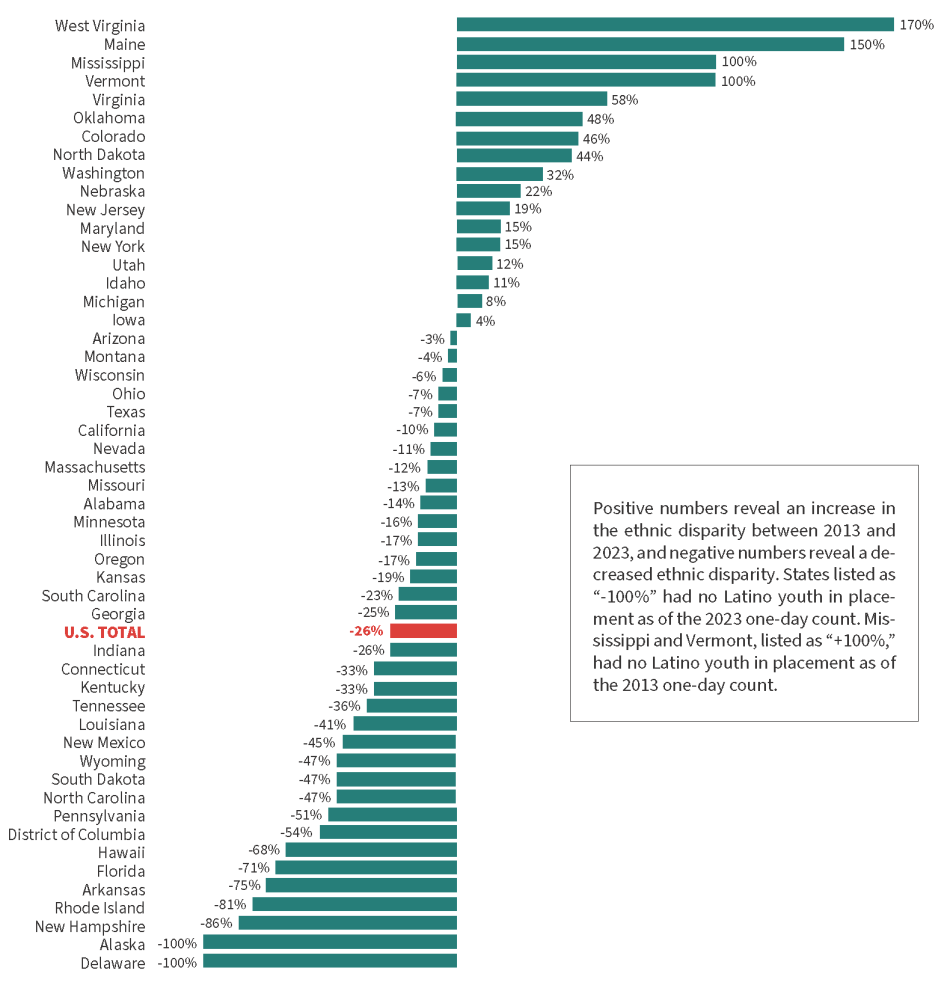
Over the last 10 years for which there are data, juvenile placements fell 46%. During this same period, Latino-white ethnic disparities in youth incarceration grew more than 10% in 15 states and decreased by at least 10% in 29 states and the District of Columbia. Other trends during this period include:
- Mississippi and West Virginia saw their ethnic disparity at least double.
- Delaware, Alaska, New Hampshire, Rhode Island, Arkansas, Florida, Hawaii, District of Columbia, and Pennsylvania decreased their ethnic disparity by at least half.
Latino youth were at least three times as likely to be held in placement as white youth in New Jersey, Massachusetts, Connecticut, Utah, and South Carolina.
| Latino rate | White rate | L/W Disparity | |
|---|---|---|---|
| Alabama | 54 | 87 | 0.62 |
| Alaska | - | 179 | N/A |
| Arizona | 51 | 42 | 1.21 |
| Arkansas | 46 | 95 | 0.48 |
| California | 69 | 33 | 2.09 |
| Colorado | 96 | 47 | 2.04 |
| Connecticut | 23 | 5 | 4.60 |
| Delaware | - | 33 | N/A |
| District of Columbia | 132 | 94 | 1.40 |
| Florida | 16 | 72 | 0.22 |
| Georgia | 32 | 36 | 0.89 |
| Hawaii | 14 | 17 | 0.82 |
| Idaho | 135 | 98 | 1.38 |
| Illinois | 26 | 18 | 1.44 |
| Indiana | 58 | 90 | 0.64 |
| Iowa | 85 | 49 | 1.73 |
| Kansas | 82 | 56 | 1.46 |
| Kentucky | 49 | 60 | 0.82 |
| Louisiana | 27 | 51 | 0.53 |
| Maryland | 26 | 12 | 2.17 |
| Massachusetts | 79 | 15 | 5.27 |
| Michigan | 51 | 40 | 1.28 |
| Minnesota | 39 | 32 | 1.22 |
| Mississippi | 84 | 36 | 2.33 |
| Missouri | 70 | 75 | 0.93 |
| Montana | 123 | 65 | 1.89 |
| Nebraska | 143 | 60 | 2.38 |
| Nevada | 91 | 95 | 0.96 |
| New Hampshire | 33 | 24 | 1.38 |
| New Jersey | 35 | 6 | 5.83 |
| New Mexico | 94 | 114 | 0.82 |
| New York | 40 | 21 | 1.90 |
| North Carolina | 19 | 18 | 1.06 |
| North Dakota | 56 | 19 | 2.95 |
| Ohio | 96 | 77 | 1.25 |
| Oklahoma | 52 | 30 | 1.73 |
| Oregon | 162 | 137 | 1.18 |
| Pennsylvania | 68 | 44 | 1.55 |
| Rhode Island | 46 | 73 | 0.63 |
| South Carolina | 185 | 54 | 3.43 |
| South Dakota | 40 | 54 | 0.74 |
| Tennessee | 17 | 21 | 0.81 |
| Texas | 81 | 63 | 1.29 |
| Utah | 127 | 33 | 3.85 |
| Virginia | 73 | 39 | 1.87 |
| Washington | 89 | 46 | 1.93 |
| West Virginia | 216 | 225 | 0.96 |
| Wisconsin | 56 | 31 | 1.81 |
| Wyoming | 129 | 129 | 1.00 |
| U.S. TOTAL | 65 | 52 | 1.25 |
The table to the right and the figure below are limited to the 48 states and the District of Columbia with at least 5,000 Latino residents between 10- and 17-years old. Numbers in the third column reveal the extent to which Latino youth are incarcerated relative to white youth. For example, in Arizona, Latino youth are 21% more likely to be held in a juvenile facility as their white peers. A number less than 1 reflects a reverse disparity, wherein white youth are more likely to be in placement than their Latino peers.
Change in Latino/White Placement Disparity: 2013 vs. 2023
| 1. | Puzzanchera, C., Sladky, T.J., and Kang, W. (2025). Easy access to the census of juveniles in residential placement. National Center for Juvenile Justice. |
|---|---|
| 2. | Puzzanchera, C., Hockenberry, S., Sladky, T.J., and Kang, W. (2024). Juvenile residential facility census databook. National Center for Juvenile Justice. |
| 3. | Carson, E.A., and Kluckow, R. Prisoners in 2022 – Statistical tables (Table 15). Bureau of Justice Statistics. Zeng, Z. (2025). Jail |
inmates in 2023 – Statistical tables (Table 4). Bureau of Justice Statistics.

