
Washington State Should Restore Voting Rights to Over 15,000 Citizens
Washington should strengthen its democracy and advance racial justice by ensuring its entire voting-eligible population can vote.
Related to: Voting Rights, State Advocacy
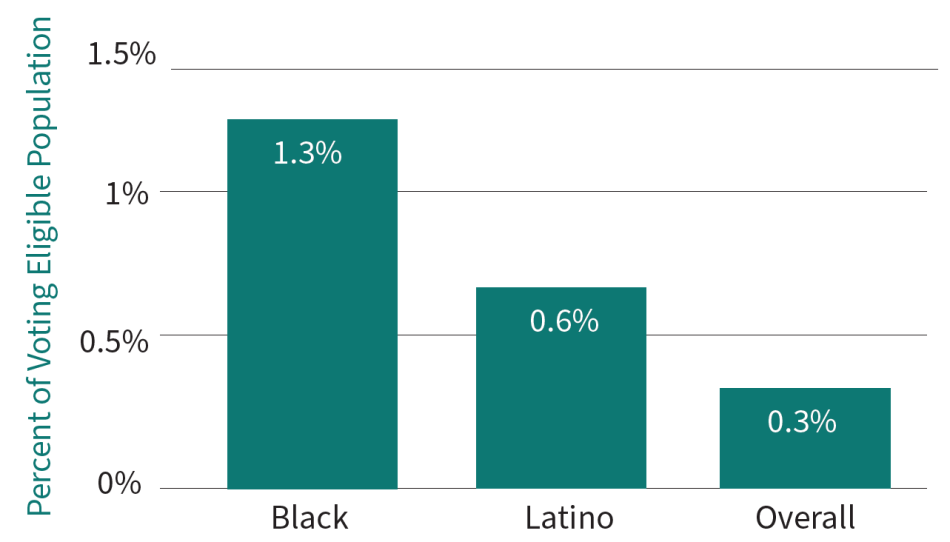
Over 15,000 citizens of Washington state are prevented from voting while completing a felony-level sentence in prison or jail.1 This voter exclusion falls heavily on people of color. Black citizens of Washington state are over five times as likely as non-Black citizens to be excluded from voting due to a felony conviction. Latino citizens are twice as likely as non-Latino citizens to have their voting rights denied for the same reason.2 Washington is diluting the voices of people of color at the ballot box.
Voter Exclusion in Washington by Race and Ethnicity, 2024
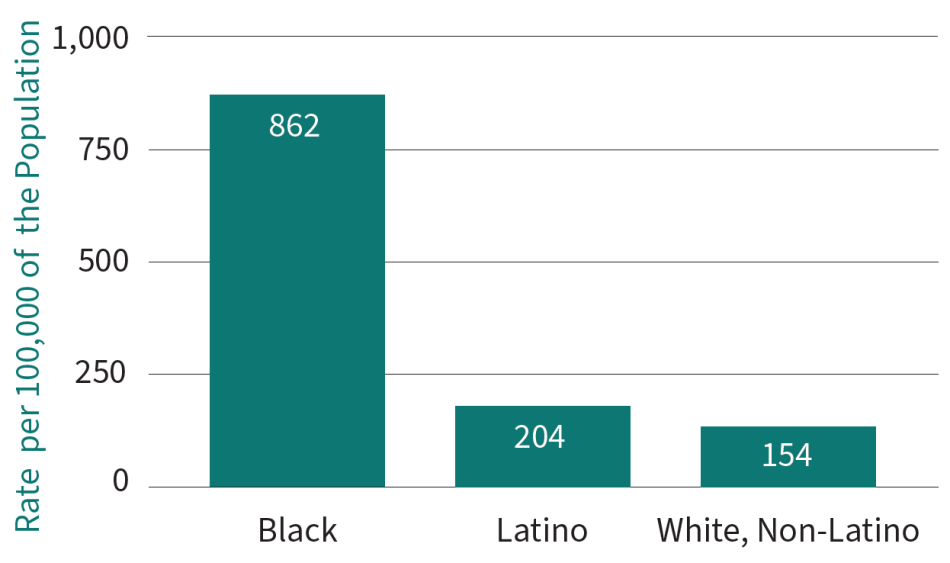
Imprisonment Rates in Washington by Race and Ethnicity, 2024
Restricting Washington’s citizens from voting while they are completing a sentence in prison or jail for a felony conviction undermines Washington’s democratic and constitutional values. Preventing Washingtonians from voting runs counter to the state constitution’s provision that “governments derive their just power from the consent of the governed.”3
To ameliorate this injustice, Washington state should follow the lead of Maine, Vermont, Puerto Rico, and Washington, DC, and extend voting rights to all citizens, including persons completing their felony-level sentence in prison or jail.
Expanding Voting Rights in Washington State is a Racial Justice Issue
Voter exclusion falls heavily on people of color in Washington state due to their disproportionate incarceration for felony convictions. This exclusion is particularly acute for Black Washingtonians. Despite only comprising 4% of the total state population, over 18% of Washington’s prison population is Black.4 Washington’s Black residents are almost six times as likely as white residents to be in prison.5 Latino Washingtonians are also disproportionately imprisoned, comprising 16% of the prison population but only 14% of the state population.
The stark racial and ethnic disparity in incarceration in Washington state can be connected to entrenched racial injustices in the criminal legal system. The following examples illustrate these disparate effects:
- Stop and search: Black residents of Seattle were found to be significantly overrepresented in law enforcement searches in 2021, according to an analysis of Seattle Police Department (SPD) data by the Center for Policing Equity. Black citizens represented one-third of all searches while making up only 7% of Seattle’s population.6 White people were also found to be treated the most leniently by officers during stops, being arrested least frequently, while Black people had a higher-than-average arrest rate.7 Washington State University (WSU) has shown that State Patrol stops of Washingtonians found contraband less often among searched Black and Latino Washingtonians compared to white Washingtonians.8
- Weapon-sentencing: Black and Latino Washingtonians had a higher probability of receiving a weapon “enhancement” in their sentences compared to white Washingtonians, according to a Washington Department of Corrections report.9 Latino people were also more likely than white people to receive a “weapon-enhanced” sentence for certain offenses.10 Each weapon “enhancement” was estimated to produce a 62% increase in an individual’s sentence length.11
- Drug sentencing: Analysis by the Seattle University Task Force 2.0 on Race and the Criminal Justice System found that Black Washingtonians who were convicted of drug-related felony offenses were more likely to receive prison sentences compared to other racial and ethnic groups in 2022.12
- Life sentencing and the death penalty: Black people have been disproportionately subjected to life sentences, according to a report by the ACLU of Washington.13 From 1986 to 2017, Black people represented 28% of those sentenced to life in prison.14 A 2016 study of Washington’s death penalty cases from 1981 to 2014 found Black defendants were far more likely to have juries impose the death penalty and have the death penalty retained in their cases compared to white defendants.15 The Washington Supreme Court’s 2018 decision determined the death penalty to be unconstitutional because of its racial bias.16 In 2023, Gov. Jay Inslee signed legislation to end the death penalty in Washington state.17
People of color, and particularly Black citizens of Washington state, experience a combination of an increased likelihood of interacting with law enforcement, an increased chance of receiving prison time for felony offenses, and a greater chance of spending longer in prison. This racial injustice means that people of color in Washington disproportionately have their political voices silenced due to a racially disparate criminal legal system.
Supporting Voting Rights Improves Public Safety
Research shows that an opportunity to participate in democracy has the potential to reduce one’s perceived status as an “outsider.” The act of voting can have a meaningful and sustaining positive influence on justice-impacted citizens by making them feel they belong to a community.18 Having a say and a stake in the life and well-being of your community is at the heart of our democracy.
Re-enfranchisement can facilitate successful re-entry and reduce recidivism. The University of Minnesota’s Christopher Uggen and New York University’s Jeff Manza find that among people with a prior arrest, there are “consistent differences between voters and non-voters in rates of subsequent arrest, incarceration, and self-reported criminal behavior.”19 Research also suggests having the right to vote immediately after incarceration matters for public safety. Individuals in states which continued to restrict the right to vote after incarceration were found to have a higher likelihood of experiencing a subsequent arrest compared to individuals in states who had their voting rights restored post-incarceration.20 Given re-enfranchisement misinformation and obstacles facing justice-impacted citizens upon re-entry into our communities, one path to bolster public safety and promote prosocial identities is to preserve voting rights during incarceration.
Allowing people to vote, including persons completing felony sentences in prisons or jails, supports successful reentry and strengthens civic identity. By ending voter exclusion while in prison or jail, Washington can improve public safety while also promoting reintegrative prosocial behaviors.
Washington State Can Strengthen its Democracy by Restoring the Right to Vote
Since 1997, 26 states and the District of Columbia have expanded voting rights to people with felony convictions, resulting in over 2 million Americans having regained the right to vote.21 As part of this movement, voting rights were restored in 2009 to Washingtonians that have exited the criminal legal system with outstanding financial obligations.22 In 2021, Washington state passed HB 1078, which automatically restored the right to vote for those on parole or felony probation.23 This restored voting rights to over 20,000 Washingtonians.24 In 2025, HB 1196 was introduced to restore voting rights to all in prison except those serving a sentence punishable by death.25 Washington state should carry forward this momentum and ensure that all Washingtonians have access to the ballot regardless of criminal legal involvement. Washington should strengthen its democracy and advance racial justice by ensuring its entire voting-eligible population can vote.
| 1. | Uggen, C., Larson, R., Shannon, S., Stewart, R., & Hauf, M. (2024). Locked out 2024: Four million denied voting rights due to a felony conviction. The Sentencing Project. |
|---|---|
| 2. | Uggen, C., Larson, R., Shannon, S., Stewart, R., & Hauf, M. (2024). Locked out 2024: Four million denied voting rights due to a felony conviction. The Sentencing Project. |
| 3. | |
| 4. | Washington Department of Corrections. (2025). Agency fact card – June 2025. Washington Department of Corrections; U.S. Census Bureau. (2023). American Community Survey, ACS 5-year estimates detailed tables – table B03002. U.S. Census Bureau. |
| 5. | Washington Department of Corrections. (2025). Agency fact card – June 2025. Washington Department of Corrections; U.S. Census Bureau. (2023). American Community Survey, ACS 5-year estimates detailed tables – table B03002. U.S. Census Bureau. |
| 6. | Buchanan, K. S., Jarsky, K., Martin, D., Graham, M., Kawabata, T., Skinner, C., Dang, S., Schutz, J., Odigie-Turley, L., Crane, N., Mulligan, K., Tindel, J., Rau, H., Dunn, K., & Goff, P. A. (2021). The science of justice: Seattle Police Department National Justice Database city report. Center for Policing Equity. |
| 7. | Buchanan, K. S., Jarsky, K., Martin, D., Graham, M., Kawabata, T., Skinner, C., Dang, S., Schutz, J., Odigie-Turley, L., Crane, N., Mulligan, K., Tindel, J., Rau, H., Dunn, K., & Goff, P. A. (2021). The science of justice: Seattle Police Department National Justice Database city report. Center for Policing Equity. |
| 8. | Sanders, C., Hoard, S., Makin, D., Willits, D., Gaffney, M. J., Anderson, B., Bartol, M., Boardman, K., Brown, A., Mammadov, A., Parks, M., & Yakub, H. (2021). Report to the Washington State Patrol. Washington State University. |
| 9. | Jones, K., Keogh, K., & Saxe, C. (2022). Sentence enhancements and race. Washington Department of Corrections. |
| 10. | Jones, K., Keogh, K., & Saxe, C. (2022). Sentence enhancements and race. Washington Department of Corrections. |
| 11. | Jones, K., Keogh, K., & Saxe, C. (2022). Sentence enhancements and race. Washington Department of Corrections. |
| 12. | Barnes, M. L., Clark, A. E., & Rooksby, J. H. (2022). Race and Washington’s criminal justice system: 2021 report to the Washington Supreme Court Race and Washington’s Criminal Justice System. Seattle University Law Review, 45, 969-1023. |
| 13. | Beckett, K., & Evans, D. H. (2020). About time: How long or life sentences fuel mass incarceration in Washington state. ACLU of Washington. |
| 14. | Beckett, K., & Evans, D. H. (2020). About time: How long or life sentences fuel mass incarceration in Washington state. ACLU of Washington. See also Nellis, A., & Barry, C. (2025). A matter of life and death: The scope and impact of life and long term imprisonment in the United States. The Sentencing Project. |
| 15. | Beckett, K., & Evans, H. (2016). Race, death and justice: Capital sentencing in Washington state, 1981-2014. Columbia Journal of Race and Law, 6(2), 77-114. |
| 16. | State v. Gregory, 427 P.3d 621 (Wash. 2018), See also Equal Justice Initiative. (2018, October 11). Washington Supreme Court strikes down death penalty, citing racial bias. Equal Justice Initiative. |
| 17. | Duster, C. (2023, April 21). Washington state eliminates death penalty from law. CNN. |
| 18. | Budd, K. M., & Monazzam, N. (2023). Increasing public safety by restoring voting rights. The Sentencing Project; Aviram, H., Bragg, A., & Lewis, C. (2017). Felon disenfranchisement. Annual Review of Law and Social Science, 13, 295-311. https://doi.org/10.1146/annurev-lawsocsci-110316-113558 |
| 19. | Uggen, C., & Manza, J. (2004). Voting and subsequent crime and arrest: Evidence from a community sample. Columbia Human Rights Law Review, 36(1), 193-216. |
| 20. | Budd, K. M., & Monazzam, N. (2023). Increasing public safety by restoring voting rights. The Sentencing Project; Aviram, H., Bragg, A., & Lewis, C. (2017). Felon disenfranchisement. Annual Review of Law and Social Science, 13, 295-311. https://doi.org/10.1146/annurev-lawsocsci-110316-113558 |
| 21. | Porter, N. D., & McLeod, M. (2023). Expanding the vote: State felony disenfranchisement reform, 1997-2023. The Sentencing Project. |
| 22. | Porter, N. D., & McLeod, M. (2023). Expanding the vote: State felony disenfranchisement reform, 1997-2023. The Sentencing Project. |
| 23. | Wa. State Legislature. (2022). HB 1078 – 2021-22. Washington State Legislature; Washington Department of Corrections. (n.d.). Voting Rights. Washington Department of Corrections. |
| 24. | Porter, N. D., & McLeod, M. (2023). Expanding the vote: State felony disenfranchisement reform, 1997-2023. The Sentencing Project. |
| 25. | Wa. State Legislature (2025-26). HB 1196 – 2025-26. Revoking a person’s voting rights only when convicted of a state crime punishable by death. Washington State Legislature. |

